
Buying a pre-owned watch can be an excellent way to acquire a luxury timepiece at a fraction of the retail price, but it requires careful attention to authenticity, condition, and seller credibility. This comprehensive guide walks through every essential step to ensure a safe, informed purchase when shopping for second-hand watches.
Key Takeaways
- Always verify the seller’s reputation through reviews and authentication credentials
- Request complete documentation including original box, papers, and service records
- Examine the watch for authenticity markers like serial numbers, engravings, and movement quality
- Use secure payment methods that offer buyer protection
- Get independent appraisals for high-value purchases before finalizing the transaction
- Understand return policies and warranty options before committing to a purchase
Research the Watch Model Thoroughly
Before making any purchase, understanding the specific model’s characteristics is essential. Each watch brand and model has unique features, common issues, and typical price ranges that buyers need to know.
Identify Authentic Model Specifications
Start by gathering detailed information about the exact model being considered. Visit the manufacturer’s official website to review specifications like case size, movement type, materials used, and production years. This baseline knowledge helps identify discrepancies when examining a pre-owned piece.
Compare prices across multiple platforms including authorized dealers, auction houses, and reputable online marketplaces. Price variations beyond 15-20% from the average market value often signal potential issues with authenticity or condition.
Study Common Counterfeits and Red Flags
Luxury watch counterfeiting has become increasingly sophisticated. Research known replica versions of the desired model by checking collector forums and authentication guides. Pay attention to frequently counterfeited details like dial printing quality, logo placement, and case finishing.
Most authentic luxury watches feature precise engravings, specific serial number placements, and high-quality materials that counterfeiters struggle to replicate perfectly. Knowing these details before shopping provides a critical advantage during inspection.
Verify Seller Credentials and Reputation
The seller’s trustworthiness directly impacts the safety of any pre-owned watch transaction. Taking time to thoroughly vet potential sellers prevents most scam scenarios and problematic purchases.
Check Reviews and Business History
For established dealers, examine their track record through multiple review platforms. Look for consistent positive feedback spanning several years, and pay attention to how they handle complaints or returns. A seller with hundreds of verified transactions and transparent communication typically offers lower risk.
Private sellers require extra scrutiny. Request verifiable identification, check their selling history on the platform, and look for red flags like newly created accounts or sellers unwilling to provide additional photos or documentation.
Confirm Authentication Credentials
Reputable dealers often hold certifications from watch industry organizations or maintain relationships with brand-authorized service centers. Ask about their authentication process and whether they employ certified watchmakers for inspections.
Some platforms offer third-party authentication services where independent experts verify watches before shipment. This service, while adding cost, provides substantial peace of mind for high-value purchases.
Pro-Tip: Request a video call to inspect the watch in real-time. This allows examination of details that photos might miss and confirms the seller actually possesses the timepiece. Legitimate sellers rarely refuse reasonable verification requests.
Request Complete Documentation
Original paperwork significantly impacts both authenticity verification and resale value. Complete documentation typically includes the warranty card, instruction manual, original purchase receipt, and service records.
Examine Warranty Cards and Certificates
Authentic warranty cards contain specific information matching the watch, including serial numbers, purchase date, and authorized dealer stamps. Cross-reference this information with the watch itself to ensure consistency.
Some luxury brands now use digital certificates or blockchain-based authentication systems. Verify that any digital documentation can be validated through the manufacturer’s official channels.
Review Service History Records
Service records reveal how well the previous owner maintained the watch. Regular servicing at authorized centers demonstrates proper care, while gaps of 5+ years without service might indicate upcoming maintenance costs.
For mechanical watches, service intervals typically occur every 3-5 years. Recent servicing adds value and reduces immediate maintenance expenses, making it a worthwhile consideration during price negotiations.
Inspect Physical Condition Carefully
A detailed physical inspection reveals the watch’s true condition and helps identify potential problems that might not appear in photographs.
Examine the Case and Crystal
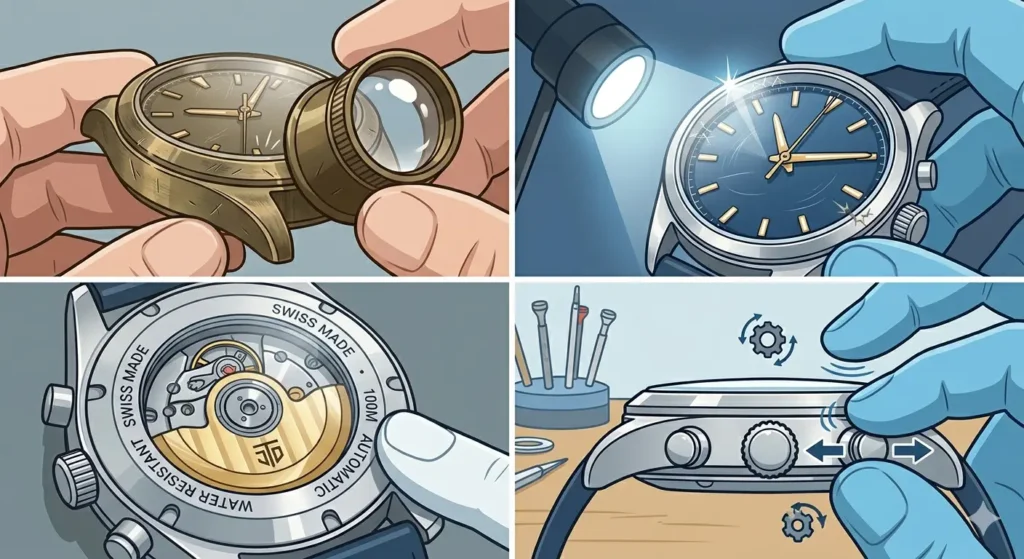
- Step 1: Check for scratches, dents, or polishing marks on the case that might indicate excessive wear or poor refinishing
- Step 2: Inspect the crystal for cracks, chips, or cloudiness that could require replacement
- Step 3: Verify that all engravings appear crisp and properly aligned, not shallow or poorly executed
- Step 4: Test the crown and pushers for smooth operation without excessive play or resistance
Original factory finishing has a distinctive quality that aftermarket modifications rarely match. Excessive polishing removes metal and softens case edges, reducing both authenticity and value.
Assess Dial and Hands Condition
The dial reveals crucial authenticity indicators and condition issues. Examine printing quality, logo clarity, and date window alignment under good lighting. Authentic dials feature sharp, evenly applied printing with consistent spacing.
Check for moisture damage, discoloration, or ‘tropical’ patina development. While some collectors value naturally aged dials, artificial aging or water damage significantly reduces value and indicates potential internal problems.
Hands should sit properly aligned at 12 o’clock when the time is set to noon. Misaligned hands or luminous material that doesn’t match the dial markers often signal replacement parts or poor service work.
Verify Serial and Reference Numbers
Locate the serial number (typically on the case between the lugs) and reference number to confirm they match the documentation. These numbers should be cleanly engraved with consistent depth and spacing.
Cross-reference these numbers with the manufacturer’s database or authentication services. Some brands offer online verification tools where serial numbers can be checked against production records.
Test Watch Functionality
Beyond visual inspection, functional testing ensures the movement operates correctly and meets accuracy standards.
Check Timekeeping Accuracy
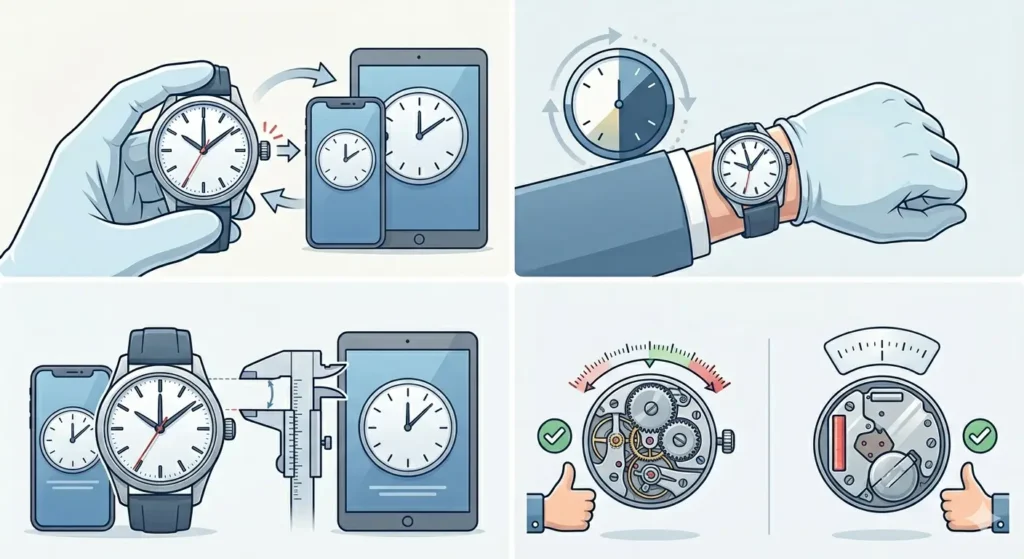
- Step 1: Set the watch to match a precise time source like an online time comparison tool
- Step 2: Allow the watch to run for 24 hours in the typical wearing position
- Step 3: Compare the watch’s time against the reference source to measure daily deviation
- Step 4: Expect mechanical watches to vary -4 to +6 seconds daily, while quartz movements should remain within +/- 15 seconds monthly
Significant deviations beyond these ranges indicate needed service or potential movement problems that should factor into the purchase price.
Test All Complications
For watches with additional functions like chronographs, date displays, or GMT complications, test each feature thoroughly. Chronograph pushers should engage smoothly, return hands to zero precisely, and stop/start without hesitation.
Date changes should occur cleanly around midnight, not gradually over several hours. Quick-set date functions must work without forcing, and the calendar should advance properly through month-end transitions.
Arrange Professional Authentication
For high-value purchases, professional authentication provides essential verification that justifies its cost through risk reduction.
Use Independent Watchmakers
Independent watchmakers with brand-specific experience can open the case back to examine the movement directly. This inspection reveals whether the movement is genuine, properly functioning, and free from water damage or corrosion.
Ask for a written condition report detailing findings, recommended service work, and authentication confirmation. This document proves valuable for insurance purposes and future resale.
Consider Brand Service Center Evaluation
Some luxury brands offer authentication services through their service centers. While more expensive, this option provides the highest confidence level and often includes a detailed condition assessment.
Brand service centers can verify every component’s authenticity and provide estimates for any needed repairs, allowing informed negotiation before finalizing the purchase.
Understand Payment Security
Payment method selection significantly impacts buyer protection and transaction security, especially for high-value watch purchases.
Choose Protected Payment Methods
Credit cards and PayPal offer substantial buyer protection through chargeback capabilities if the watch proves inauthentic or significantly misrepresented. These methods create a documented transaction trail and provide recourse options.
Avoid wire transfers, cryptocurrency, or cash transactions for expensive watches. These payment methods offer no protection if problems arise, making them favorites of scammers and fraudulent sellers.
Use Escrow Services for High-Value Transactions
Escrow services hold payment until the buyer receives and authenticates the watch. This arrangement protects both parties, ensuring sellers receive payment while giving buyers time for professional inspection.
While escrow services charge fees (typically 1-3% of transaction value), this cost proves worthwhile for purchases exceeding several thousand dollars where risk justification demands maximum security.
Pro-Tip: For transactions over $10,000, consider meeting in person at a bank or authorized dealer location. This environment provides security, allows immediate professional authentication, and facilitates safe payment exchange through certified checks or wire transfers initiated on-site.
Review Return Policy and Warranty
Understanding the seller’s policies regarding returns and warranties protects against undisclosed issues or misrepresented conditions.
Clarify Return Windows
Reputable dealers typically offer 3-14 day return windows allowing professional authentication and inspection. Understand whether return shipping costs fall on the buyer or seller, and confirm the watch must be returned in the exact received condition.
Get all return policy terms in writing before completing the purchase. Verbal agreements hold little value if disputes arise regarding authenticity or undisclosed damage.
Evaluate Warranty Coverage
Some dealers provide limited warranties covering movement functionality for 6-12 months after purchase. While not matching manufacturer warranties, these guarantees offer protection against immediate mechanical failures.
Understand warranty exclusions, which typically include water resistance, crystal damage, and cosmetic issues. Determine whether the dealer uses authorized service centers for warranty work or employs independent watchmakers.
Document the Transaction Completely
Thorough documentation protects investment value and provides essential records for insurance, future service, or resale purposes.
Photograph Everything
- Step 1: Take detailed photos of the watch from multiple angles including case, dial, caseback, and bracelet
- Step 2: Photograph serial and reference numbers clearly
- Step 3: Document all included accessories, boxes, papers, and extras
- Step 4: Save copies of all correspondence with the seller including descriptions, promised conditions, and agreed terms
These photos establish the purchase condition and prove valuable for insurance claims if the watch is lost, stolen, or damaged.
Obtain Detailed Receipts
Request itemized receipts listing the watch model, serial number, purchase price, date, and seller information. This documentation proves ownership and establishes provenance for future sales.
For insurance purposes, receipts should clearly indicate the watch’s fair market value at purchase time. Some insurers require professional appraisals for high-value timepieces, so inquire about coverage requirements immediately after purchase.
Tips for Successful Pre-Owned Watch Buying
- Start with less expensive models to gain experience before investing in high-value pieces
- Join watch collector communities and forums to learn from experienced buyers about specific models and sellers
- Visit authorized dealers to handle authentic versions of desired models, building familiarity with genuine quality
- Set a firm budget including potential service costs, as pre-owned watches often need maintenance
- Be patient – rushing into purchases without proper verification leads to costly mistakes
- Consider watches with complete sets (box and papers) as they retain value better for future resale
- Track the watch’s time using a reliable clock tool during the evaluation period to verify accuracy
- Research the specific seller’s return process by reading reviews about others’ return experiences
- Save all digital communications and create a dedicated folder for each watch purchase
- Build relationships with trusted dealers for future purchases and authentication assistance
Common Problems and Solutions
Seller Won’t Provide Additional Photos or Information
Legitimate sellers understand that serious buyers need comprehensive information before committing to expensive purchases. If a seller refuses reasonable requests for additional photos, video verification, or documentation details, consider this a red flag and walk away from the transaction.
Solution: Work only with sellers who demonstrate transparency and willingness to provide thorough verification. Thousands of pre-owned watches are available, so never feel pressured to proceed with an uncooperative seller.
Watch Arrives Different from Description
Sometimes watches arrive with undisclosed damage, missing components, or functional issues not mentioned in listings. This constitutes misrepresentation and grounds for return or dispute.
Solution: Document everything immediately with photos and videos showing the received condition. Contact the seller within hours explaining discrepancies and requesting a full refund including return shipping. If using a payment platform with buyer protection, file a dispute claim if the seller refuses to cooperate.
Serial Numbers Don’t Match Documentation
Mismatched serial numbers between the watch and papers indicate either documentation from a different watch or potential authenticity issues with either the watch or paperwork.
Solution: Halt the transaction immediately and request clarification from the seller. Contact the manufacturer’s customer service to verify which serial number corresponds to the model in question. Never proceed with a purchase where serial numbers don’t align perfectly with documentation.
Watch Stops Running Shortly After Purchase
Mechanical watches may stop running due to insufficient winding, magnetization, or internal mechanical problems. This often emerges within the first few days or weeks of ownership.
Solution: First ensure the watch is properly wound (automatic watches need 30-40 manual winds initially, while manual watches require daily winding). If the problem persists, contact the seller immediately as this may be covered under their return policy or warranty. Have a watchmaker diagnose the issue and provide a written estimate to support refund or repair requests.
Authentication Service Declares Watch Inauthentic
Discovering an inauthentic watch after purchase represents a serious problem requiring immediate action to recover funds and report fraudulent sellers.
Solution: Obtain written authentication reports from the service. Contact the seller immediately demanding a full refund with proof of inauthenticity. File disputes with the payment provider and selling platform. Report the seller to platform administrators and consider filing police reports for high-value fraud cases. Never return the watch until payment refund is secured, as some scammers use this to reclaim counterfeit merchandise while keeping funds.
Frequently Asked Questions
How can someone verify a pre-owned watch’s authenticity before buying?
Verify authenticity by examining serial numbers against manufacturer databases, checking engravings and finishing quality, reviewing complete documentation, and using professional authentication services from independent watchmakers or brand service centers. Request detailed photos of the movement, case back, and all markings for expert comparison.
What documents should come with a pre-owned luxury watch?
A complete set includes the original warranty card with matching serial numbers, instruction manual, original purchase receipt, service records from authorized centers, and the original box with inner and outer packaging. While not all pre-owned watches include everything, complete documentation significantly increases confidence and resale value.
Are pre-owned watches from online marketplaces safe to buy?
Online marketplaces vary in safety depending on their authentication processes and buyer protection policies. Platforms offering third-party authentication, escrow services, and robust buyer protection provide safer transactions than peer-to-peer sales without verification. Always research the platform’s policies and seller reputation before purchasing.
How much should someone expect to pay for authentication services?
Authentication costs range from $50-$300 depending on the watch’s complexity and value. Basic external inspections start around $50-$100, while comprehensive evaluations requiring movement inspection cost $150-$300. For watches valued over $5,000, this expense represents worthwhile insurance against counterfeit purchases.
What is a reasonable return period for pre-owned watches?
Reputable dealers typically offer 3-14 day return windows, with 7 days being most common. This timeframe allows buyers to conduct professional authentication and testing. Be cautious of sellers offering no returns or extremely short windows (24-48 hours), as this limits time for proper verification.
Should pre-owned watches be serviced immediately after purchase?
Not necessarily. If the watch comes with recent service documentation (within the past 2-3 years) and functions properly, immediate servicing is unnecessary. However, watches without service history or showing timing issues should be serviced by qualified watchmakers to prevent further damage and ensure longevity.
How can someone tell if a watch movement is authentic?
Authentic movements display precise finishing, proper decoration consistent with the manufacturer’s style, correct rotor design and engraving, and appropriate jewel count and arrangement. Counterfeit movements often show rough finishing, incorrect stampings, or use generic movements instead of brand-specific calibers. Professional authentication requires opening the case back for direct examination.
What red flags indicate a potential scam when buying pre-owned watches?
Major red flags include prices significantly below market value, sellers refusing additional verification requests, newly created seller accounts with no history, pressure to complete transactions quickly, requests for wire transfers or cryptocurrency payment, missing or mismatched documentation, and unwillingness to meet in person or use escrow services for high-value transactions.
Is buying from private sellers riskier than authorized dealers?
Private sellers generally carry higher risk due to lack of authentication infrastructure, limited recourse if problems arise, and potential for misrepresentation. However, legitimate private sellers exist and sometimes offer better prices. The key is conducting thorough verification, using protected payment methods, and obtaining professional authentication before finalizing purchases.
How important is the original box and papers for pre-owned watches?
Original boxes and papers significantly impact resale value (typically 10-30% premium) and authentication confidence, though their importance varies by brand and model. Some collectors only purchase complete sets, while others prioritize the watch’s condition over accessories. For investment-grade pieces, complete documentation proves essential for maximum value retention.