

A Beginner’s Guide to Watch Lingo introduces essential watch terminology every enthusiast should know. Understanding watch lingo helps when shopping for timepieces, discussing horology, or reading watch reviews. This comprehensive guide breaks down 30 fundamental terms that form the foundation of watch knowledge, from basic components to advanced technical features.
Quick Summary Table
| Category | Key Terms Covered |
|---|---|
| Basic Components | Case, Dial, Crown, Crystal, Bezel, Lugs |
| Movement Types | Automatic, Manual, Quartz, Mechanical |
| Functions & Features | Chronograph, Complication, GMT, Power Reserve |
| Technical Specs | Water Resistance, Caliber, Jewels, Beat Rate |
| Design Elements | Guilloche, Patina, Lume, Indices |
Understanding Watch Case Components
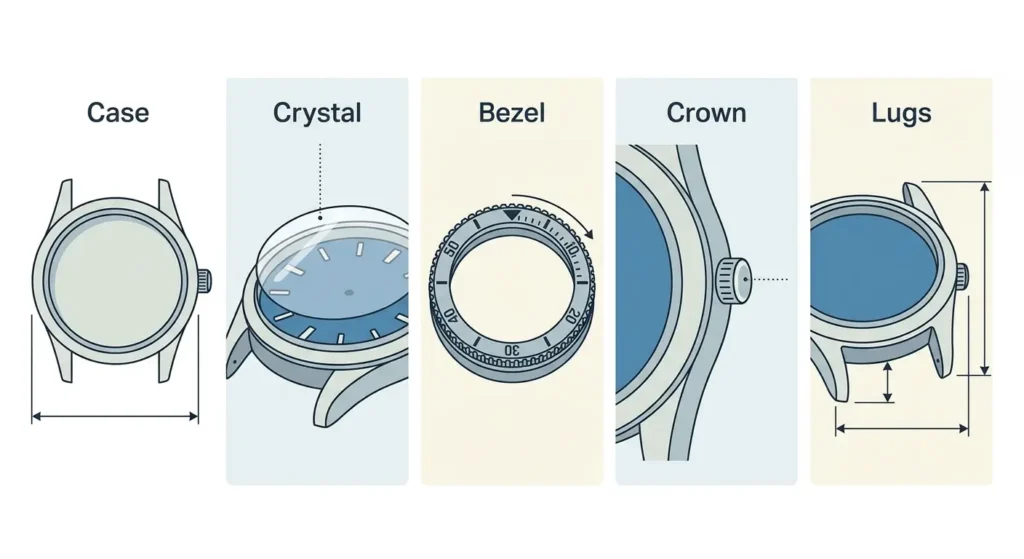
Case
The case is the outer shell that houses and protects the watch movement. Most cases come in stainless steel, titanium, gold, or ceramic materials. Case sizes typically range from 36mm to 44mm in diameter, measured across the widest point excluding the crown. The case shape varies from classic round designs to rectangular, square, or cushion styles.
Crystal
The crystal is the transparent cover protecting the watch dial. Three main types exist: acrylic (plastic), mineral glass, and sapphire crystal. Sapphire crystal offers superior scratch resistance and clarity, making it the preferred choice for quality timepieces. Some crystals feature anti-reflective coating to reduce glare and improve readability.
Bezel
The bezel is the ring surrounding the crystal, often featuring markings or rotating functionality. Dive watches use unidirectional rotating bezels to track elapsed time underwater. GMT watches feature fixed bezels with 24-hour markings. Tachymeter bezels help calculate speed based on time and distance.
Crown
The crown is the knob on the watch case side used to set time, date, and wind the movement. Screw-down crowns thread into the case for enhanced water resistance. Push-pull crowns offer easier operation for daily adjustments. Some watches feature crown guards – protective protrusions that shield the crown from impacts.
Lugs
Lugs are the projections extending from the case where the strap or bracelet attaches. Lug width, measured in millimeters between the lugs, determines compatible strap sizes. Common lug widths include 18mm, 20mm, and 22mm. Lug-to-lug distance affects how the watch wears on the wrist.
Movement Terminology Explained
Mechanical Movement
A mechanical movement uses a complex system of gears, springs, and other mechanical components to keep time. These movements require no battery and run entirely on mechanical energy. The mainspring stores energy that slowly releases to power the watch. Mechanical movements represent traditional watchmaking craftsmanship and can last generations with proper maintenance.
Automatic Movement
An automatic movement is a self-winding mechanical movement that uses a rotor to wind the mainspring. The rotor spins with wrist movement, converting kinetic energy into stored power. Most automatic watches provide 38-72 hours of power reserve when fully wound. This eliminates the need for daily manual winding during regular wear.
Manual Movement
A manual movement requires daily winding via the crown to maintain operation. Turning the crown tensions the mainspring, storing energy to power the watch. Most manual watches need 20-40 crown rotations for a full wind. Watch enthusiasts often appreciate the ritual and connection to the timepiece that manual winding provides.
Quartz Movement
A quartz movement uses a battery-powered electronic oscillator regulated by a quartz crystal. Quartz watches offer superior accuracy, typically within 15 seconds per month. These movements require minimal maintenance and cost less than mechanical alternatives. Battery replacements occur every 2-3 years depending on usage and features.
Caliber
Caliber refers to the specific movement model or designation used by manufacturers. Each caliber has unique specifications, dimensions, and features. For example, the Seiko 4R36 caliber indicates an automatic movement with date and day complications. Understanding calibers helps identify movement quality and capabilities.
Watch Dial Features and Elements
Dial
The dial is the watch face displaying time and other information. Dial finishes range from simple matte to elaborate guilloche patterns. Common dial colors include black, white, blue, and silver, though many variations exist. Dial design significantly impacts the watch’s overall aesthetic and readability.
Indices
Indices are the hour markers on the dial, replacing or supplementing numerals. Applied indices are raised markers attached to the dial surface. Printed indices sit flush with the dial. Common styles include simple batons, Arabic numerals, Roman numerals, and decorative shapes. Indices often feature luminous material for low-light visibility.
Hands
Hands indicate hours, minutes, and seconds on the dial. Hand styles vary widely: dauphine (tapered and faceted), sword (pointed), snowflake (distinctive angular design), and Mercedes (rounded with circle). Many hands feature lume for nighttime legibility. Hand design must balance aesthetics with clear time reading.
Lume
Lume is luminous material applied to hands and indices for visibility in darkness. Modern watches use Super-LumiNova or tritium-based luminescence. Super-LumiNova requires light exposure to charge and glows bright green or blue. Tritium tubes produce constant glow without charging but dim over 10-20 years.
Guilloche
Guilloche is an intricate engraved pattern on the dial created through engine-turning. This decorative technique produces geometric designs with exceptional depth and visual interest. Common guilloche patterns include concentric circles, waves, and basketweave designs. High-end watchmakers use guilloche to showcase craftsmanship and add luxury appeal.
Watch Complications and Functions
Complication
A complication is any function beyond basic timekeeping. Simple complications include date displays and small seconds subdials. Complex complications encompass perpetual calendars, moon phases, and tourbillons. The number and sophistication of complications often indicate a watch’s technical achievement and value.
Chronograph
A chronograph is a stopwatch function built into the watch. Pushers on the case side control start, stop, and reset operations. Subdials on the main dial track elapsed seconds, minutes, and sometimes hours. Chronographs serve practical timing needs and add sporty visual appeal. Racing enthusiasts and pilots particularly value this complication.
GMT
GMT (Greenwich Mean Time) is a complication displaying a second time zone. An additional hand completes one rotation every 24 hours, reading against a 24-hour bezel or subdial. This feature benefits travelers tracking home time while abroad. Some GMT watches offer ‘true GMT’ functionality, allowing independent hour hand adjustment.
Power Reserve Indicator
The power reserve indicator shows remaining stored energy in the mainspring. This display appears as a subdial, arc, or linear scale marked in hours or days. Knowing power reserve helps prevent the watch from stopping unexpectedly. Most automatic watches provide 40-72 hours of reserve, though some exceed 100 hours.
Date Window
The date window is an aperture on the dial showing the current date. Standard placement occurs at the 3 o’clock or 6 o’clock position. Some watches feature cyclops magnification over the date for easier reading. Date complications require manual adjustment for months with fewer than 31 days.
Technical Specifications and Measurements
Water Resistance
Water resistance indicates the watch’s ability to withstand moisture and pressure. Ratings appear in meters, feet, or ATM (atmospheres). A 50m rating suits everyday wear but not swimming. 100m allows swimming and snorkeling. Dive watches start at 200m with features like screw-down crowns and rotating bezels. Never operate crowns or pushers underwater, as this compromises water resistance.
Pro-Tip: Water resistance decreases over time as gaskets age. Schedule regular pressure testing every 2-3 years, especially before swimming or diving with the watch. Even watches rated for 200m can leak if gaskets fail. Most watch service centers perform quick pressure tests for minimal cost.
Jewels
Jewels are synthetic ruby or sapphire bearings reducing friction in the movement. These hard stones allow smooth gear rotation with minimal wear. Quality mechanical movements contain 17-31 jewels at critical friction points. More jewels don’t automatically mean better quality – placement matters more than count. Excessive jewel counts sometimes serve marketing rather than functional purposes.
Beat Rate
Beat rate measures how many times per hour the balance wheel oscillates. Common rates include 21,600 bph (3 Hz), 28,800 bph (4 Hz), and 36,000 bph (5 Hz). Higher beat rates generally produce smoother seconds hand motion and potentially better accuracy. However, faster beats increase wear and reduce power reserve.
Accuracy
Accuracy describes how precisely the watch keeps time, measured in seconds per day. Quartz watches typically achieve ±15 seconds per month. Standard mechanical watches run -10 to +30 seconds per day. COSC-certified chronometers must stay within -4 to +6 seconds daily. Actual accuracy varies with position, temperature, and wearing habits.
Strap and Bracelet Terms
Bracelet
A bracelet is a metal strap integrated with the watch design. Common styles include oyster (three-link), jubilee (five-link), and mesh (Milanese). Bracelets offer durability and versatility but add weight compared to leather or fabric straps. Solid end links connect seamlessly to the case, while hollow end links create slight gaps.
NATO Strap
The NATO strap is a one-piece nylon strap threading under the case back. This design ensures the watch stays on the wrist even if a spring bar fails. Originally military issue, NATO straps now come in countless colors and patterns. The casual, comfortable style works well with tool watches and sport watches.
Watch Condition and Aging
Patina
Patina is the natural aging and discoloration of watch components over time. Lume turns creamy or yellow, dials fade, and metals oxidize. Collectors often prize vintage patina as evidence of authenticity and character. Artificial patina attempts to simulate age but lacks genuine wear patterns. Natural patina develops gradually through decades of exposure and use.
Using Watch Terminology in Practice
Applying watch terminology effectively requires practice and context. When shopping, asking about ‘caliber specifications’ sounds more knowledgeable than ‘what movement does it have.’ Discussing ‘lug-to-lug dimensions’ helps ensure proper fit before purchasing. Understanding these terms enables meaningful conversations with dealers, collectors, and fellow enthusiasts.
Reading watch reviews becomes easier with terminology knowledge. Phrases like ‘applied indices with BGW9 lume’ or ‘exhibition caseback showcasing the decorated rotor’ make complete sense. Technical specifications transform from confusing numbers into useful information for comparing timepieces.
Most importantly, knowing watch lingo deepens appreciation for horology as both art and engineering. Each term represents centuries of innovation and craftsmanship. Whether choosing a first watch or expanding a collection, this foundation supports informed decisions and greater enjoyment of timepieces. Tools like the world time comparison tool complement watch ownership by tracking multiple time zones accurately.
Tips for Learning Watch Terminology
- Visit watch forums and communities where enthusiasts discuss pieces using proper terminology – reading conversations provides context for unfamiliar terms
- Handle watches in person at authorized dealers to connect physical features with technical names
- Watch YouTube videos from reputable channels that explain complications and movements visually
- Create flashcards for terms and review regularly until they become second nature
- Start with basic components before advancing to complex complications and technical specifications
- Read manufacturer documentation and spec sheets to see how brands describe their products
- Join local watch collector groups for hands-on learning and discussions with experienced members
- Use the clock tab feature to practice reading different dial layouts and hand styles
Common Problems Understanding Watch Terms
Fix 1: Confusing Movement Types
Many beginners struggle distinguishing automatic from manual mechanical movements. Remember: automatic movements self-wind through wrist motion via a rotor, while manual movements require daily crown winding. Both are mechanical and battery-free, but automatic adds convenience. Examining the movement through an exhibition caseback reveals the rotor in automatic watches – a semicircular weight that manual movements lack.
Fix 2: Misunderstanding Water Resistance Ratings
Water resistance numbers confuse many new watch owners. A 30m rating means splash-resistant only, not suitable for swimming despite the ‘meters’ designation. These ratings measure static pressure testing, not real-world conditions. Dynamic pressure from swimming, showering, or water sports far exceeds static ratings. Always choose 100m minimum for water activities and 200m for diving.
Fix 3: Overcounting Jewel Importance
Jewel count seems like a quality indicator, leading some to choose watches solely by this number. However, functional movements need only 17-31 jewels. Counts above 31 often add decorative jewels without functional benefit. Focus instead on movement reputation, brand heritage, and finishing quality. A well-made 21-jewel movement outperforms a poorly executed 50-jewel movement.
Fix 4: Expecting Mechanical Accuracy
Newcomers sometimes expect mechanical watches to match quartz precision. Mechanical movements naturally vary -10 to +30 seconds daily due to position, temperature, and magnetism. This variation represents normal operation, not defects. COSC chronometer certification (-4 to +6 seconds daily) improves accuracy but costs significantly more. Understanding these limitations prevents disappointment and unrealistic expectations. For precise timekeeping needs, the online stopwatch offers digital accuracy.
Pro-Tip: When learning watch terminology, photograph your own watches and label each component digitally. This personal reference guide makes abstract terms concrete and memorable. Return to these labeled images when encountering unfamiliar terms in reviews or conversations. Building this visual vocabulary accelerates learning significantly.
Frequently Asked Questions
What is the most important watch term for beginners to learn first?
Understanding ‘movement’ takes priority as it determines the watch’s fundamental operation, maintenance needs, and value. Knowing whether a watch uses quartz, automatic, or manual movement informs every other aspect of ownership from accuracy expectations to service requirements. This single term opens the door to understanding how watches actually work.
How does water resistance rating translate to real-world use?
Water resistance ratings indicate static pressure testing, not activity suitability. A 30m rating handles splashes only. 50m allows brief swimming. 100m suits regular swimming and snorkeling. 200m+ enables diving. Never operate crowns or pushers underwater regardless of rating, as this allows water entry even in highly resistant watches.
Why do automatic watches stop when not worn for a few days?
Automatic watches rely on wrist movement to wind the mainspring through the rotor mechanism. When left stationary, the stored power reserve depletes in 38-72 hours depending on the specific movement. This represents normal operation, not a defect. Watch winders maintain power for collections, while occasional wearers simply reset and restart their watches.
What does COSC certification actually mean for watch quality?
COSC certification verifies that a movement maintains accuracy between -4 and +6 seconds per day across multiple positions and temperatures. This testing confirms superior timekeeping compared to standard movements (-10 to +30 seconds daily). However, COSC tests movements only, not complete watches. Certification indicates precision but doesn’t guarantee overall build quality or durability.
Are more jewels always better in a watch movement?
No, jewel count above 17-31 provides minimal functional benefit. Quality movements place jewels at critical friction points where metal gears contact. Excessive jewels often serve marketing purposes rather than improving performance. A well-designed 21-jewel movement from a reputable manufacturer outperforms a 50-jewel movement with poor engineering and finishing.
Can quartz watches be as valuable as mechanical watches?
While mechanical movements generally command higher prices due to craftsmanship, certain quartz watches hold significant value. High-end quartz like Grand Seiko’s 9F movement demonstrates exceptional finishing and precision. Vintage quartz pieces from historic releases also appreciate. Value depends more on brand, condition, and historical significance than movement type alone.
What causes lume to stop glowing during the night?
Super-LumiNova requires light exposure to charge photoluminescent pigments. The glow intensity decreases exponentially, starting bright but fading within hours. Brightness depends on light exposure duration and intensity before darkness. Tritium tubes provide constant glow without charging but dim gradually over 10-20 years as the radioactive material decays.
How often should watch water resistance be tested?
Gaskets deteriorating over time compromise water resistance even in unworn watches. Testing every 2-3 years maintains protection, especially for watches exposed to water. After battery changes, crown service, or crystal replacement, immediate testing confirms proper sealing. Most jewelers and watch service centers perform pressure tests quickly and affordably.
Why do some watches have exhibition casebacks while others are solid?
Exhibition casebacks showcase the movement, appealing to enthusiasts who appreciate mechanical artistry. Solid casebacks provide better protection, durability, and sometimes allow engraving. Dive watches typically use solid backs for enhanced water resistance and shock protection. The choice balances aesthetic appeal against practical concerns based on watch purpose.
What is the difference between a chronograph and a chronometer?
A chronograph is a stopwatch complication with start, stop, and reset functions controlled by pushers. A chronometer is a watch certified by COSC for superior accuracy (-4 to +6 seconds daily). These terms describe completely different attributes – one refers to functionality, the other to precision. A watch can be both, either, or neither.