
Learning how to read a tachymeter scale on a watch bezel opens up a practical tool for measuring speed and distance without any additional equipment. This chronograph feature, found on many sport and racing watches, allows quick calculations based on time and distance traveled. The tachymeter scale typically displays numbers from 500 down to 60 around the outer edge of the watch face or bezel, providing instant speed measurements in units per hour.
Quick Summary Table
| Key Point | Details |
|---|---|
| What It Measures | Speed in units per hour (mph, km/h, etc.) |
| Distance Required | Exactly 1 unit (1 mile, 1 kilometer, etc.) |
| Time Range | Works best between 7.2 and 60 seconds |
| Primary Use | Calculating average speed over known distance |
| Essential Feature | Requires a chronograph (stopwatch) function |
Understanding the Tachymeter Scale
The tachymeter scale represents a mathematical formula converted into an easy-to-read circular display. Most watches feature numbers ranging from 500 at the top (near 12 o’clock) down to 60 near the bottom, though some models extend to 700 or higher. These numbers indicate units per hour based on how long it takes to travel one unit of distance.
This scale works on a simple principle: it divides 3,600 (the number of seconds in an hour) by the elapsed time in seconds. The result shows how many times that action could be repeated in one hour. For racing enthusiasts, this means instant lap speed calculations. For everyday users, it provides quick measurements for various activities.
Scale Number Meanings
Each number on the tachymeter represents a specific speed. The number 120, for example, means 120 units per hour. If measuring in miles, that’s 120 mph. If measuring in kilometers, that’s 120 km/h. The scale doesn’t care about the unit – it simply shows ‘per hour’ calculations based on elapsed time.
Higher numbers appear near the 12 o’clock position because they represent faster speeds (shorter times). Lower numbers spread around the bottom half because slower speeds require more time to complete one unit of distance. The online stopwatch can help practice timing intervals before using the watch feature.
How to Read a Tachymeter for Speed Measurement
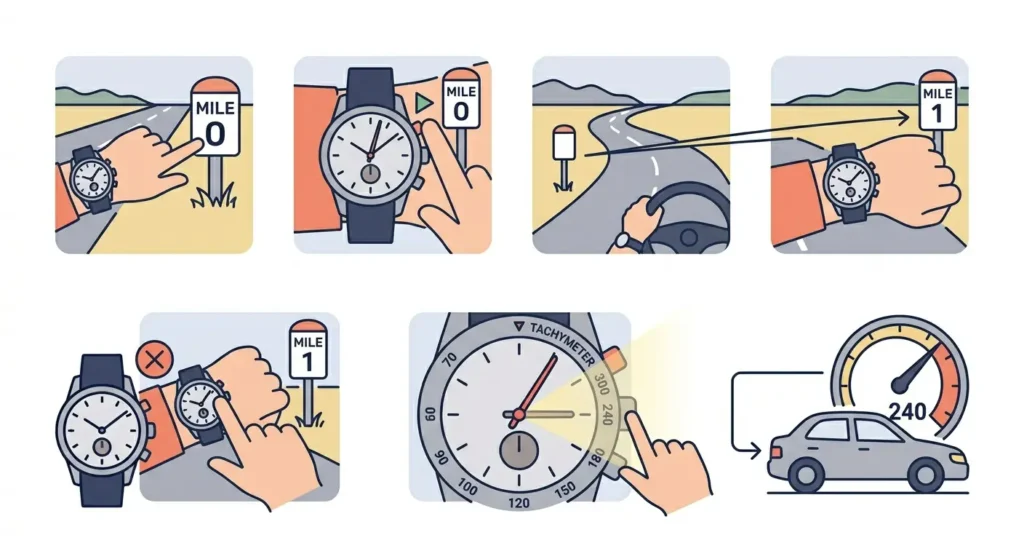
Reading the tachymeter requires three components: a known distance, the chronograph function, and proper timing technique. The process remains straightforward once the basic steps become familiar.
- Step 1: Identify a starting point for the measured distance. This could be a mile marker on a highway, a kilometer post on a road, or any known one-unit distance marker.
- Step 2: Start the chronograph exactly when passing the starting point. Press the top pusher on the watch to begin timing.
- Step 3: Keep the chronograph running while traveling the exact distance. Maintain consistent speed for accurate results.
- Step 4: Stop the chronograph precisely when reaching the end of the one-unit distance. Press the top pusher again to freeze the time.
- Step 5: Read the number on the tachymeter scale that aligns with the chronograph second hand. This number represents the average speed in units per hour.
Pro-Tip: The tachymeter only works accurately when measuring exactly one unit of distance. Measuring half a mile or two kilometers will give incorrect readings. Always use precisely one unit (1 mile, 1 km, 1 nautical mile, etc.) for proper calculations.
Practical Speed Calculation Example
Imagine driving on a highway with mile markers clearly visible. Starting the chronograph at mile marker 45 and stopping it at mile marker 46 provides the data needed. If the elapsed time shows 30 seconds, the chronograph second hand points to 120 on the tachymeter scale. This indicates an average speed of 120 mph for that measured mile.
The same principle applies to any unit. Racing cyclists often use kilometer markers. Starting at one marker and stopping at the next kilometer marker after 45 seconds would show approximately 80 on the scale, indicating 80 km/h average speed.
Using the Tachymeter for Production Rate
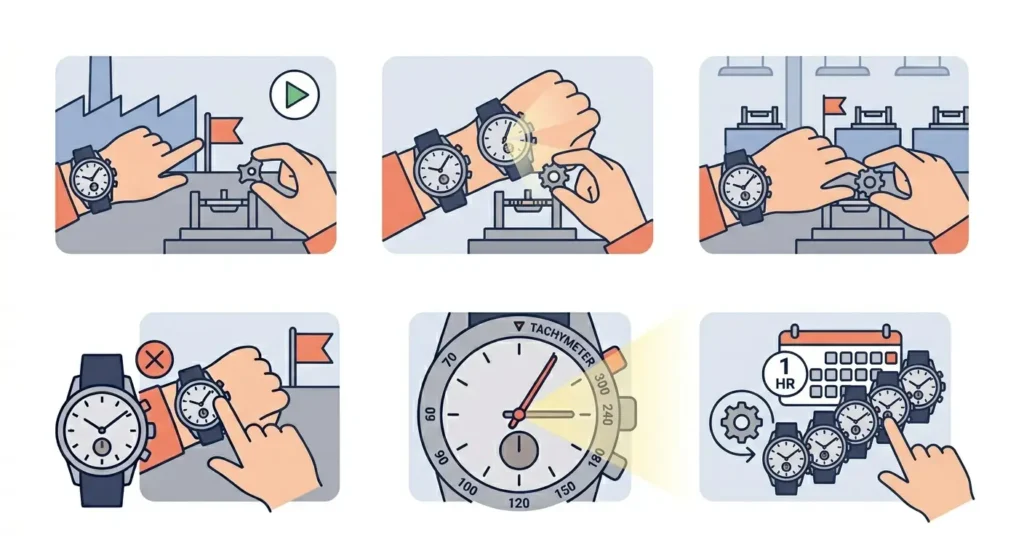
Beyond speed measurement, the tachymeter calculates production rates or repetitive task frequencies. This application proves useful in manufacturing, assembly work, or any situation involving repeated actions.
- Step 1: Start the chronograph when beginning one complete unit of work. This could be assembling one product, packaging one item, or completing one cycle.
- Step 2: Stop the chronograph when the single unit is complete. The timing must capture one full cycle from start to finish.
- Step 3: Read the tachymeter value where the second hand stopped. This number shows how many units could be produced per hour at that pace.
For instance, if assembling one product takes 40 seconds, the tachymeter shows 90, meaning 90 units per hour at that consistent pace. This works best for tasks taking between 10 and 60 seconds.
Reading Beyond the 60-Second Mark
Most tachymeter scales end at 60, but measurements can extend beyond one minute using simple division. When timing takes longer than 60 seconds, divide the tachymeter reading by the number of minutes elapsed.
If traveling one mile takes 90 seconds (1.5 minutes), the chronograph second hand points to 40 on the tachymeter after one full rotation plus 30 seconds. Dividing 40 by 1.5 gives approximately 27, indicating about 27 mph average speed. This method works but introduces more room for calculation errors.
Tachymeter Limitations
The scale works most accurately between roughly 7 and 60 seconds. Measurements under 7 seconds require extremely high speeds (over 500 units per hour), while measurements over 60 seconds need additional calculations. Most practical applications fall comfortably within the 10-60 second range.
Distance must be exact. Estimating ‘about a mile’ or ‘roughly a kilometer’ produces inaccurate results. Using the world time comparison tool helps coordinate timing with others measuring the same distances in different locations.
Tips for Accurate Tachymeter Readings
Several techniques improve measurement accuracy and make tachymeter readings more reliable across different situations.
Maintain Consistent Speed
Acceleration or deceleration during the measured distance skews results. The tachymeter calculates average speed, but dramatic speed changes make that average less meaningful. Try to maintain steady velocity throughout the measured unit.
Use Clear Distance Markers
Highway mile markers, kilometer posts, and track distance indicators provide the most reliable reference points. Estimating distances by eye or using approximate landmarks reduces accuracy significantly. Always choose clearly marked, officially measured distances.
Practice Button Timing
Quick, precise chronograph button presses matter. Delayed reactions when starting or stopping add measurement errors. Practice the timing motion several times before attempting actual measurements. The timing should become automatic, with minimal lag between passing the marker and pressing the button.
Account for Reaction Time
Human reaction time typically ranges from 0.2 to 0.3 seconds. This delay affects both start and stop measurements. While these errors partially cancel each other out, awareness helps understand why multiple measurements might show slight variations.
Pro-Tip: Take three consecutive measurements of the same route and average the results. This method compensates for minor timing variations and provides more reliable speed data than single measurements.
Read at Eye Level
Viewing the tachymeter scale from an angle can cause parallax errors – the second hand might appear to point to a different number than it actually indicates. Hold the watch directly in front at eye level for the most accurate reading.
Common Tachymeter Applications
Understanding various practical uses helps maximize the tachymeter’s utility beyond simple speed measurement.
Racing and Motorsports
Racing drivers use tachymeters to calculate average lap speeds or sector times. Knowing that a particular section of track was completed at 140 mph helps compare performance across different laps or against competitors. This immediate feedback doesn’t require waiting for official timing data.
Aviation and Marine Navigation
Pilots and sailors calculate ground speed or water speed using known nautical mile markers or waypoints. When flying between two checkpoints exactly one nautical mile apart, the tachymeter immediately shows groundspeed in nautical miles per hour (knots).
Running and Cycling
Athletes training on measured courses use tachymeters to gauge pace. A runner completing one mile in 8 minutes (480 seconds) would need to calculate 3600÷480 = 7.5 mph, but the tachymeter provides this instantly. Cyclists benefit similarly on kilometer-marked bike paths.
Industrial Applications
Quality control inspectors measure inspection rates, assembly line workers track production speed, and warehouse staff calculate picking rates. Any repetitive task taking 10-60 seconds per unit becomes measurable in units per hour.
Common Problems and Troubleshooting
Several issues can affect tachymeter accuracy or usability. Understanding these problems helps achieve better results.
Chronograph Second Hand Misalignment
When the chronograph is reset, the second hand should point exactly to 12 o’clock (the 60/500 position). If it points slightly off-center, all subsequent readings will be incorrect. Most chronographs have a reset adjustment procedure in the watch manual.
Incorrect Distance Measurement
Using distances other than exactly one unit renders tachymeter readings meaningless. Half a mile in 30 seconds does not equal 120 mph – it equals 60 mph. The scale only works for precisely one unit of measurement. Recalculate by ensuring the measured distance is exact.
Reading the Wrong Hand
Chronographs typically have multiple hands: the main second hand, chronograph second hand, and sometimes subdial hands. Make sure to read the tachymeter against the chronograph second hand (usually the central sweeping hand), not the regular timekeeping second hand.
Scale Number Visibility
Small watch faces or aging eyes can make reading tiny tachymeter numbers difficult. Using the watch under good lighting conditions helps. Some choose watches with larger bezels or clearer number printing for easier reading.
Measurements Outside Optimal Range
Very fast speeds (under 10 seconds per unit) compress all readings into a small portion of the scale near 12 o’clock, making precise reading difficult. Very slow speeds (over 60 seconds) require additional calculations. Choose measurement distances that result in 15-50 second timings for easiest reading.
Frequently Asked Questions
What is the difference between a tachymeter and a speedometer?
A tachymeter measures average speed over a known distance using elapsed time, while a speedometer continuously displays current instantaneous speed. Tachymeters require manual timing of exactly one unit of distance, whereas speedometers automatically update speed readings constantly without user input.
Can a tachymeter measure distance instead of speed?
Tachymeters are designed specifically for speed measurement over known distances, not for measuring unknown distances. The scale requires knowing the exact distance traveled (one unit) to calculate speed. Reversing this to find distance from speed requires different calculation methods not built into the tachymeter scale.
Why do tachymeter scales start at 500 or 60?
The scale starts at high numbers because those represent the fastest speeds (shortest times). The number 500 appears at 12 o’clock because covering one unit in 7.2 seconds equals 500 units per hour. The scale ends at 60 because that represents one unit covered in 60 seconds (60 units per hour).
Do all chronograph watches have tachymeter scales?
Not all chronograph watches include tachymeter scales. Many chronographs feature different bezels or complications like pulsometer scales, telemeter scales, or decimal scales. The tachymeter is common on sport and racing watches but optional on chronograph timepieces.
Can the tachymeter be used for walking speed?
Yes, tachymeters work for measuring walking speed if using properly marked distances. Average walking speed around 3-4 mph means covering one mile takes 15-20 minutes, requiring calculations beyond the 60-second scale limit. Measuring over shorter marked distances like 0.1 miles provides more practical timing ranges.
How accurate are tachymeter speed measurements?
Tachymeter accuracy depends entirely on timing precision and distance accuracy. Human reaction time introduces roughly ±0.5 seconds of variation, and the scale’s limited precision means readings within ±2-3 units per hour of actual speed. Professional timing equipment provides much greater accuracy, but tachymeters offer reasonable estimates for practical purposes.
What does the tachymeter show if timing two units of distance?
Timing two units of distance (like two miles or two kilometers) gives a reading exactly double the actual speed. If two miles take 60 seconds, the tachymeter shows 60, but actual speed is 30 mph. The scale only calibrates correctly for exactly one unit of distance – using other distances requires mathematical adjustment.
Can digital watches have tachymeter functions?
Digital watches can include tachymeter calculations programmed into their software, though this is less common than on analog chronographs. Some digital sports watches calculate pace and speed automatically using GPS or manual distance inputs, essentially providing the same information without the traditional circular scale.
Why are tachymeters popular on racing watches?
Racing watches feature tachymeters because motorsports involve precisely measured track distances and the need for quick lap speed calculations. Drivers and racing teams historically used tachymeter watches to gauge performance between laps before electronic timing systems became universal. The feature remains popular for its heritage and practical utility.
Does watch size affect tachymeter readability?
Larger watch cases provide more space for tachymeter numbers and clearer scale markings, making readings easier and more precise. Watches under 40mm often have compressed scales with smaller numbers that can be difficult to read accurately. Cases 42mm and larger typically offer better tachymeter visibility and usability.