
Reading a 24-hour watch dial is a practical skill that eliminates AM/PM confusion and provides a clear view of the entire day at a glance. This step-by-step guide covers everything needed to confidently read military time on any 24-hour format timepiece.
Key Takeaways
- 24-hour watch dials display the full day cycle from 0:00 (midnight) to 23:59
- Morning hours (1-11) read the same as 12-hour format
- Afternoon hours require simple math: subtract 12 from numbers above 12
- The hour hand completes one full rotation per day instead of two
- Most 24-hour watches show double the numbers or extended hour markers
Understanding the 24-Hour Watch Layout
A 24-hour watch dial differs from traditional timepieces by displaying all 24 hours of the day on a single face. Instead of the hour hand rotating twice daily, it makes just one complete rotation every 24 hours. The dial typically shows numbers from 1 to 24, or uses markers that represent this extended time scale.
The top of the dial (12 o’clock position) represents either midnight (00:00/24:00) or noon (12:00) depending on the watch design. Some models place 24 at the top, while others keep 12 in the traditional position with 24-hour markings around the outer edge.
Reading Morning Hours (00:00 to 11:59)
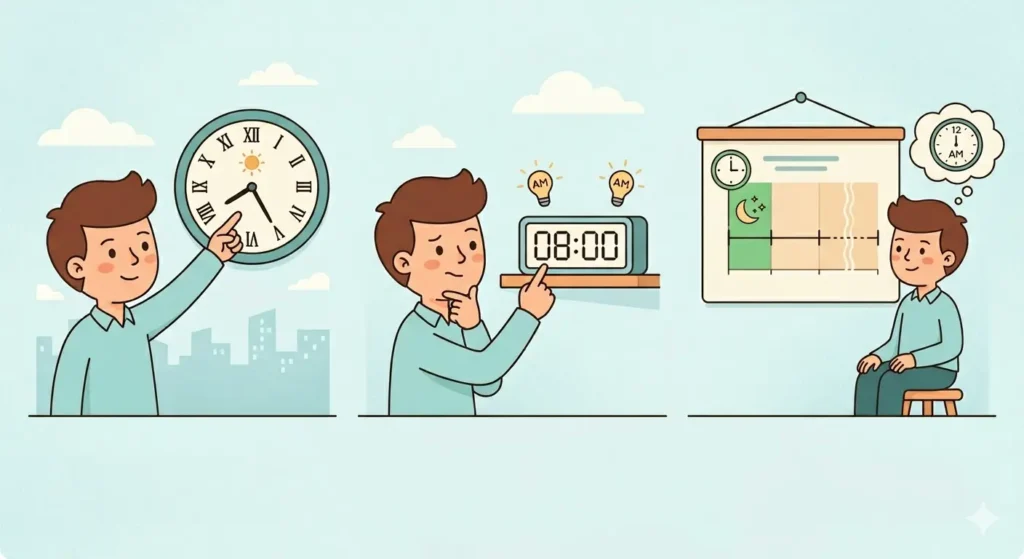
Step 1: Look at the hour hand position between midnight and noon
Step 2: Read the number directly – these hours match standard 12-hour time
Step 3: Note that 00:00 to 00:59 represents the first hour after midnight (12 AM in standard time)
Morning hours are straightforward. When the hour hand points to 7, it means 7:00 AM. When it reaches 11, that represents 11:00 AM. The only adjustment involves midnight: 00:00 on a 24-hour dial equals 12:00 AM in conventional time.
For precise time tracking throughout the day, tools like the world time comparison tool can help coordinate schedules across different formats.
Reading Afternoon and Evening Hours (12:00 to 23:59)
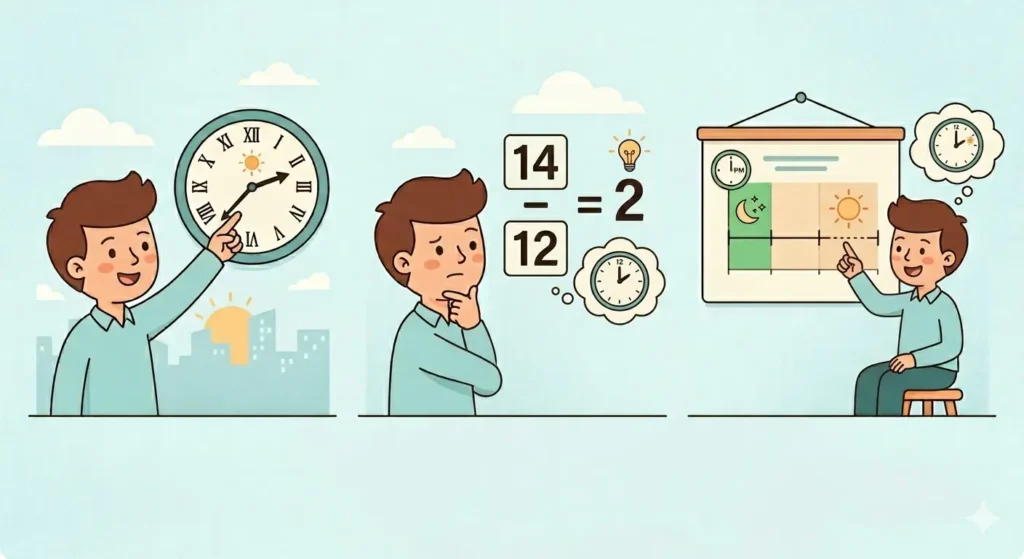
Step 1: Identify when the hour hand points to a number above 12
Step 2: Subtract 12 from that number to get the standard time equivalent
Step 3: Remember this represents PM hours in 12-hour format
When the hour hand reaches 13, this means 1:00 PM (13 – 12 = 1). Similarly, 18:00 equals 6:00 PM, and 20:00 translates to 8:00 PM. The highest reading, 23:59, represents one minute before midnight (11:59 PM).
Pro-Tip: Create a mental reference by remembering key times – 18:00 is dinner time (6 PM), 21:00 is prime time TV (9 PM), and 15:00 is mid-afternoon (3 PM). These anchors make quick conversions easier.
Reading the Minute Hand
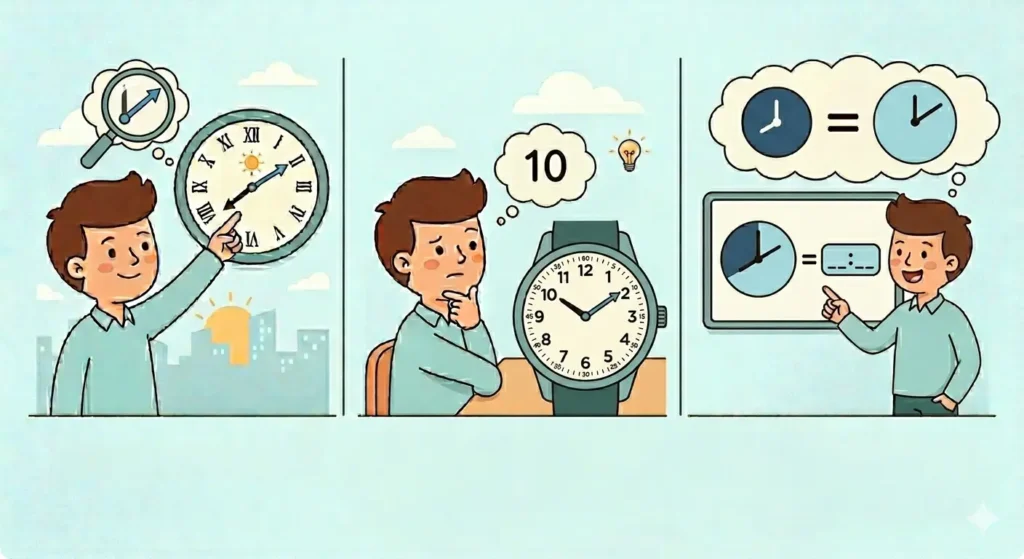
Step 1: Locate the minute hand (typically longer and thinner than the hour hand)
Step 2: Read minutes exactly as on a traditional watch
Step 3: Combine the hour and minute readings for complete time
The minute hand functions identically to 12-hour watches. Each marking represents one minute, with five-minute intervals usually highlighted. When the hour hand shows 16 and the minute hand points to 30, the time reads 16:30 (4:30 PM).
Identifying Different 24-Hour Dial Types
Several design variations exist for 24-hour watch dials:
- Full numeric dials display all numbers from 1-24 around the face
- Dual-scale dials show both 12-hour and 24-hour markings
- Single-hand 24-hour watches use only an hour hand with minute markers
- Military-style dials often use 00-23 numbering instead of 1-24
- Hybrid designs might show 13-24 on an inner ring with 1-12 on the outer
Each style requires slight adjustment in reading technique, but the core principle remains consistent: the hour hand position indicates where in the 24-hour cycle the current time falls.
Quick Reference Conversion Chart
| 24-Hour Time | 12-Hour Equivalent |
| 00:00 | 12:00 AM (Midnight) |
| 06:00 | 6:00 AM |
| 12:00 | 12:00 PM (Noon) |
| 15:00 | 3:00 PM |
| 18:00 | 6:00 PM |
| 21:00 | 9:00 PM |
| 23:59 | 11:59 PM |
Tips for Mastering 24-Hour Time Reading
Practice makes perfect when learning to read 24-hour dials quickly. Start by checking the watch frequently throughout the day and mentally converting the time. Most people find that after one week of consistent use, reading 24-hour format becomes second nature.
Set a clock tab in the browser to display both formats simultaneously during the learning period. This provides instant reference without needing to calculate.
Focus on memorizing the afternoon ‘anchor times’ first: 13:00 (1 PM), 15:00 (3 PM), 18:00 (6 PM), and 21:00 (9 PM). These common reference points make estimating times in between much simpler.
Pro-Tip: When telling time to others unfamiliar with 24-hour format, convert automatically in speech. Instead of saying ‘sixteen thirty,’ say ‘four thirty PM’ – this keeps communication clear while maintaining personal comfort with military time.
Common Problems When Reading 24-Hour Dials
Fix 1: Confusing Hour and Minute Hands
This happens frequently with similarly sized hands. The hour hand moves more slowly – it travels from one hour marking to the next over 60 minutes. The minute hand completes a full rotation every hour. If unsure which is which, observe the watch for a few minutes to see which hand moves noticeably.
Fix 2: Misreading Between-Hour Positions
When the hour hand sits between two numbers, the current hour is the lower number. If the hand rests between 14 and 15, the time is 14-something, not 15-something. The hour only changes once the hand passes the next number.
Fix 3: Forgetting to Subtract 12
Afternoon hour confusion clears up with consistent practice. Keep a mental note card: any number above 12 needs 12 subtracted. Some find it helpful to think ‘teens equal afternoon’ (13-19) and ‘twenties equal evening’ (20-23).
Fix 4: Mixing Up Midnight and Noon
Remember that 00:00 (or 24:00) marks midnight – the start of a new day. 12:00 represents noon – the middle of the day. Think of it as a number line: 00:00 starts at zero, and time counts upward through 12:00 to 23:59.
Frequently Asked Questions
What does 00:00 mean on a 24-hour watch?
00:00 represents midnight – the very start of a new day. This is equivalent to 12:00 AM in standard time format. Some watches display this as 24:00 at the end of the previous day.
How do you say 24-hour time out loud?
For times like 14:30, say ‘fourteen thirty’ or ‘fourteen hundred thirty hours’ in military style. Alternatively, convert and say ‘two thirty PM’ for everyday conversation. There is no single correct method – context determines the best approach.
Do all 24-hour watches show all 24 numbers?
Not necessarily. Some show only 1-12 with 13-24 marked on an inner ring. Others use tick marks without numbers. Single-hand designs might show all 24 hours as individual markers around the dial. Design varies by manufacturer and watch style.
Is 12:00 on a 24-hour watch noon or midnight?
12:00 represents noon – the middle of the day. This is the same as 12:00 PM. Midnight is marked as either 00:00 (start of the day) or 24:00 (end of the previous day).
How fast does the hour hand move on a 24-hour watch?
The hour hand completes one full rotation in 24 hours, moving at half the speed of a traditional 12-hour watch. It takes two hours to travel the distance between major hour markers, assuming they represent standard hour positions.
Can you use a 24-hour watch for timing events?
Yes, though a dedicated online stopwatch might prove more precise for short durations. The 24-hour format excels at tracking time across full days and eliminating AM/PM confusion for scheduled events.
Why do some watches show 1-24 while others show 0-23?
Both systems represent the same 24-hour period. The 1-24 format follows traditional clock numbering, while 0-23 aligns with military time and digital standards. Functionally, they work identically – just read the numbers as presented.
Do 24-hour watches have a second hand?
Most do, functioning exactly like traditional watches. The second hand completes one rotation per minute regardless of whether the watch uses 12-hour or 24-hour format. Some minimalist designs omit the second hand entirely.
How accurate are 24-hour watches compared to regular watches?
Accuracy depends on the movement mechanism (quartz, mechanical, automatic), not the dial format. A 24-hour quartz watch maintains the same precision as a 12-hour quartz watch. The time display format does not affect timekeeping accuracy.
Can you convert a regular watch to show 24-hour time?
Not mechanically – the dial and gear ratios are specifically designed for each format. However, many digital watches and smartwatches allow switching between 12-hour and 24-hour display modes in their settings.