

The helium escape valve on a dive watch is a specialized feature designed for professional saturation divers working in hyperbaric environments. This step-by-step guide explains how to properly operate the helium escape valve, when it’s needed, and why most recreational divers will never use this technical feature during their diving activities.
Quick Summary Table
| Key Point | Details |
| What It Does | Releases helium gas that seeps into the watch during saturation diving |
| When to Use | Only during decompression after saturation dives (100+ meters for extended periods) |
| Valve Types | Automatic (self-releasing) or Manual (requires activation) |
| Activation Timing | During decompression phase, before pressure differential becomes critical |
| Recreational Diving | Not needed – standard recreational depths don’t require helium atmospheres |
Understanding the Helium Escape Valve
A helium escape valve (also called a gas escape valve) is a one-way pressure relief system built into professional dive watches. During saturation diving, divers live in pressurized chambers filled with a helium-oxygen mixture for days or weeks. Helium molecules are incredibly small – much smaller than water molecules – and can penetrate the watch case seals over time.
As helium accumulates inside the watch during the saturation phase, pressure builds. When divers begin decompression and the external pressure drops, the trapped helium inside the watch expands. Without an escape route, this pressure differential can pop off the crystal, damage the case, or destroy the watch completely. The helium escape valve prevents this catastrophic failure by releasing the trapped gas safely.
How to Use a Manual Helium Escape Valve
Method 1: Operating During Decompression
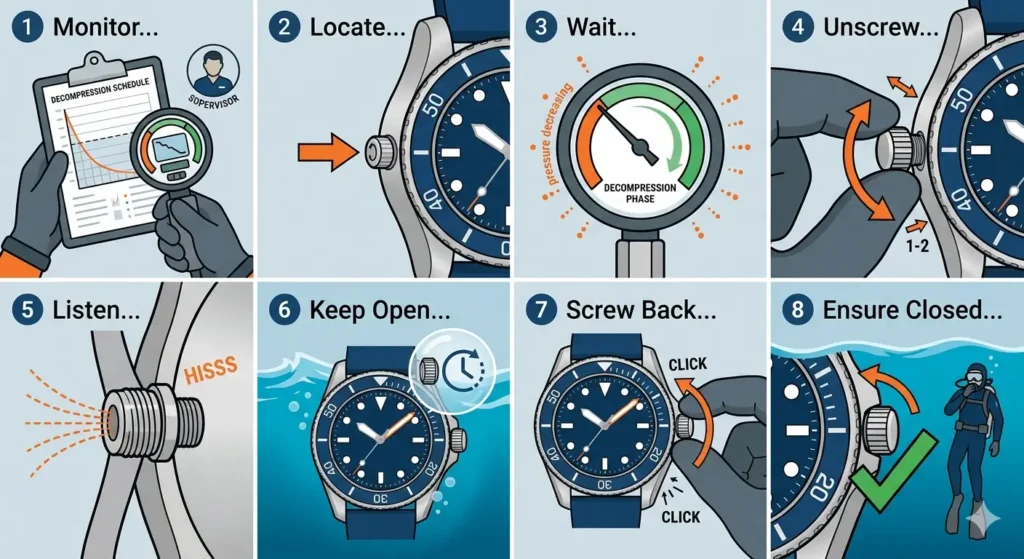
- Step 1: Monitor the decompression schedule provided by the dive supervisor or chamber operator
- Step 2: Locate the helium escape valve on the watch case – typically positioned at 9 o’clock or 10 o’clock on the case side
- Step 3: Wait until the decompression phase begins and chamber pressure starts decreasing
- Step 4: Unscrew the valve crown counterclockwise by 1-2 full turns – similar to unscrewing a screw-down crown
- Step 5: Listen for a faint hissing sound indicating helium is escaping from inside the watch case
- Step 6: Keep the valve open throughout the entire decompression process
- Step 7: Once decompression is complete and the chamber reaches normal atmospheric pressure, screw the valve crown back down clockwise until hand-tight
- Step 8: Ensure the valve is fully closed before returning to water to maintain water resistance
Pro Tip: Never open the helium escape valve while still at depth or in the pressurized chamber before decompression begins. Opening it too early allows the helium-oxygen breathing mixture to enter the watch case, which defeats the purpose and can introduce moisture or contaminants into the movement.
Method 2: Automatic Valve Operation
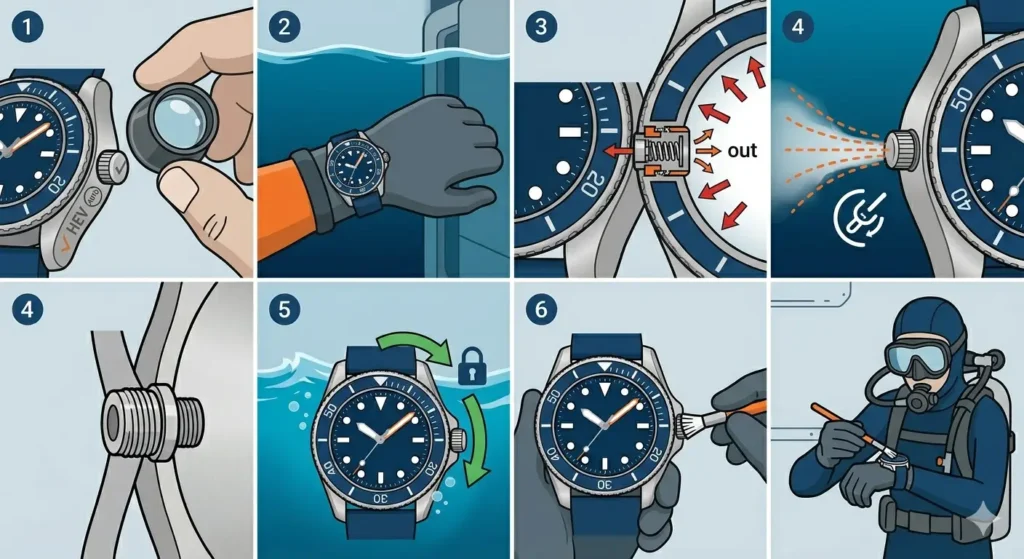
Many modern professional dive watches feature automatic helium escape valves that require no manual intervention. These spring-loaded valves operate passively based on pressure differential.
- Step 1: Verify the watch has an automatic helium escape valve – check the manufacturer specifications or case markings
- Step 2: Wear the watch normally during saturation diving operations
- Step 3: The valve automatically opens when internal pressure exceeds external pressure by a predetermined threshold (typically 3-5 bar)
- Step 4: Helium releases automatically during decompression without any action required
- Step 5: The valve automatically reseals when pressure equalizes
- Step 6: Inspect the valve annually to ensure the mechanism remains functional and debris-free
When the Helium Escape Valve Is Actually Needed
The helium escape valve serves a very specific purpose in extreme diving scenarios. Understanding when it’s genuinely necessary helps clarify why recreational divers can safely ignore this feature.
Saturation diving occurs when divers work at depths exceeding 100 meters for extended periods – sometimes weeks at a time. At these depths, breathing compressed air would cause nitrogen narcosis and oxygen toxicity, so divers breathe a helium-oxygen mixture instead. Between work dives, they live in pressurized habitats or bells that maintain the same pressure as their working depth. This eliminates the need for repeated decompression cycles.
During these extended stays in helium-rich environments, the tiny helium molecules gradually penetrate the watch case seals and accumulate inside. When the saturation diving operation concludes, the slow decompression process (which can take days) creates a dangerous pressure differential. The helium escape valve prevents watch failure during this critical phase.
Recreational diving – even technical diving to 40-50 meters – doesn’t involve helium atmospheres or extended exposure times that would allow helium to penetrate the watch case. Standard recreational dive profiles use compressed air or nitrox, neither of which contains helium in significant quantities. The dive durations are also too short for meaningful helium penetration to occur. For context, tracking dive times accurately becomes easier with tools like the online stopwatch for timing safety stops and bottom time.
Helium Escape Valve Maintenance Tips
Proper maintenance ensures the helium escape valve functions correctly when needed, though most watch owners will never activate it in real diving conditions.
Annual Inspection
- Have authorized service centers inspect the valve mechanism during regular watch servicing
- Check that the valve crown turns smoothly without binding or excessive resistance
- Verify the seals remain intact and show no signs of degradation or cracking
- Test the valve opens and closes properly – though this should only be done by trained technicians
Cleaning Protocols
- Rinse the valve area with fresh water after any saltwater exposure
- Use a soft brush to remove salt deposits or debris around the valve crown
- Never force the valve open or closed if it feels stuck – seek professional service instead
- Avoid using chemical cleaners or solvents near the valve that could damage seals
Storage Considerations
- Keep the valve closed during normal wear and storage to maintain water resistance
- Store the watch in a dry environment away from extreme temperatures
- Avoid storing the watch in pressurized containers or environments
Pro Tip: If the watch will never be used for saturation diving, there’s no need to obsess over helium valve maintenance beyond basic cleanliness. The valve adds a point of potential failure, but modern designs are remarkably reliable when left undisturbed. Focus maintenance efforts on the primary crown and case back seals instead.
Common Problems and Solutions
Issue 1: Valve Won’t Unscrew
If the manual helium escape valve feels stuck or won’t turn, don’t force it. Salt deposits, corrosion, or dried lubricant can cause the threads to bind. Soak the watch in fresh water for 30 minutes, then try again gently. If it remains stuck, take the watch to an authorized service center – forcing it can strip threads or damage the valve assembly.
Issue 2: Valve Leaks Water During Normal Diving
Water entering through the helium escape valve during recreational diving indicates seal failure. This happens when the valve wasn’t properly closed after previous use, or when the gasket has deteriorated. Remove the watch from water immediately, do not attempt to open or close the valve further, and send it for professional service. Continuing to dive with a compromised valve risks flooding the movement.
Issue 3: No Hissing Sound When Valve Opens
If opening the manual valve during decompression produces no audible hissing, either insufficient helium penetrated the case (common with shorter exposures), or the valve mechanism isn’t functioning. As long as the watch crystal doesn’t pop off and the watch continues functioning, this typically indicates the saturation exposure wasn’t long enough to require valve activation rather than a mechanical problem.
Issue 4: Valve Opens Spontaneously
Automatic helium valves occasionally open in non-diving situations, particularly during air travel or in pressurized environments. This happens when cabin pressure changes or temperature fluctuations create minor pressure differentials inside the case. It’s generally harmless and the valve will reseal automatically. However, if the valve fails to close after pressure normalizes, have it inspected – a stuck-open valve compromises water resistance.
Frequently Asked Questions
Do recreational divers need a helium escape valve?
No, recreational divers do not need a helium escape valve. Standard recreational diving uses compressed air or nitrox at depths and durations that don’t involve helium atmospheres. The valve only becomes necessary for professional saturation divers who spend extended periods in helium-rich pressurized environments exceeding 100 meters depth.
Can a helium escape valve fail and flood the watch?
Yes, a malfunctioning helium escape valve can allow water to enter the watch case if the seals fail or if the valve is accidentally left open during water exposure. However, quality dive watches use robust valve designs with multiple sealing gaskets, making failure rare. Regular maintenance and proper operation minimize this risk significantly.
How often should the helium escape valve be serviced?
The helium escape valve should be inspected during regular watch servicing intervals, typically every 2-3 years for dive watches. Professional saturation divers who actually use the valve should have it checked annually. For watch enthusiasts who never activate the valve, standard service intervals are sufficient to maintain the seals and mechanism.
What’s the difference between automatic and manual helium escape valves?
Manual helium escape valves require the user to unscrew a crown to release trapped helium during decompression. Automatic valves use a spring-loaded mechanism that opens automatically when internal pressure exceeds external pressure by a set threshold, then reseals when pressure equalizes. Automatic valves offer convenience but add mechanical complexity, while manual valves give the diver complete control over activation timing.
Will a helium escape valve affect the watch’s water resistance rating?
When properly closed and maintained, a helium escape valve does not reduce the watch’s water resistance rating. Professional dive watches with helium valves maintain their full depth ratings (often 300-1000+ meters) because the valve includes dedicated sealing systems. However, if the valve is left open or the seals deteriorate, water resistance is completely compromised.
Can helium damage a watch without an escape valve?
Yes, helium can cause catastrophic damage to watches without escape valves during saturation diving decompression. The trapped helium expands as external pressure decreases, potentially popping off the crystal, distorting the case, or destroying internal components. This is why professional saturation dive watches specifically include helium escape valves as essential safety features.
Should the helium escape valve be opened during regular dive watch pressure testing?
No, the helium escape valve should remain closed during standard water resistance pressure testing. Opening the valve during wet testing would allow water to enter the case and flood the movement. Service technicians perform helium valve testing separately using dry pressure methods or specialized equipment designed specifically for valve functionality checks.
How long does helium take to penetrate a watch case during saturation diving?
Helium penetration into a watch case during saturation diving typically requires 24-48 hours of continuous exposure to a helium-rich pressurized environment. The exact timeline depends on the partial pressure of helium, the quality of case seals, and the ambient pressure level. Short exposures under 12 hours rarely allow sufficient helium accumulation to require valve activation. When planning extended activities or tracking time zones across different locations, tools like the world time comparison tool help coordinate schedules effectively.
Is it safe to fly with a dive watch that has a helium escape valve?
Yes, flying with a dive watch equipped with a helium escape valve is completely safe. Commercial aircraft cabin pressure changes are minor compared to saturation diving decompression, and insufficient helium exists in the cabin atmosphere to penetrate the watch case. Some automatic valves might briefly activate due to pressure changes during ascent or descent, but this is harmless and the valve reseals automatically.
Can opening the helium escape valve help if the watch crystal pops off?
No, opening the helium escape valve after the crystal has already popped off serves no purpose – the damage is done and the case is no longer sealed. The valve must be opened during decompression before the pressure differential becomes critical enough to dislodge the crystal. Once structural failure occurs, the watch requires complete disassembly, cleaning, and professional repair regardless of valve position. For timing critical tasks accurately during repairs or maintenance, the clock tab provides reliable timekeeping.