
Inspecting a watch before buying ensures authenticity, functionality, and value for money. Whether shopping for a new luxury timepiece or a pre-owned vintage model, knowing what to check prevents costly mistakes and ensures the watch meets expectations. This guide provides a comprehensive step-by-step approach to examining watches thoroughly before making a purchase decision.
Quick Summary Table
| Inspection Area | What to Check | Why It Matters |
|---|---|---|
| External Case | Scratches, dents, finish quality | Indicates condition and authenticity |
| Crystal/Glass | Cracks, scratches, clarity | Affects readability and value |
| Movement | Accuracy, smooth operation | Core functionality indicator |
| Crown & Pushers | Smooth operation, water resistance | Prevents future repair costs |
| Bracelet/Strap | Wear, fit, clasp function | Comfort and security |
| Documentation | Papers, warranty, service history | Proves authenticity and coverage |
Examining the Watch Case and External Condition
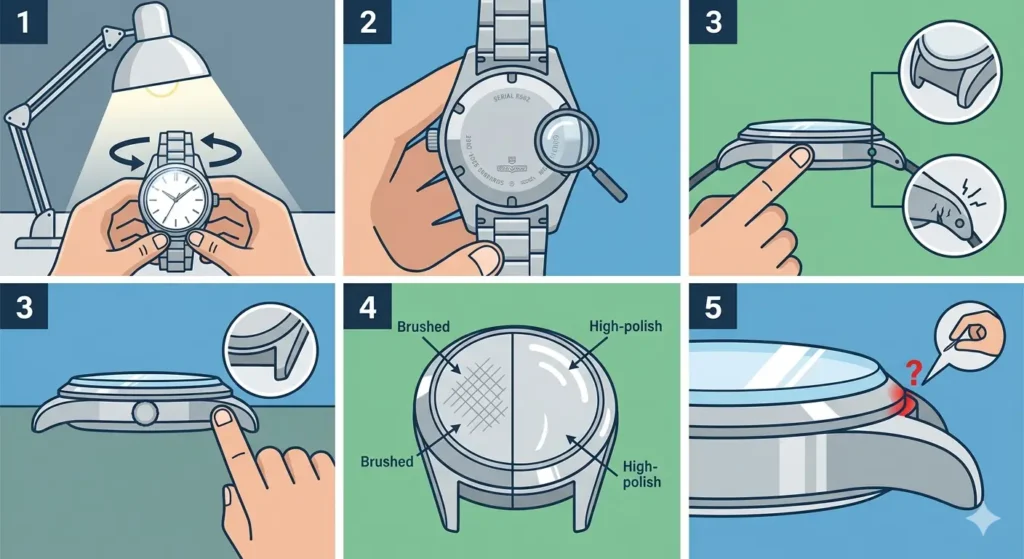
The case serves as the first impression and protection for the watch movement. Start by examining the overall finish and looking for any signs of damage or poor craftsmanship.
- Step 1: Hold the watch under good lighting and rotate it slowly to inspect all surfaces for scratches, dents, or discoloration.
- Step 2: Check the case back for engravings, serial numbers, and proper markings that match the brand’s authentication standards.
- Step 3: Examine the lugs (where the strap attaches) for wear, cracks, or signs of previous strap changes that may indicate heavy use.
- Step 4: Verify that the case finish is consistent throughout – polished areas should be uniformly shiny, and brushed sections should show even grain patterns.
- Step 5: Look for any gaps between the case and bezel, which could indicate poor assembly or water damage.
For used watches, some surface wear is normal, but deep gouges, severe scratches, or corrosion suggest neglect or harsh treatment. New watches should have flawless cases with protective stickers intact.
Inspecting the Crystal and Dial
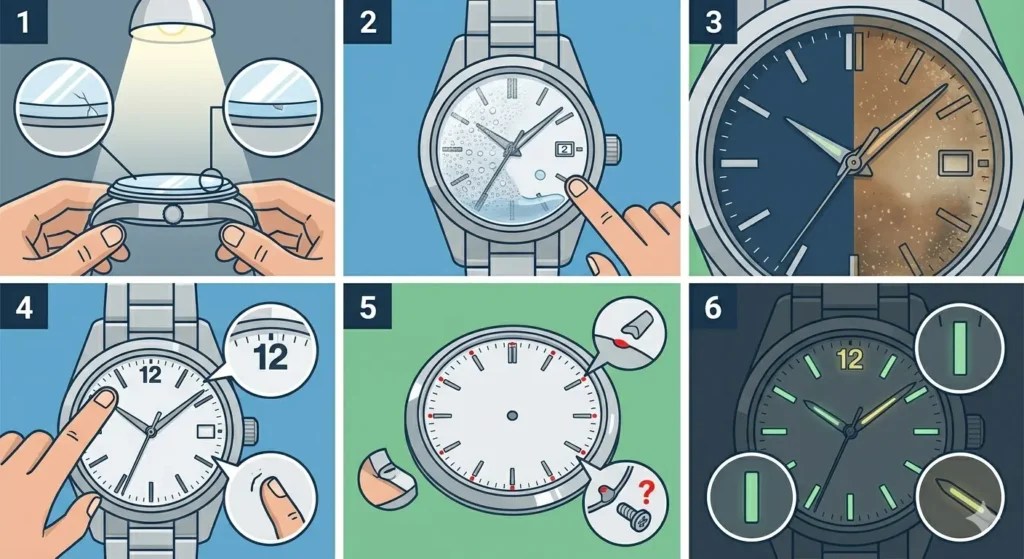
The crystal protects the dial and must be clear and intact. The dial reveals much about the watch’s condition and authenticity.
- Step 1: Examine the crystal from multiple angles under direct light to spot any scratches, chips, or cracks that might not be immediately visible.
- Step 2: Check for moisture or condensation inside the crystal, which indicates compromised water resistance or internal damage.
- Step 3: Inspect the dial for discoloration, fading, or ‘tropical’ aging patterns that may affect value depending on the watch model.
- Step 4: Verify that all dial markers, hands, and text are properly aligned and show no signs of damage or aftermarket replacement.
- Step 5: Look for ‘dial feet’ shadows or uneven spacing, which can indicate the dial has been removed or serviced improperly.
- Step 6: Check that the lume (luminous material) on hands and markers matches in color and brightness, as mismatched lume suggests replaced parts.
Using tools like an online stopwatch can help time the lume glow duration, which should last several hours for quality watches with fresh luminous material.
Pro-Tip: Dial Authenticity Check
Compare the dial printing, fonts, and spacing with official brand images. Counterfeit watches often have slight spelling errors, incorrect fonts, or poorly aligned text. Authentic luxury watches feature razor-sharp printing with perfect spacing and alignment.
Testing the Movement and Timekeeping Accuracy
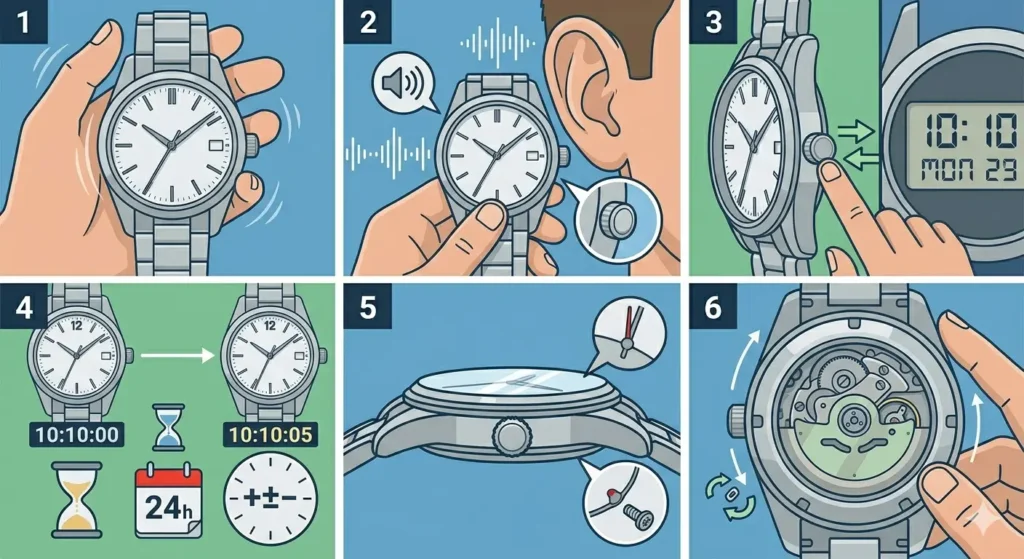
The movement determines the watch’s core functionality and value. Testing accuracy and operation reveals the movement’s health.
- Step 1: Wind the watch fully (for manual movements) or shake it gently (for automatic movements) to ensure it starts running smoothly.
- Step 2: Listen to the ticking sound – it should be consistent and rhythmic without any stuttering, rattling, or unusual noises.
- Step 3: Set the watch to match a precise clock tab or atomic time source.
- Step 4: Allow the watch to run for 24 hours and compare the time again to measure daily deviation.
- Step 5: Test the hacking function (seconds hand stopping when crown is pulled) if the movement should have this feature.
- Step 6: For automatic watches, check that the rotor spins freely and smoothly when the watch is gently shaken.
Acceptable accuracy varies by movement type. Mechanical watches typically run +/-10 seconds per day, while chronometer-certified pieces should stay within -4/+6 seconds daily. Quartz movements should be accurate to within 15 seconds per month.
Checking the Crown and Pushers
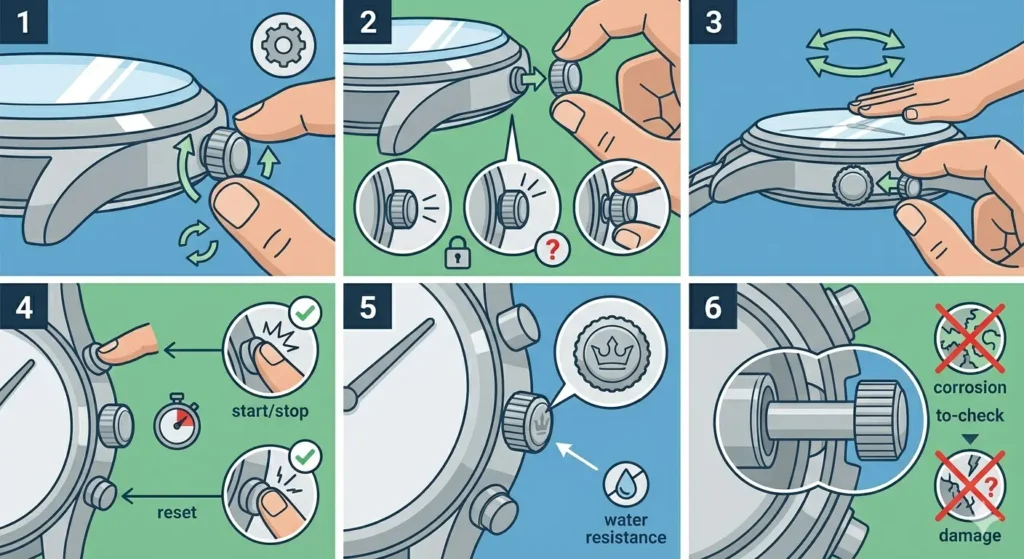
The crown and pushers allow time-setting and complication operation. These components must function smoothly and maintain water resistance.
- Step 1: Unscrew the crown (if it’s a screw-down type) and verify it turns smoothly without resistance or grinding.
- Step 2: Pull the crown through all positions and ensure each click is distinct and the crown doesn’t slip back.
- Step 3: Test time-setting in both directions – the hands should move smoothly without jumping or sticking.
- Step 4: For chronograph pushers, press each button to verify crisp action and proper function of start, stop, and reset operations.
- Step 5: Check that the crown is properly engraved with brand markings and screws down completely flush with the case.
- Step 6: Verify the crown tube shows no corrosion or damage that could compromise water resistance.
A properly functioning crown should feel firm but smooth. Grinding, excessive play, or difficult operation indicates worn threads or internal damage requiring service.
Evaluating the Bracelet, Strap, and Clasp
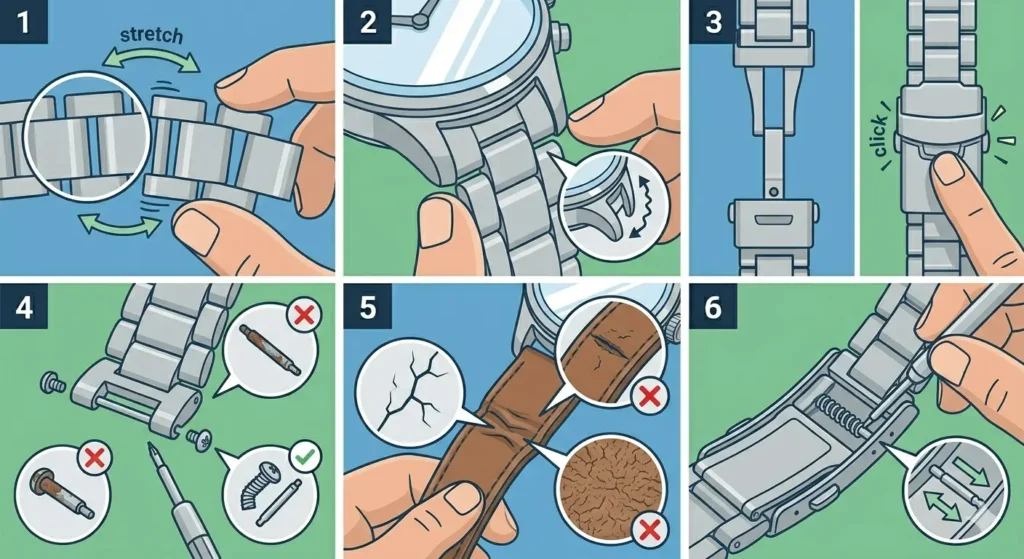
The bracelet or strap affects comfort, security, and overall watch presentation. Thorough inspection prevents unexpected failures or discomfort.
- Step 1: Examine each bracelet link for excessive play, stretch, or looseness that indicates wear.
- Step 2: Check end links (connecting bracelet to case) for proper fit without gaps or wobbling.
- Step 3: Test the clasp mechanism repeatedly to ensure it locks securely and opens smoothly.
- Step 4: Inspect pins, screws, or other connectors for damage, corrosion, or missing parts.
- Step 5: For leather straps, check for cracks, tears, excessive creasing, or dry rot that signals replacement need.
- Step 6: Verify that any micro-adjustment or extension features work properly.
Bracelet stretch is common in older watches but excessive play reduces security and value. Budget for replacement if the bracelet shows significant wear.
Verifying Serial Numbers and Documentation
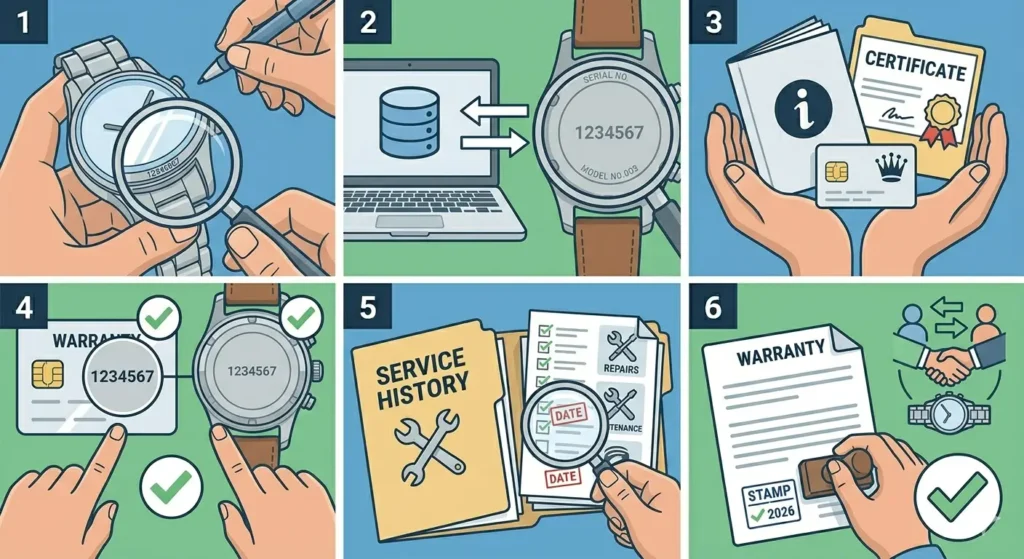
Proper documentation proves authenticity and provides warranty coverage. Serial numbers help verify the watch’s age and origin.
- Step 1: Locate the serial number on the case (usually between lugs or on case back) and write it down.
- Step 2: Contact the manufacturer or use online databases to verify the serial number matches the model and production year.
- Step 3: Request all original documentation including warranty card, instruction manual, and certificate of authenticity.
- Step 4: Check that warranty card serial numbers match the watch case serial number exactly.
- Step 5: Review any service history documentation to understand previous maintenance and repairs.
- Step 6: Verify that the warranty is still valid and transferable to the new owner.
Missing papers significantly reduce resale value, especially for luxury brands. Always request complete documentation and verify authenticity before finalizing purchase.
Testing Water Resistance (If Applicable)
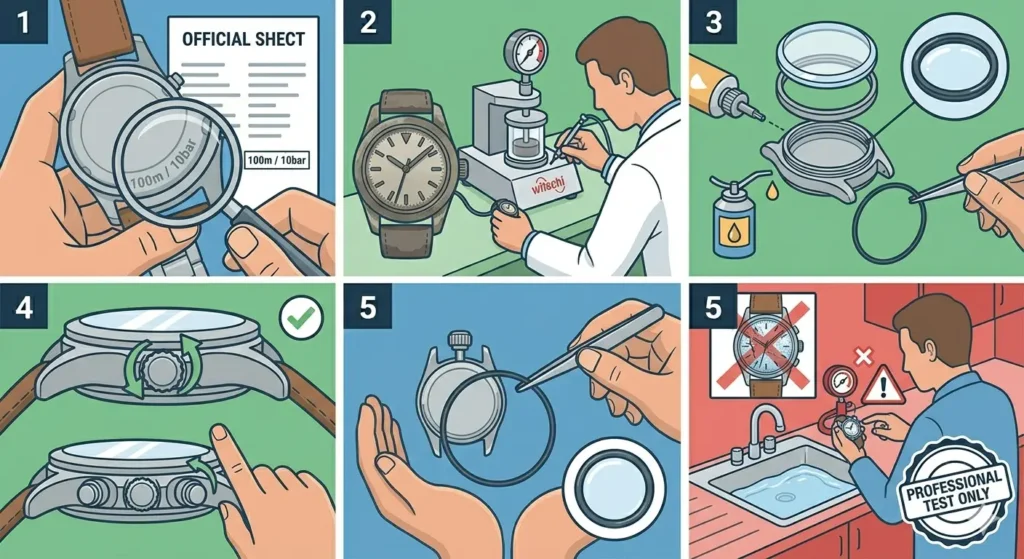
Water resistance claims must match actual capability. Professional testing prevents costly water damage.
- Step 1: Verify the water resistance rating printed on the case back or dial matches manufacturer specifications.
- Step 2: For used watches, request a professional pressure test from a watchmaker before water exposure.
- Step 3: Check that all gaskets, crown seals, and case back seals appear fresh and properly lubricated.
- Step 4: Ensure the crown is fully screwed down and pushers are in locked position (for screw-down types).
- Step 5: Never test water resistance yourself without proper equipment – moisture damage voids warranties and causes expensive repairs.
Water resistance degrades over time and requires regular maintenance. Even dive watches need gasket replacement every 2-3 years to maintain rated depth capability.
Pro-Tip: Understanding Water Resistance Ratings
Water resistance ratings can be misleading. A 30m (3 ATM) rating means splash resistance only – not suitable for swimming. 100m (10 ATM) allows swimming and snorkeling, while 200m+ (20 ATM+) handles diving. Static pressure testing differs from real-world dynamic pressure during water activities.
Examining the Movement Through the Case Back
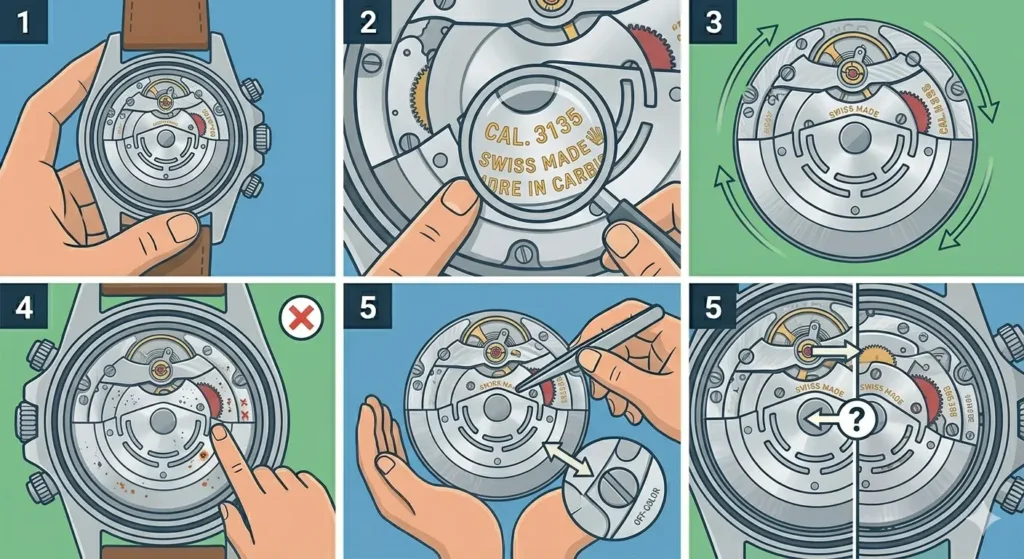
Display case backs reveal movement quality and finishing. This inspection helps verify authenticity and craftsmanship.
- Step 1: Look through the case back at the movement decoration including perlage, Geneva stripes, or other finishing patterns.
- Step 2: Check for manufacturer markings, caliber numbers, and quality stamps on the movement bridges.
- Step 3: Verify that the rotor (for automatic watches) is properly engraved with brand logo and rotates smoothly.
- Step 4: Look for any dust, moisture, or corrosion inside the case that indicates poor sealing or damage.
- Step 5: Compare the movement appearance with official manufacturer images to spot aftermarket parts or service issues.
High-quality movements feature beautiful finishing visible through display backs. Generic or poorly finished movements in supposedly luxury watches indicate counterfeits or frankenwatches assembled from mixed parts.
Tips for Successful Watch Inspection
- Always inspect watches in good natural lighting or use a jeweler’s loupe for detailed examination of small components and printing.
- Bring a timing reference like a smartphone with world time comparison tool to verify accuracy against precise time sources.
- Take detailed photos during inspection to reference later when comparing multiple watches or negotiating price.
- Don’t rush the inspection process – spend at least 15-20 minutes examining each watch thoroughly before making decisions.
- Ask the seller detailed questions about service history, ownership duration, and reason for selling to gauge honesty.
- Request a return period or money-back guarantee, especially when buying online or from unfamiliar sellers.
- Consider hiring a professional watchmaker for pre-purchase inspection on expensive pieces over $5,000.
- Trust your instincts – if something feels wrong or the deal seems too good, walk away and find another watch.
Common Problems Found During Watch Inspection
Problem 1: Moisture or Condensation Inside Crystal
Moisture indicates failed gaskets or case seal compromise. This requires immediate professional service to prevent rust, dial damage, and movement corrosion. Never purchase a watch with visible moisture unless heavily discounted and factoring in complete service costs.
Problem 2: Inconsistent or Erratic Timekeeping
Watches running extremely fast or slow (more than 30 seconds per day for mechanical) need regulation or service. This could indicate magnetization, worn movement parts, or lack of proper maintenance. Budget $200-$800 for professional service depending on movement complexity.
Problem 3: Loose or Wobbly Bezel
A bezel that rotates with excessive play, wobbles, or doesn’t click precisely indicates worn springs or detent balls. Replacement parts and labor typically cost $150-$400 depending on the watch brand and model.
Problem 4: Crown Doesn’t Screw Down Properly
Screw-down crowns that don’t fully engage or cross-thread signal damaged crown tubes or worn threads. This compromises water resistance and requires crown tube replacement, typically costing $100-$300 plus service.
Problem 5: Dial Markers or Hands Showing Lume Deterioration
Faded, discolored, or missing luminous material affects nighttime readability. Re-luming requires professional service costing $200-$600 depending on dial complexity. Some collectors prefer original faded lume for vintage character.
Problem 6: Bracelet Excessive Stretch
Metal bracelets with significant play between links reduce security and value. Replacement bracelets from manufacturers cost $300-$2,000+ depending on brand. Aftermarket options provide cheaper alternatives but may affect resale value.
Frequently Asked Questions
What is the most important thing to check when buying a used watch?
Verify authenticity through serial numbers and compare all details with manufacturer specifications. Counterfeits have improved dramatically, making authentication the critical first step before examining condition or functionality. A genuine watch in poor condition holds more value than a perfect fake.
How can someone tell if a watch movement is authentic?
Compare the movement finishing, engravings, and caliber markings with official manufacturer images. Authentic movements feature high-quality decoration, correct brand markings, and precise finishing patterns. Generic movements or poorly finished components indicate counterfeits or replacement parts.
Should someone buy a watch without original papers and box?
Yes, but expect to pay 15-30% less than complete sets. Missing documentation reduces resale value but doesn’t affect the watch’s functionality. Verify authenticity through serial numbers and professional authentication before purchasing watches without papers.
How much deviation is acceptable for a mechanical watch?
Standard mechanical watches running +/-10 seconds per day are acceptable. Chronometer-certified pieces should maintain -4/+6 seconds daily. Vintage watches may show larger deviations but should still keep time within predictable ranges. Anything beyond 30 seconds daily needs service.
What does water resistance really mean on a watch?
Water resistance ratings indicate static pressure testing, not real-world dynamic pressure. 30m means splash resistance only, 100m allows swimming, and 200m+ handles diving. These ratings degrade over time and require gasket replacement every 2-3 years to maintain protection.
Is it worth getting a pre-purchase inspection from a watchmaker?
Absolutely, for watches costing over $5,000. Professional watchmakers charge $50-$150 for pre-purchase inspections and can identify hidden problems, authenticate movements, and estimate service costs. This small investment prevents expensive mistakes on luxury timepieces.
How can someone spot a fake luxury watch?
Check dial printing quality, movement finishing, serial number verification, weight and materials, crown and case back engravings, and overall build quality. Counterfeits often have spelling errors, poor finishing, light weight, and incorrect materials. Always buy from authorized dealers when possible.
What should someone look for in a watch crystal?
Examine for scratches, chips, cracks, or cloudiness. Sapphire crystals should be extremely scratch-resistant and clear. Acrylic crystals scratch easily but can be polished. Mineral glass falls between the two. Check for proper anti-reflective coating if the watch should have it.
How much does typical watch servicing cost?
Basic quartz service runs $50-$150, standard mechanical service costs $200-$500, and luxury brand complete overhauls range $500-$2,000+. Complicated movements with chronographs or perpetual calendars cost significantly more. Factor these costs when evaluating used watch prices.
Can someone test water resistance themselves before buying?
Never test water resistance without professional equipment. Home testing risks moisture damage that voids warranties and causes expensive repairs. Always request professional pressure testing from a watchmaker, which costs $20-$50 and provides peace of mind.