

A guide to dress watches is something every style-conscious person eventually needs. Whether stepping into a formal event or a boardroom meeting, the watch on the wrist speaks before a single word is said. Dress watches carry a different set of expectations compared to sport or casual timepieces – and knowing the unwritten rules makes all the difference between looking polished and looking off.
Quick Summary: Key Takeaways
- Dress watches should be thin, simple, and understated – less is always more
- Leather straps (especially black or dark brown) are the standard for formal occasions
- The case diameter should ideally fall between 36mm and 40mm for a classic fit
- Avoid complications beyond date – a clean dial is the goal
- Match metal tones: gold watch with gold accessories, silver with silver
- The watch should sit under the shirt cuff, not over it
- White or champagne dials pair with almost any outfit
- Roman numerals and minimal indexes both work – avoid busy, sporty dials
What Makes a Watch a Dress Watch
Not every elegant-looking watch qualifies as a true dress watch. The defining traits come down to design philosophy. A dress watch prioritizes visual restraint over function-heavy features. Think of it as the formal suit equivalent in the watch world – structured, refined, and built for a specific occasion.
The key characteristics to look for:
- A thin case profile – typically under 10mm in height
- A simple dial with minimal text and clean hour markers
- No rotating bezels, dive scales, or chronograph pushers
- Leather strap as the default choice
- Precious or precious-looking metals for the case
Brands like Patek Philippe, Jaeger-LeCoultre, and A. Lange and Sohne have built their reputations on dress watches precisely because simplicity done well is incredibly hard. Even at the more accessible end, brands like Tissot and Longines offer solid options that follow the same principles.
Step-by-Step: How to Choose the Right Dress Watch
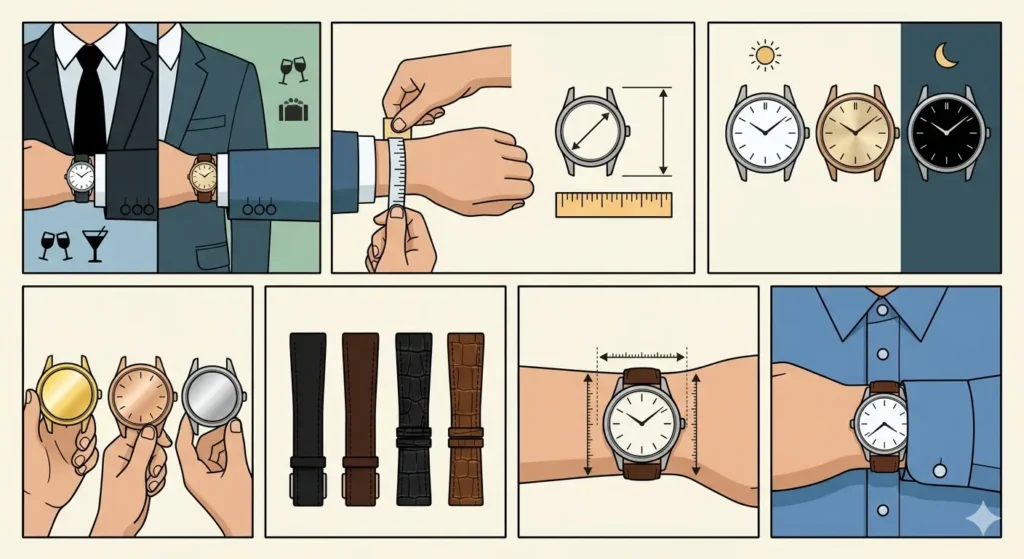
- Step 1: Determine the occasions where the watch will mostly be worn. Black tie events demand the slimmest, most minimal options. Business formal allows slightly more flexibility.
- Step 2: Measure the wrist. A common mistake is buying a watch that is too large. For dress purposes, a case diameter between 36mm and 40mm is the sweet spot for most wrist sizes.
- Step 3: Choose a dial color. White and champagne are universally safe. Black dials work beautifully in evening settings. Avoid multi-colored or heavily textured dials for strict formal use.
- Step 4: Select the case metal. Yellow gold reads traditional and luxurious. Rose gold is warmer and slightly modern. Steel or white gold reads cleaner and more contemporary.
- Step 5: Pick the strap material. For formal events, a smooth leather strap in black or dark brown is the correct choice. Alligator or crocodile-embossed leather elevates the look further.
- Step 6: Check the lug-to-lug measurement – this is the distance across the watch from top to bottom. This number should not exceed the width of the wrist to avoid the watch hanging over the edges.
- Step 7: Try it under a shirt cuff. A true dress watch should disappear elegantly under a buttoned shirt sleeve, not compete with it for space.
The Unwritten Rules of Wearing a Dress Watch
Owning a beautiful dress watch is only half the equation. Knowing how to wear it properly is where most people make small but noticeable mistakes.
Rule 1: Match Metal Tones Across Accessories
If the watch has a yellow gold case, the belt buckle, cufflinks, and tie bar should also be gold-toned. Mixing silver and gold metals in a formal setting creates visual noise. This rule feels strict, but it is one of the most noticed details by those with a trained eye.
Rule 2: The Watch Goes on the Left Wrist, Under the Cuff
This is standard practice for the majority of people. More importantly, the watch should sit comfortably under the shirt cuff – not resting on top of it. A watch that pokes out awkwardly from under the sleeve breaks the clean line of a tailored outfit. When checking the current time at a formal event, the motion should be subtle – lift the cuff slightly, glance, done.
Rule 3: Keep Complications Minimal
A dress watch with a date complication is acceptable and widely seen. Beyond that, complications like moon phases, world timers, or chronographs start pushing the watch into different territory. The cleaner the dial, the more formal the watch reads. Every added feature is a visual element that pulls the eye away from overall elegance.
Rule 4: Avoid Rubber or NATO Straps
Those strap choices belong to sport and casual watches. A dress watch on a rubber or woven nylon strap sends conflicting messages. The strap is a critical part of the overall silhouette. Smooth leather – preferably with a deployment clasp or a simple tang buckle – is always the right call for formal settings.
Rule 5: Dress Watch Sizing Should Fit the Occasion, Not the Trend
Oversized watches have had their moment in fashion, but dress watches operate outside of trend cycles. A 44mm watch with a thick case looks out of place under a slim French-cuff shirt. Stick to proportions that have stood the test of time – 36mm to 40mm remains the gold standard for a reason.
Pro Tip: When attending a black-tie event, opt for a watch thinner than 8mm with no date window. A date display, while practical, slightly interrupts the symmetry of a minimalist dial. For the most formal occasions, pure time-only dials are the pinnacle choice.
Step-by-Step: How to Style a Dress Watch With Different Outfits
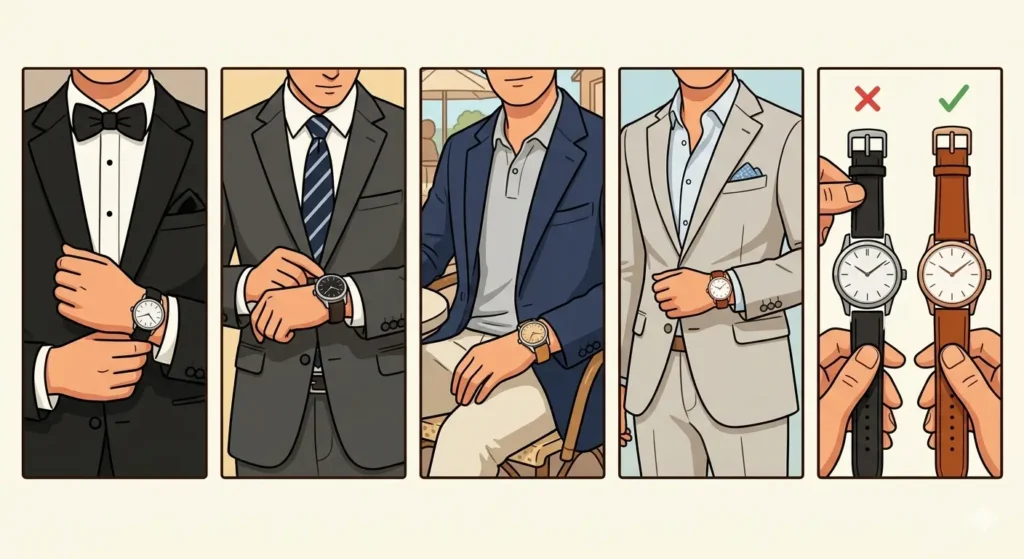
- Step 1: For a black-tie tuxedo, pair with a black leather strap dress watch with a white or silver dial. Keep everything monochromatic and understated.
- Step 2: For a business suit in navy or charcoal, a steel case with a white or black dial and dark brown leather strap offers contrast without drawing too much attention.
- Step 3: For smart-casual (blazer without tie), slightly more flexibility is allowed. A champagne dial with a tan leather strap reads relaxed but still intentional.
- Step 4: For formal events with a light-colored suit, consider a rose gold case with a white dial and a tan or cognac leather strap. The warmth of rose gold complements lighter fabric tones naturally.
- Step 5: Always confirm that the strap width matches the case lug width. Mismatched straps look improvised, not styled.
Dress Watch Dial Details Worth Understanding
The dial is the face of the watch – and in dress watchmaking, it carries enormous weight. A few elements to understand before making a choice:
Hour Markers
Roman numerals are traditional and lend a classic feel. Applied baton indexes (slim rectangular markers) read as more contemporary. Both are appropriate for dress watches. Avoid Arabic numerals in bold or sporty fonts – they lean casual.
Dial Texture
Guilloché dials (with their intricate engraved patterns) are a hallmark of traditional horology and look exceptional in person. Sunburst and matte dials are clean and modern. Both work well. Avoid glossy, over-lacquered dials that reflect light in a way that reads cheap.
Hands
Dauphine hands and Breguet hands are the most associated with dress watches. Stick to hands with a polished finish that catches light subtly. Broad sword hands or skeletonized hands belong to a different category.
Pro Tip: A signed crown (the winding crown engraved with the brand logo) is a small detail that signals quality in higher-end dress watches. It is not a deal-breaker, but it is a mark of craftsmanship worth noticing when comparing options.
Strap and Bracelet Options for Dress Watches
The strap transforms the personality of a dress watch more than almost any other element. Here is how the main options break down:
- Black smooth leather: The most formal option. Pairs with tuxedos and dark suits effortlessly.
- Dark brown leather: Slightly more versatile. Works across business and smart-casual settings.
- Tan or cognac leather: Best with lighter or warmer suit colors. Adds warmth to the overall look.
- Integrated metal bracelet: Certain dress watches come with elegant slim bracelets. This is acceptable but lean toward watches where the bracelet is as refined as the case.
- Alligator or crocodile leather: The pinnacle of dress strap options. Reserved for high-end watches and very formal occasions.
Keeping track of time during events across different time zones is increasingly common for business travelers. Using a world time comparison tool alongside a dress watch keeps things practical without compromising the elegance of a minimal dial.
Tips for Caring for a Dress Watch
- Store dress watches in a watch box or pouch when not in use – dust and humidity affect both the case and the leather strap
- Avoid exposing a dress watch to water unless it has a water resistance rating of at least 30 meters – even then, leather straps should not get wet
- Have the watch serviced every 4 to 5 years by a qualified watchmaker to keep the movement running accurately
- Rotate leather straps regularly – wearing the same strap every day accelerates wear and stretching
- Polish the case gently with a soft microfiber cloth – avoid abrasive materials that can scratch the finish
- Keep the watch away from strong magnets, which can disrupt the accuracy of mechanical movements
Common Problems With Dress Watches
Problem 1: The Watch Runs Slow or Fast
Mechanical dress watches can drift by a few seconds per day – this is normal. If the variance exceeds 15 to 20 seconds per day, the movement likely needs servicing or regulation. A qualified watchmaker can adjust the regulator inside the movement to improve accuracy.
Problem 2: The Leather Strap Cracks or Dries Out
Leather straps have a lifespan. Exposure to sweat, moisture, and sunlight accelerates degradation. Conditioning the leather occasionally with a proper leather conditioner extends its life. When cracks begin forming near the buckle holes, it is time for a replacement strap.
Problem 3: The Crystal Gets Scratched
Mineral crystal watches are more prone to scratching than sapphire crystal. Light scratches on mineral crystals can sometimes be buffed out with a watch crystal polish. Sapphire crystal is highly scratch-resistant but shatters under direct impact – it cannot be polished the same way. When purchasing a dress watch, sapphire crystal is the preferred choice for long-term durability.
Problem 4: The Crown Becomes Stiff or Hard to Wind
A stiff crown on a manual-wind or hand-set watch usually indicates that the movement needs lubrication. Forcing a stiff crown risks damaging the setting mechanism. Take the watch to a watchmaker rather than applying extra pressure.
Problem 5: The Clasp or Buckle Shows Wear
Tang buckles on dress watches eventually show surface wear on the prong. This is purely cosmetic on steel buckles. Gold-plated buckles, however, can show base metal underneath as the plating wears. Replacing the strap and buckle as a unit is usually the cleanest solution.
Frequently Asked Questions
What is considered a dress watch?
A dress watch is a timepiece designed primarily for formal and semi-formal occasions. It is typically slim, features a simple dial with minimal complications, uses a leather strap, and has a case size that fits comfortably under a shirt cuff. The defining goal is elegance through restraint.
What size should a dress watch be?
The ideal size for a dress watch falls between 36mm and 40mm in diameter. Watches in this range sit proportionately on most wrist sizes and slide easily under a shirt cuff without creating bulk. Anything above 42mm starts to read more casual or sporty.
Can a dress watch be worn every day?
Yes, many dress watches are built for daily wear. However, the context matters. Wearing a slim dress watch to a gym session or while swimming is not advisable. For office environments and social settings, a dress watch works perfectly as an everyday piece.
Is a steel dress watch acceptable at formal events?
Absolutely. Steel dress watches are widely worn at formal events and are perfectly appropriate. The key is the design – a slim steel case with a clean dial and leather strap reads just as refined as a gold option. The metal of the case matters less than the overall proportion and elegance of the design.
What strap is best for a dress watch?
A smooth leather strap in black or dark brown is the most formal and widely accepted choice. Alligator and crocodile leather elevate the look further for very high-end occasions. Avoid rubber, nylon, or heavily textured straps in formal settings.
Can a dress watch have a date complication?
Yes, a date complication is the one addition most accepted on a dress watch. It remains practical without significantly disrupting the dial’s visual balance. Beyond the date, complications like chronographs or GMT functions start to shift the watch into different categories.
How thick should a dress watch be?
A dress watch should ideally be under 10mm in total thickness. The thinner the case, the more refined and formal it reads. Many haute horlogerie dress watches come in at under 7mm, which allows them to slide seamlessly under even the most fitted shirt cuffs.
What is the difference between a dress watch and a casual watch?
The primary difference is design intent. Dress watches prioritize visual simplicity, slim profiles, and formal materials like fine leather and precious metals. Casual watches allow for larger cases, sport-oriented features, rubber straps, and bold dials. The occasion dictates which is appropriate.
Should a dress watch match the belt?
The strap of the watch should ideally match the color of the belt and shoes. A dark brown leather strap pairs with brown shoes and a matching belt. A black leather strap goes with black shoes and a black belt. This coordination is one of the most classic rules of formal dressing.
Are automatic or quartz movements better for dress watches?
Both work perfectly well in dress watches. Automatic movements carry heritage and craftsmanship value – seeing a decorated movement through a caseback is part of the experience. Quartz movements offer superior accuracy and lower maintenance. For dress purposes, the movement type is a personal preference rather than a rule.