
Learning how to use a chronograph watch opens up a world of precise timing capabilities right on your wrist. A chronograph is more than just a regular timepiece – it’s a sophisticated tool that combines everyday timekeeping with stopwatch functionality, making it perfect for tracking elapsed time during sports, cooking, work tasks, or any activity requiring accurate time measurement.
Key Takeaways
- A chronograph watch features three main pushers: start/stop, reset, and the crown for setting time
- The subdials display elapsed seconds, minutes, and hours during timing
- Most chronographs can measure up to 12 hours of continuous timing
- The center chronograph hand sweeps around the main dial to show running seconds
- Proper operation requires following the correct sequence: start, stop, then reset
Understanding Your Chronograph Watch Components
Before diving into operation, it’s essential to identify the key parts of a chronograph watch. The main dial shows regular time with hour, minute, and second hands. Three smaller subdials (also called registers) typically display chronograph minutes, chronograph hours, and running seconds for regular timekeeping. Two pushers sit on the right side of the case – the top pusher starts and stops the chronograph, while the bottom pusher resets it back to zero.
The crown, located between or below the pushers, functions the same as on any watch – pull it out to set the time and date. The large central hand that remains stationary during normal use is the chronograph seconds hand, which springs into action when timing begins.
How to Operate the Chronograph Function
Starting the Chronograph
To begin timing an event, simply press the top pusher once. The central chronograph hand will immediately start sweeping around the dial, counting seconds. Simultaneously, the subdials begin tracking minutes and hours. The watch continues to display regular time as usual, so there’s no interruption to basic timekeeping functions.
Most people find that practicing with simple tasks – like timing how long it takes to brew coffee or complete a short walk – helps build familiarity with the chronograph operation. The online stopwatch can serve as a digital comparison tool when learning to read chronograph subdials accurately.
Stopping the Chronograph
When the timed event ends, press the top pusher again. The chronograph hand freezes in place, allowing for an accurate reading of the elapsed time. The subdials also stop, preserving the complete timing record. This pause function is particularly useful when multiple time readings are needed, or when comparing times across different attempts.
Resetting the Chronograph
After stopping, press the bottom pusher to return all chronograph hands to their zero positions. This clears the previous measurement and prepares the watch for the next timing session. Pro Tip: Never press the reset pusher while the chronograph is still running, as this can damage the movement in many watch models. Always stop first, then reset.
Reading the Chronograph Subdials
The three subdials require careful attention to read accurately. The layout varies by manufacturer, but typically one subdial shows elapsed minutes (usually up to 30 or 60 minutes), another displays elapsed hours (up to 12 hours), and the third shows continuous running seconds for regular timekeeping.
To read total elapsed time, check the central chronograph hand for seconds, then look at the minute and hour subdials. For example, if the central hand points to 45 seconds, the minute subdial shows 12, and the hour subdial shows 2, the total elapsed time is 2 hours, 12 minutes, and 45 seconds.
Common Subdial Configurations
Different chronograph watches arrange their subdials in various patterns. The classic three-register layout places subdials at 3, 6, and 9 o’clock positions. Two-register chronographs eliminate the hour counter for a cleaner dial appearance. Understanding the specific configuration helps prevent misreading times, especially during critical measurements.
Advanced Chronograph Features
Split-Second Timing (Rattrapante)
High-end chronographs may include a split-second complication, featuring an additional pusher and a second chronograph hand. This allows timing multiple events that start simultaneously but end at different times. Press the extra pusher to stop one hand while the other continues – perfect for timing lap splits in racing.
Flyback Function
A flyback chronograph lets users reset and restart timing with a single press of the bottom pusher, even while the chronograph is running. This eliminates the normal three-step process (stop, reset, start) down to one action, making it ideal for timing consecutive events like multiple laps or repeated tasks.
Tachymeter Scale
Many chronographs feature a tachymeter scale on the bezel or outer dial edge. This scale calculates speed based on travel time or measures productivity rates. To use it, time how long it takes to travel one kilometer or mile, then read the number where the chronograph hand stops – this indicates the average speed.
Tips for Using Your Chronograph Watch
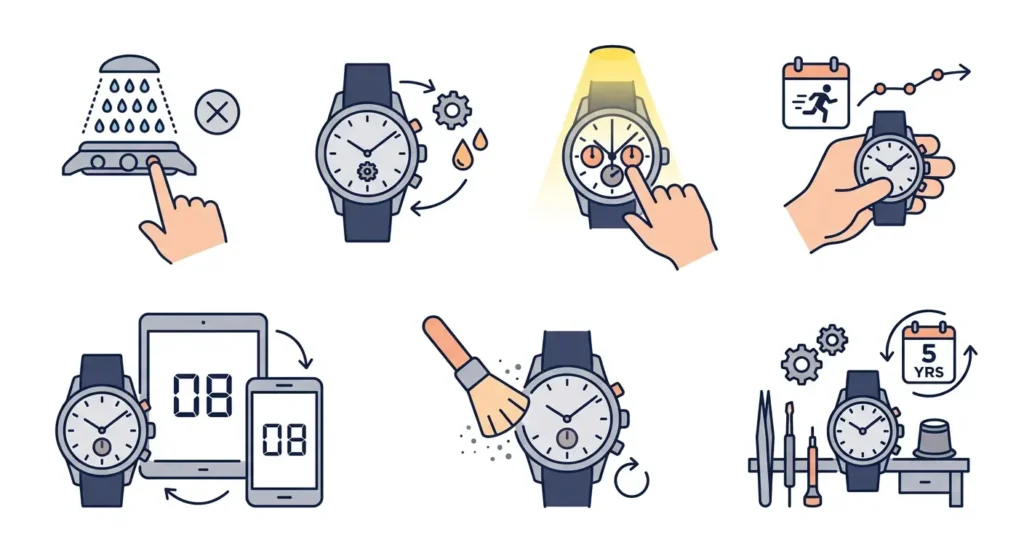
- Avoid operating chronograph pushers underwater unless the watch is specifically rated for this use
- Regular chronograph use actually benefits the movement by keeping lubricants distributed
- Practice reading the subdials in good lighting until it becomes second nature
- Keep track of when chronograph operation began if timing extends beyond visible subdial ranges
- Use the clock tab feature to compare your chronograph readings with digital time references
- Clean pushers gently with a soft brush to prevent dirt buildup that can affect operation
- Service the watch every 3-5 years to maintain chronograph accuracy and smooth pusher action
Pro Tip: The chronograph mechanism consumes more battery power in quartz watches and affects power reserve in automatic watches. For daily wear, consider leaving the chronograph stopped when not actively timing something to maximize power efficiency.
Caring for Your Chronograph Watch
Proper maintenance ensures long-term reliability and accuracy. Avoid pressing pushers when the crown is pulled out, as this can cause internal damage. Store the watch with the chronograph stopped to reduce wear on the mechanism. If the watch is water-resistant, ensure the crown and pushers are fully pressed in before exposure to water.
Mechanical chronographs require periodic servicing by qualified watchmakers. The chronograph module contains numerous small parts that need cleaning and lubrication. Quartz chronographs are generally more robust but still benefit from professional attention every few years. When comparing different timing methods, the world time comparison tool helps verify chronograph accuracy across various time zones.
Common Problems and Solutions
Chronograph Hand Doesn’t Return to Zero
If the chronograph hand stops slightly off the zero marker after resetting, the watch may need adjustment. Some models include a quick-set feature – pull the crown to the time-setting position and press one of the pushers to move the hand incrementally. For watches without this feature, professional adjustment is necessary.
Pushers Feel Stiff or Stuck
Stiff pushers usually indicate dirt accumulation or dried lubricant. Avoid forcing them, as this can break internal components. A professional cleaning typically resolves this issue. In the meantime, operate pushers gently and avoid using the chronograph until serviced.
Subdials Not Moving During Timing
When the central chronograph hand moves but subdials remain frozen, the chronograph clutch mechanism may have issues. This requires professional repair – continuing to use the chronograph in this state can cause additional damage. Stop using the timing function and consult a watchmaker.
Chronograph Runs Continuously
If the chronograph starts on its own or won’t stop when the pusher is pressed, the start/stop mechanism has likely failed. This drains power quickly and should be addressed immediately. For mechanical watches, this can also affect timekeeping accuracy.
Frequently Asked Questions
Can a chronograph watch be used as a regular watch?
Absolutely. A chronograph functions as a normal watch even when the timing feature isn’t in use. The chronograph complication is completely separate from regular timekeeping, so the watch displays hours, minutes, and seconds just like any standard timepiece. The chronograph hands remain stationary until activated.
How accurate is a chronograph watch for timing?
Most mechanical chronographs measure time in increments of 1/5 or 1/8 of a second, while quartz chronographs can measure down to 1/10 or even 1/100 of a second. For everyday timing needs – cooking, exercise, parking meters – this accuracy is more than sufficient. Professional-grade chronographs used in scientific or competitive settings offer even greater precision.
Does using the chronograph drain the battery faster?
Yes, in quartz watches, running the chronograph consumes additional battery power because it activates extra motors and circuits. The impact varies by model, but continuous chronograph use can reduce battery life by 30-50%. Mechanical automatic watches also see reduced power reserve when the chronograph runs, though the effect is less dramatic than with quartz movements.
What’s the difference between a chronograph and a chronometer?
These terms are often confused but mean entirely different things. A chronograph is a watch with stopwatch functionality for measuring elapsed time. A chronometer is any highly accurate timepiece that has been certified by an official testing institute (like COSC) to meet strict precision standards. A watch can be both a chronograph and a chronometer, but they refer to different features.
How long can a chronograph measure time continuously?
Most chronographs can run continuously for 12 hours before the hour counter completes a full rotation. Some models offer 24-hour counters. The limitation isn’t mechanical – chronographs could theoretically run indefinitely – but rather practical, as the subdials only display up to their maximum range before starting over.
Can chronograph pushers be pressed underwater?
This depends entirely on the watch’s specific design and water resistance rating. Most standard chronographs should not have pushers operated underwater, as this can allow water to enter the case. However, some dive chronographs are specifically engineered with sealed pushers that can be safely operated at depth. Always check the manufacturer’s specifications.
Why do some chronographs have two pushers and others have three?
Standard chronographs use two pushers – one for start/stop and one for reset. Models with three pushers typically feature additional complications like split-second timing (rattrapante), flyback functions, or pusher-controlled date adjustments. The extra pusher provides access to these advanced features without interfering with basic chronograph operation.
What should be done if the chronograph hand doesn’t align with zero?
Minor misalignment can often be corrected using the watch’s built-in adjustment feature. Pull the crown to the time-setting position and press the appropriate pusher to advance the chronograph hand to the correct zero position. If the watch lacks this feature or the misalignment is severe, a watchmaker needs to perform a mechanical adjustment.
Is it harmful to leave a chronograph running for extended periods?
While not immediately harmful, leaving a chronograph running continuously for days or weeks increases wear on the movement’s components. The chronograph mechanism wasn’t designed for perpetual operation – it’s meant for intermittent timing tasks. Extended use accelerates wear on pivots, springs, and friction points, potentially requiring more frequent servicing.
Do all chronograph watches have the same subdial layout?
No, subdial configurations vary significantly between manufacturers and models. Common layouts include the ‘3-6-9’ configuration (subdials at those hour positions), ‘6-9-12’ arrangement, and two-register designs. Some brands also use unconventional layouts like vertical subdials or asymmetric placements. Always consult the manual to understand the specific subdial functions on any chronograph.