

A guide to watch lume (tritium vs. Super-LumiNova) helps enthusiasts understand the two most popular luminescent materials used in modern timepieces. Watch lume technology allows dials and hands to glow in darkness, providing essential visibility for divers, pilots, military personnel, and everyday watch wearers. Choosing between tritium and Super-LumiNova depends on factors like brightness duration, maintenance needs, and longevity preferences.
Quick Summary Table
| Feature | Tritium | Super-LumiNova |
|---|---|---|
| Light Source | Self-luminous (radioactive gas) | Photoluminescent (needs charging) |
| Initial Brightness | Moderate | Very bright |
| Glow Duration | Constant for 10-20 years | Fades after 7-10 hours |
| Maintenance | None required | Requires light exposure |
| Safety | Minimal radiation (safe) | Non-radioactive |
| Lifespan | 25 years (half-life) | Indefinite with proper care |
Understanding Watch Lume Technology
Watch lume refers to luminous material applied to watch dials, hands, and hour markers that glows in low-light or dark conditions. This technology evolved from radium-based paints in the early 1900s to safer, more efficient materials used today. The primary purpose is ensuring time readability without external light sources, which proves critical in professional settings like diving, aviation, and military operations.
Modern watch lume falls into two main categories: self-luminous materials (tritium) and photoluminescent compounds (Super-LumiNova). Each technology operates on different principles and offers distinct advantages depending on usage patterns. Understanding these differences helps determine which option suits specific needs and lifestyle requirements. For those tracking time across different scenarios, tools like the world time comparison tool can complement watches with quality lume during travel.
What Is Tritium Lume
Tritium is a radioactive isotope of hydrogen that emits beta particles, causing phosphor materials to glow continuously without requiring external light. Watch manufacturers encase tritium gas in sealed glass tubes coated with phosphor, creating small capsules called gaseous tritium light sources (GTLS). These tubes are then applied to watch hands and dial markers.
The glow from tritium is constant and self-sustaining, requiring no charging from sunlight or artificial light. This makes tritium particularly valuable for individuals who work in environments with limited light exposure or need immediate visibility after extended periods in darkness. The radioactivity level is extremely low – about 25 milliCuries per watch – which poses no health risk under normal use.
Tritium Brightness and Longevity
Tritium provides a steady, moderate glow that remains consistent throughout the night. While not as initially bright as charged Super-LumiNova, tritium maintains the same luminosity level from dusk until dawn. The half-life of tritium is approximately 12.3 years, meaning the brightness reduces to half its original intensity after this period. Most tritium watches remain readable for 20-25 years before requiring replacement.
The color options for tritium include green, yellow, orange, blue, and white, with green typically appearing brightest to the human eye. Manufacturers like Ball Watch Company and Luminox specialize in tritium technology, offering watches with exceptional low-light visibility.
What Is Super-LumiNova
Super-LumiNova is a photoluminescent material manufactured by Swiss company RC Tritec (formerly Nemoto & Co.). Unlike tritium, Super-LumiNova contains no radioactive elements and instead stores energy from light exposure, then releases it as a visible glow in darkness. The material consists of strontium aluminate crystals mixed with rare earth elements.
This lume technology requires ‘charging’ through exposure to natural or artificial light. A few minutes under bright light can provide several hours of glow, with intensity gradually decreasing over time. Super-LumiNova replaced the earlier LumiNova formula and offers significantly improved brightness and duration compared to older phosphorescent materials.
Super-LumiNova Brightness and Duration
Super-LumiNova exhibits extremely bright initial glow when freshly charged – often 10 times brighter than tritium in the first moments of darkness. However, this brightness fades progressively, typically lasting 7-10 hours at visible levels. After the first hour, the intensity drops significantly, though the glow remains detectable throughout the night for most high-grade applications.
The material comes in various grades (Standard, Grade A, Grade B, Grade C) with higher grades offering longer glow duration and brightness. Color options include green, blue, and variants, with green and blue-green (BGW9) being most popular due to superior luminosity. Unlike tritium, Super-LumiNova does not degrade over time and maintains its charging capability indefinitely.
Comparing Tritium and Super-LumiNova
The choice between tritium and Super-LumiNova depends on specific usage requirements and personal preferences. Each technology excels in different scenarios, making neither universally superior to the other.
Brightness Comparison
Super-LumiNova wins in initial brightness when freshly charged. Stepping from bright daylight into darkness reveals an intensely glowing dial that clearly outshines tritium. This advantage lasts approximately 30-60 minutes before fading to levels comparable with tritium. For quick time checks during normal nighttime activities, Super-LumiNova provides excellent visibility.
Tritium offers consistent, moderate brightness throughout the entire night. While never as bright as freshly charged Super-LumiNova, tritium never dims or requires recharging. This proves advantageous for individuals working overnight shifts, military personnel on extended operations, or anyone needing reliable visibility after hours in complete darkness.
Maintenance and Convenience
Tritium requires zero maintenance. The watch glows automatically without any user intervention, making it ideal for those who keep watches in dark storage, rotate multiple timepieces, or work in low-light environments. The set-it-and-forget-it nature appeals to professionals who need guaranteed visibility regardless of prior light exposure.
Super-LumiNova demands regular light exposure to function properly. Watches stored in dark boxes or safes will not glow when retrieved. However, charging takes only minutes under any reasonably bright light source. For daily wear watches regularly exposed to daylight or indoor lighting, this requirement poses no practical inconvenience. Keeping a clock tab open can help track charging times when preparing watches for nighttime use.
Longevity and Aging
Super-LumiNova maintains its properties indefinitely. A 20-year-old watch with Super-LumiNova will charge and glow just as effectively as when new, assuming the material has not been damaged or contaminated. This longevity makes Super-LumiNova ideal for vintage watch restoration and long-term ownership.
Tritium degrades over time due to radioactive decay. After 12-15 years, the glow becomes noticeably dimmer, and after 20-25 years, it may become too faint for practical use. Replacing tritium requires professional service and can be expensive. Some collectors appreciate the vintage patina of aged tritium, while others prefer the permanent functionality of Super-LumiNova.
Choosing Between Tritium and Super-LumiNova
Selecting the appropriate lume technology requires evaluating usage patterns, professional needs, and personal priorities.
Best Use Cases for Tritium
- Military and tactical operations requiring immediate visibility without prior charging
- Professional diving in extended low-light underwater environments
- Emergency responders working unpredictable night shifts
- Watch collectors rotating multiple timepieces kept in dark storage
- Individuals working in environments with minimal light exposure
- Aviation professionals requiring constant cockpit visibility
Tritium excels when consistent, maintenance-free glow is prioritized over maximum initial brightness. The technology proves most valuable when watches might sit unused in darkness for days or weeks, then need immediate functionality upon retrieval.
Best Use Cases for Super-LumiNova
- Daily wear watches regularly exposed to ambient light
- Recreational diving with surface intervals for recharging
- General professional use with normal day-night cycles
- Vintage watch restoration requiring period-correct appearance without radioactivity
- Collectors prioritizing long-term value and permanent functionality
- Situations requiring maximum initial brightness for quick time checks
Super-LumiNova suits the majority of watch enthusiasts who wear their timepieces regularly and have normal exposure to light. The superior initial brightness and permanent properties make it the practical choice for most applications.
Identifying Tritium vs. Super-LumiNova on Watches
Distinguishing between these technologies helps when purchasing vintage or used watches, or verifying authenticity.
Method 1: Check the Dial Markings
Watches containing tritium typically display one of these markings on the dial:
- ‘T Swiss T’ or ‘T Swiss Made T’ at the 6 o’clock position
- ‘T25’ indicating 25 milliCuries of tritium
- ‘T<25’ indicating less than 25 milliCuries
- Small ‘T’ symbols near the Swiss Made text
Super-LumiNova watches show no special radiation markings, typically displaying only ‘Swiss Made’ or manufacturer-specific text. Some brands explicitly state ‘Super-LumiNova’ in their specifications or marketing materials.
Method 2: Observe the Glow Pattern
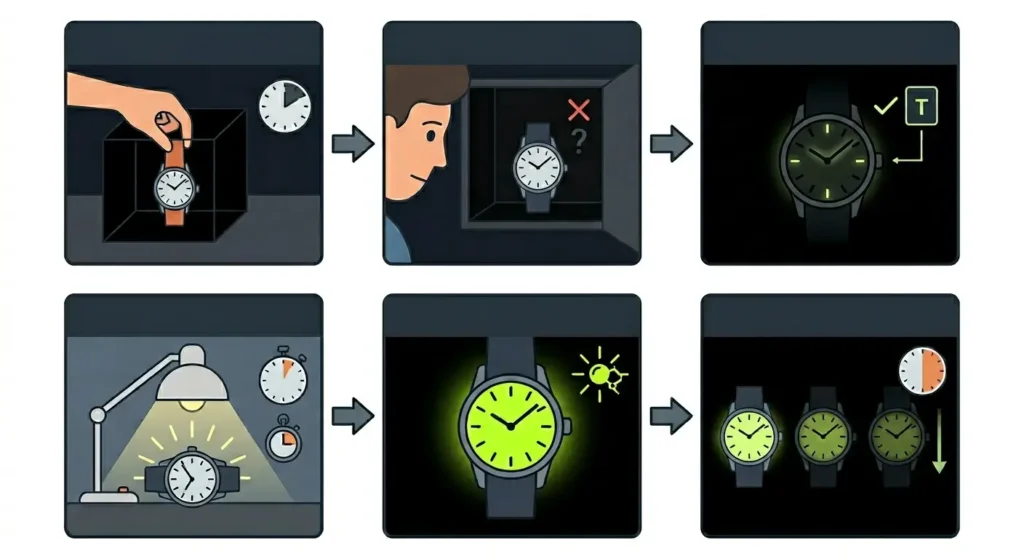
Testing the glow characteristics reveals the lume type:
- Step 1: Place the watch in complete darkness without prior light exposure for at least 2 hours
- Step 2: Check if the watch glows immediately upon entering the dark room
- Step 3: If it glows without charging, the watch contains tritium
- Step 4: If no glow appears, expose the watch to bright light for 5 minutes
- Step 5: Return to darkness and observe – Super-LumiNova will glow very brightly initially
- Step 6: Monitor the glow over 30 minutes – Super-LumiNova fades noticeably, tritium remains constant
This practical test reliably identifies the lume technology based on behavioral characteristics. Using an online stopwatch helps time the charging and observation periods accurately.
Method 3: Check the Manufacturing Date
Historical context provides clues:
- Watches made before 1998 typically use tritium or older radioactive materials
- Watches manufactured 1998-present increasingly use Super-LumiNova
- Some brands like Ball and Luminox continue using tritium exclusively
- Swiss watches from the 1960s-1990s predominantly feature tritium
Manufacturing dates combined with brand policies help narrow down the lume type, though verification through observation or documentation remains most reliable.
Tips for Maximizing Watch Lume Performance
Proper care ensures optimal luminescence regardless of technology type.
For Super-LumiNova Watches
- Expose the watch to bright light for 5-10 minutes before anticipated nighttime use
- Natural sunlight charges more effectively than most artificial lighting
- LED and fluorescent lights work well for charging; incandescent bulbs are less effective
- UV light sources provide the most efficient charging but are not necessary
- Avoid storing Super-LumiNova watches in completely dark environments for extended periods
- Clean the crystal regularly to ensure maximum light transmission to the lume
Pro Tip: Place Super-LumiNova watches near a window during the day for passive charging. Even indirect daylight provides sufficient energy for excellent nighttime visibility without requiring dedicated charging sessions.
For Tritium Watches
- Keep the crystal clean to maximize visibility of the moderate glow
- Understand that brightness will decrease by approximately 50% every 12 years
- Avoid exposing tritium tubes to impacts that could crack the sealed capsules
- Consider professional relumination after 20-25 years when glow becomes too faint
- Store tritium watches normally – darkness does not affect performance
- Verify tritium integrity during regular service intervals
General Lume Care
- Avoid chemical exposure that could degrade or discolor lume material
- Protect watches from extreme temperatures which may affect lume properties
- Do not attempt to remove or reapply lume material without professional expertise
- Keep sapphire or mineral crystals scratch-free for optimal light transmission
- Service watches regularly to prevent moisture damage to lume applications
Common Problems and Troubleshooting
Understanding typical issues helps maintain optimal lume performance and identify when professional service is needed.
Fix 1: Weak or No Glow on Super-LumiNova
When Super-LumiNova appears dim or fails to glow:
- Step 1: Verify the watch has been adequately charged with bright light for at least 10 minutes
- Step 2: Test different light sources – try direct sunlight or a bright LED flashlight
- Step 3: Clean the watch crystal thoroughly to remove any film blocking light
- Step 4: Check if moisture has entered the case and clouded the crystal from inside
- Step 5: Examine the lume under magnification for discoloration or contamination
- Step 6: If issues persist after proper charging, consult a professional watchmaker
Super-LumiNova rarely fails completely unless damaged by moisture, chemicals, or physical trauma. Apparent weakness usually stems from insufficient charging or dirty crystals blocking light.
Fix 2: Tritium Glow Fading Over Time
Tritium naturally loses brightness through radioactive decay:
- Step 1: Determine the watch age – tritium dims approximately 50% every 12 years
- Step 2: Compare current glow to similar-aged tritium watches to establish if fading is normal
- Step 3: Check for physical damage to tritium tubes that could cause premature failure
- Step 4: Verify the crystal is clean and not reducing perceived brightness
- Step 5: Consider professional relumination if the watch is 20+ years old
- Step 6: Research authorized service centers for proper tritium replacement
Normal tritium aging is irreversible without replacement. Watches older than 15-20 years showing significant dimming are experiencing expected degradation rather than a fixable problem.
Fix 3: Uneven Lume Application or Color Mismatch
Sometimes lume appears inconsistent across dial elements:
- Step 1: Determine if the issue exists across all markers or only specific ones
- Step 2: Check if the watch has undergone service where lume may have been reapplied
- Step 3: Examine for aftermarket hands or markers with different lume types
- Step 4: Assess whether color variation is intentional design versus damage
- Step 5: Consult with the manufacturer or authorized dealer for verification
- Step 6: Consider professional relumination for consistency if authenticity is confirmed
Mixing tritium and Super-LumiNova on the same watch creates obvious differences in glow behavior. Color mismatches often indicate replacement parts or service work using different lume batches.
Fix 4: Lume Discoloration or Yellowing
Aged lume sometimes changes color:
- Step 1: Identify if discoloration affects the lume material itself or surrounding dial paint
- Step 2: Understand that vintage tritium often develops cream or yellow patina over decades
- Step 3: Check for moisture damage which causes milky or cloudy appearance
- Step 4: Evaluate if discoloration impacts functionality or only aesthetics
- Step 5: Research if the patina is desirable for vintage collector value
- Step 6: Decide between preserving original aged lume or professional restoration
Pro Tip: Tritium patina is often valued by collectors as proof of authenticity and age. Before pursuing restoration, research the specific watch model to determine if aged lume increases or decreases market value.
Frequently Asked Questions
Is tritium dangerous in watches?
Tritium in watches poses no health risk under normal use. The sealed glass tubes contain minimal radioactivity (typically 25 milliCuries), emit only weak beta particles that cannot penetrate the watch case or human skin, and are regulated as safe by international standards. Even if a tube breaks, the tiny amount of tritium gas disperses harmlessly into the atmosphere.
How long does Super-LumiNova glow?
Super-LumiNova glows very brightly for the first 30-60 minutes after charging, then gradually fades over 7-10 hours. Higher grades (B and C) last longer than standard grades. While technically still emitting light after 10 hours, the glow becomes too faint for practical time reading. Recharging for just a few minutes restores full brightness.
Can Super-LumiNova lose its ability to glow over time?
Super-LumiNova maintains its charging and glowing properties indefinitely when properly cared for. Unlike tritium which decays, the photoluminescent crystals do not degrade with age. However, contamination from moisture, chemicals, or physical damage can reduce effectiveness. Properly sealed and maintained Super-LumiNova functions identically after decades of use.
Which is brighter – tritium or Super-LumiNova?
Super-LumiNova is significantly brighter immediately after charging, often 10 times more luminous than tritium. However, this brightness fades within the first hour. Tritium maintains constant moderate brightness throughout the night. For quick nighttime checks, Super-LumiNova wins. For consistent all-night visibility, tritium proves more reliable.
Do modern watches still use tritium?
Yes, certain brands continue using tritium despite the availability of Super-LumiNova. Ball Watch Company, Luminox, Traser, and Marathon specialize in tritium technology, marketing it as a premium feature for professional and military applications. However, the majority of modern watches from mainstream brands use Super-LumiNova due to its brightness, longevity, and non-radioactive properties.
How do I charge Super-LumiNova most effectively?
Direct sunlight provides the most effective charging, requiring just 5-10 minutes for maximum glow. Bright LED or fluorescent lights work well, needing 10-15 minutes. UV light sources charge most efficiently but are not necessary for good performance. Hold the watch dial-up toward the light source at close range for optimal energy absorption. Even indirect daylight through windows charges adequately during normal daily wear.
Can tritium be replaced when it gets too dim?
Yes, professional watchmakers can replace tritium tubes or reapply tritium paint during service. This process requires removing old tritium, cleaning the hands and dial, and applying fresh tritium tubes or paint. The service must be performed by authorized facilities equipped to handle radioactive materials. Costs vary but typically range from several hundred to over a thousand dollars depending on watch complexity.
Why does my watch have both T Swiss T and glow very brightly when charged?
Some vintage watches underwent service where hands or dial markers were replaced with Super-LumiNova while retaining the original dial with tritium markings. This creates a mismatch where the dial states tritium content but the actual lume behaves like Super-LumiNova. Alternatively, some transitional period watches mixed both technologies. Authentication by a specialist confirms the actual materials present.
Does Super-LumiNova come in different colors?
Yes, Super-LumiNova is available in multiple colors including green (most common and brightest), blue, blue-green (BGW9), white, orange, and others. Green and blue-green variants typically provide the longest and brightest glow due to human eye sensitivity to those wavelengths. Some watches use different colors for hands versus markers to improve differentiation in darkness.
Which lume type is better for diving watches?
Both work excellently for diving but suit different diving styles. Tritium excels for technical diving, cave diving, or extended deep dives where no surface light charging occurs and constant visibility is critical. Super-LumiNova works perfectly for recreational diving with surface intervals, providing extremely bright initial glow and easy recharging between dives. Professional dive watches often use Super-LumiNova due to superior brightness and permanent properties.
Conclusion
Understanding the differences between tritium and Super-LumiNova allows informed decisions when selecting watches for specific needs. Tritium offers maintenance-free, constant glow ideal for professional applications requiring guaranteed visibility without charging. Super-LumiNova provides superior initial brightness, permanent functionality, and practical performance for daily wear watches with regular light exposure. Neither technology is universally superior – the best choice depends on individual usage patterns, professional requirements, and personal priorities regarding brightness, longevity, and convenience.