

Watch complications are any feature on a timepiece beyond the basic display of hours and minutes. These mechanical or electronic additions transform a simple watch into a sophisticated instrument, offering functions like chronographs, moon phases, perpetual calendars, and more. Understanding watch complications helps enthusiasts appreciate the craftsmanship and functionality that make luxury watches valuable investments.
Quick Summary: Essential Watch Complications
- Date Complication: Displays current date, most common type
- Chronograph: Built-in stopwatch function for timing events
- Moon Phase: Tracks lunar cycle with visual display
- GMT/Dual Time: Shows time in multiple time zones simultaneously
- Power Reserve Indicator: Displays remaining energy in automatic watches
- Perpetual Calendar: Automatically adjusts for varying month lengths and leap years
- Tourbillon: Counteracts gravity effects for improved accuracy
Understanding Watch Complications: The Basics
The term ‘complication’ originates from the horological world, referring to any mechanism that adds complexity beyond simple timekeeping. Watchmakers consider these features demonstrations of technical mastery, with some timepieces containing dozens of complications working in harmony. The more complications a watch contains, the more intricate its movement becomes, often requiring hundreds or thousands of tiny components.
These additional functions serve both practical and aesthetic purposes. While modern smartwatches can replicate many complications digitally, mechanical versions remain highly valued for their craftsmanship, engineering precision, and timeless appeal. Traditional watchmaking treats each complication as an art form, with master watchmakers spending years perfecting single mechanisms.
Step-by-Step Guide to Common Watch Complications
Date Display Complication
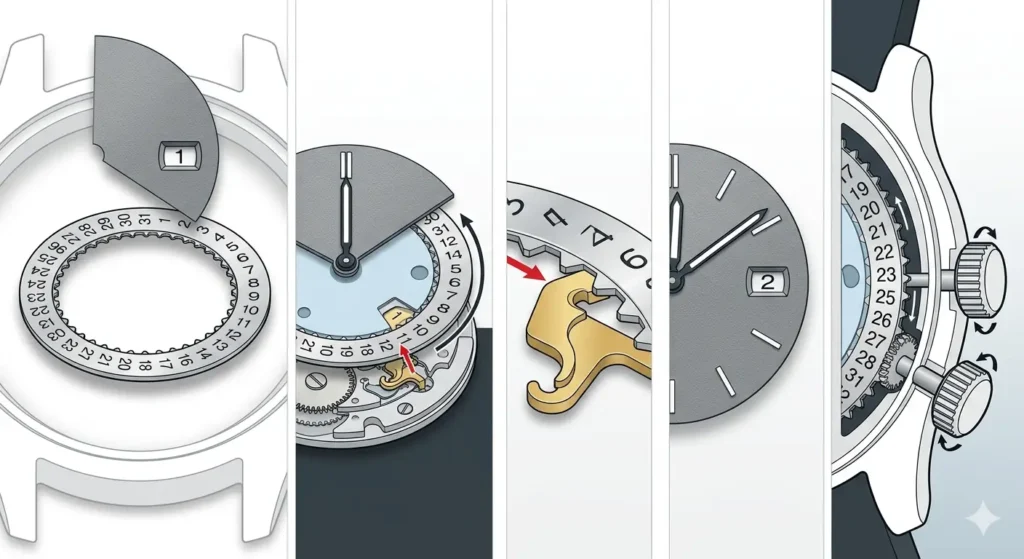
The date complication stands as the most widespread additional function found in watches. This mechanism displays the current date through a small window (often called a cyclops) on the dial, typically positioned at 3 o’clock, 6 o’clock, or 12 o’clock.
How It Works:
- Step 1: A date wheel with numbers 1-31 sits beneath the dial
- Step 2: The watch movement advances this wheel once every 24 hours at midnight
- Step 3: A small finger or lever engages with the date wheel teeth, pushing it forward one position
- Step 4: The current date appears through the date window on the dial
- Step 5: Manual adjustment using the crown corrects the date after months with fewer than 31 days
Most date complications require manual correction five times per year for months with 30 days or fewer. This limitation disappears with more advanced calendar complications like annual or perpetual calendars.
Chronograph Complication
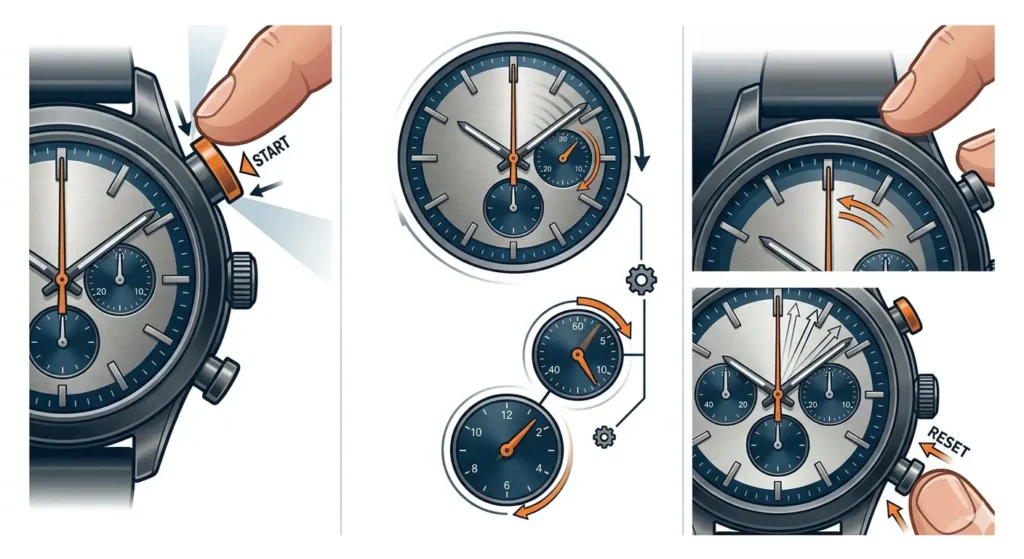
A chronograph functions as an integrated stopwatch within the watch mechanism. This complication remains incredibly popular among sports enthusiasts, pilots, and anyone needing precise timing capabilities. The name derives from Greek words meaning ‘time’ and ‘writing,’ originally referring to mechanisms that recorded elapsed time.
How It Works:
- Step 1: Press the top pusher (usually at 2 o’clock) to start the chronograph hand
- Step 2: The central chronograph seconds hand begins sweeping around the dial
- Step 3: Sub-dials track elapsed minutes and hours simultaneously
- Step 4: Press the same pusher again to stop timing
- Step 5: Press the bottom pusher (typically at 4 o’clock) to reset all chronograph hands to zero
Advanced chronographs offer split-seconds (rattrapante) functionality, allowing measurement of multiple events starting simultaneously but finishing at different times. This requires an additional hand that can be stopped independently while the main chronograph continues running.
Moon Phase Complication
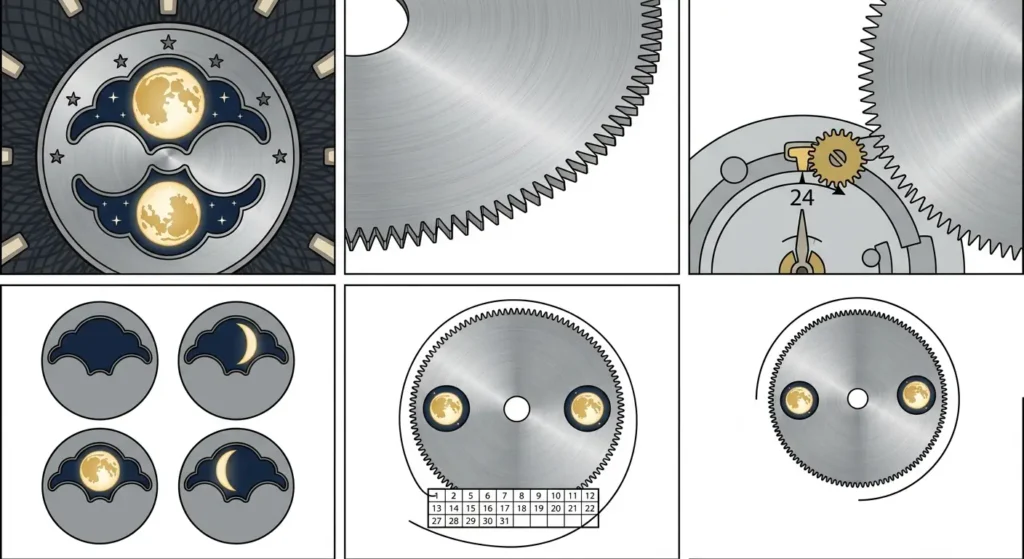
The moon phase complication displays the current lunar cycle through a rotating disc showing the moon’s illuminated portion. This romantic and visually striking complication originally served practical purposes for farmers, sailors, and fishermen who relied on lunar cycles. When planning activities across different time zones, tools like the world time comparison tool help coordinate schedules alongside moon phase tracking.
How It Works:
- Step 1: A disc with two moon images rotates beneath an aperture shaped like clouds or stars
- Step 2: The disc contains 59 teeth (representing the 29.5-day lunar cycle doubled)
- Step 3: Every 24 hours, a small finger advances the disc by one tooth
- Step 4: The visible portion shows the current moon phase: new, waxing, full, or waning
- Step 5: The cycle completes every 29.5 days, matching the actual lunar month
High-precision moon phases can maintain accuracy for 122 years before requiring adjustment of just one day. Standard moon phases need correction approximately every 2.5 years.
GMT and Dual Time Complications
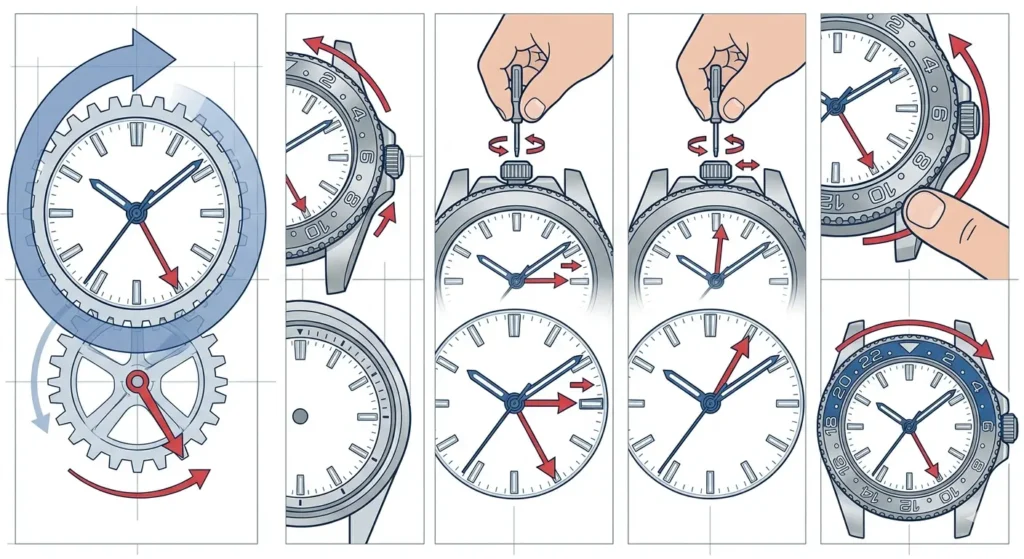
GMT (Greenwich Mean Time) complications allow tracking of multiple time zones simultaneously, essential for frequent travelers and international professionals. Originally developed for Pan Am pilots in the 1950s, these complications remain incredibly relevant in the connected world.
How It Works:
- Step 1: An additional hour hand makes one complete rotation every 24 hours
- Step 2: A rotating bezel or fixed 24-hour scale surrounds the dial
- Step 3: Set local time using the standard hour and minute hands
- Step 4: Set the GMT hand to reference time (usually home time zone)
- Step 5: Rotate the bezel to track a third time zone when needed
True GMT movements allow independent adjustment of the local hour hand without stopping the watch. This differs from ‘caller’ or ‘traveler’ complications where the 24-hour hand adjusts instead.
Power Reserve Indicator
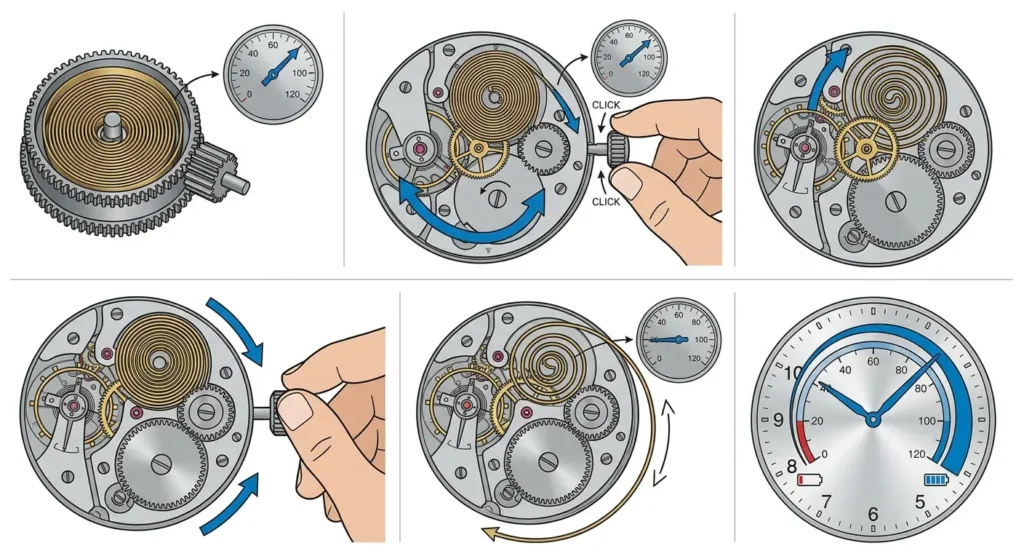
This practical complication displays how much energy remains in an automatic or manual-wind watch before it stops running. The indicator helps owners maintain consistent operation by showing when winding becomes necessary.
How It Works:
- Step 1: A small gauge on the dial connects to the mainspring barrel
- Step 2: As the mainspring winds, the indicator hand moves toward the maximum position
- Step 3: The mainspring gradually unwinds during operation, powering the watch
- Step 4: The indicator hand moves back toward zero as power depletes
- Step 5: The display shows remaining runtime, typically ranging from 40 to 120 hours
Some high-end watches feature power reserves exceeding 7 days, with indicators showing daily segments rather than hour-by-hour depletion.
Perpetual Calendar Complication
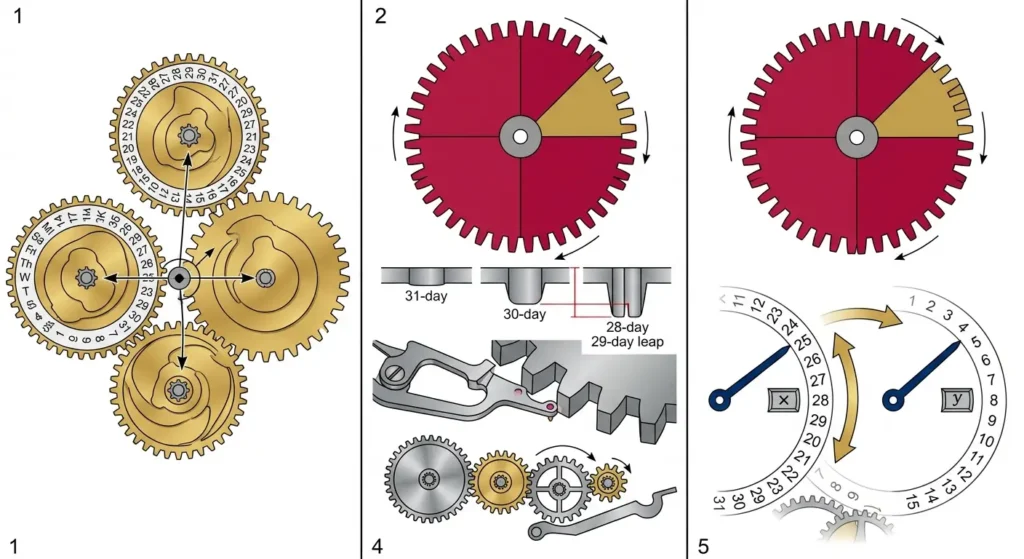
The perpetual calendar represents one of the most sophisticated complications in traditional watchmaking. This mechanism automatically accounts for varying month lengths and leap years, requiring no manual date adjustment until the year 2100 (when the Gregorian calendar skips a leap year).
How It Works:
- Step 1: Multiple cam systems track day, date, month, and leap year cycle
- Step 2: A 48-month (4-year) cam determines leap year positioning
- Step 3: Month cams with varying depths correspond to 28, 29, 30, or 31-day months
- Step 4: Sensing levers read the cam depths and adjust date advancement accordingly
- Step 5: The mechanism automatically transitions from month-end to the first, regardless of duration
Perpetual calendars often display additional information like day of the week, month, moon phase, and year. Some high-complication watches combine perpetual calendars with chronographs, creating ‘grand complications.’
Pro Tip: Never adjust any calendar complication between 8 PM and 4 AM. During this period, the date-change mechanism engages, and manual adjustment can damage delicate gears. Always move the time forward past 6 AM before making calendar corrections.
Tourbillon Complication
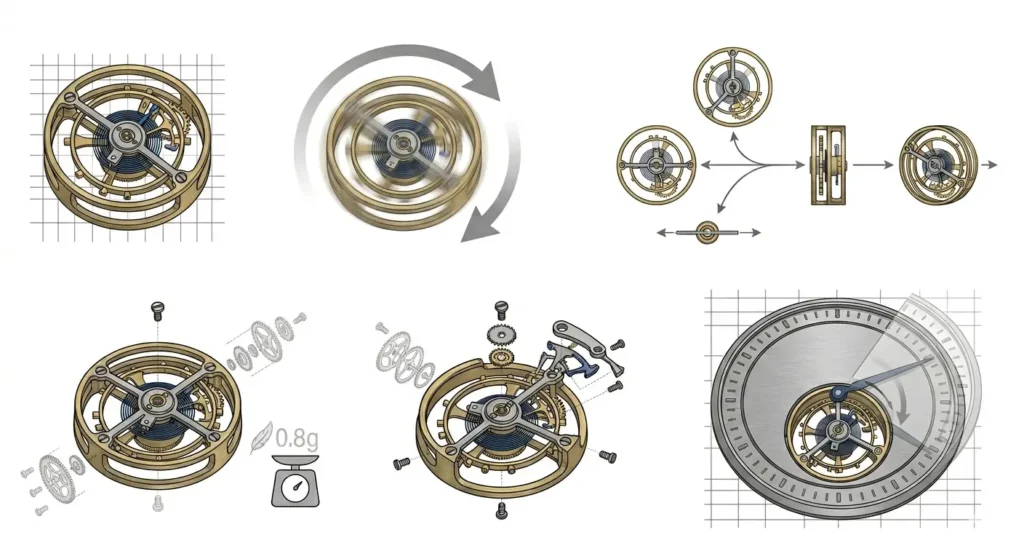
The tourbillon represents the pinnacle of watchmaking artistry, designed to counteract gravity’s effects on accuracy. Abraham-Louis Breguet invented this mesmerizing complication in 1795 for pocket watches, which spent most of their time in vertical positions.
How It Works:
- Step 1: The escapement and balance wheel mount inside a rotating cage
- Step 2: This cage completes one full rotation every 60 seconds (typically)
- Step 3: Continuous rotation averages out positional errors caused by gravity
- Step 4: The entire assembly weighs less than one gram despite containing dozens of parts
- Step 5: The rotation itself often serves as the seconds hand on the dial
Modern wristwatches move through varied positions throughout the day, making tourbillons more decorative than functional for accuracy. However, they remain highly valued for demonstrating exceptional craftsmanship and mechanical beauty.
Tips for Choosing the Right Complications
Selecting appropriate complications depends on lifestyle, needs, and appreciation for mechanical artistry. Here are practical considerations for different users:
- Frequent Travelers: Prioritize GMT or dual-time complications for tracking home and local time zones. Consider adding a date display for practical daily reference.
- Sports Enthusiasts: Chronograph complications offer versatility for timing workouts, laps, or events. Look for water resistance if participating in water sports.
- Collectors: Moon phases, annual calendars, or perpetual calendars provide visual interest and demonstrate mechanical complexity without daily interaction requirements.
- Daily Wearers: Simple date complications with power reserve indicators balance functionality and maintenance simplicity. These require minimal adjustment and serve everyday needs.
- Professionals: Date displays remain essential for business settings. Add world time or GMT complications for international work. For those managing global schedules, the clock tab complements mechanical watches by providing quick digital references.
Consider maintenance requirements when selecting complications. More complex mechanisms require specialized servicing every 3-5 years, with costs increasing proportionally to complication count. Simple three-hand watches with date complications cost significantly less to service than perpetual calendars or tourbillons.
Budget plays a crucial role in complication selection. Entry-level chronographs start around several hundred dollars, while perpetual calendars and tourbillons enter five or six-figure price ranges. Annual calendars offer middle-ground options, providing most perpetual calendar benefits at reduced complexity and cost.
Common Problems and Troubleshooting
Date Changes at Noon Instead of Midnight
This common issue occurs when the watch’s 12-hour cycle becomes misaligned with the AM/PM cycle. The date mechanism triggers every 12 hours, so incorrect timing setting causes midday date changes.
Solution: Pull the crown to the time-setting position and advance the hands by exactly 12 hours. The date should jump forward during this process. Once the date advances, continue setting the correct time. This realigns the date-change mechanism with the proper 24-hour cycle.
Chronograph Hand Won’t Return to Zero
When chronograph hands fail to reset completely to the zero position, magnetic interference or impact damage typically causes misalignment. Sometimes, internal dust or dried lubricant creates friction preventing smooth operation.
Solution: First, demagnetize the watch using a demagnetizer tool, available at most watchmakers or online. If magnetism isn’t the cause, the movement requires professional service to realign the chronograph mechanism or replace damaged components. Avoid forcing the reset function repeatedly, as this can cause additional damage.
Moon Phase Display Inaccurate
Moon phase complications drift from accuracy over time, especially lower-precision models with 59-tooth gearing. The actual lunar cycle measures 29.53059 days, while standard moon phases approximate 29.5 days, creating gradual deviation.
Solution: Consult an almanac or moon phase calendar to determine the current actual moon phase. Use the watch’s adjustment pusher (often recessed in the case side) to advance the moon disc until it matches the current phase. Most watches require a thin pin or dedicated tool for this adjustment. High-precision moon phases maintain accuracy for decades, while standard versions need correction every 2-3 years.
Perpetual Calendar Stopped Working Correctly
Perpetual calendars require continuous operation to maintain accuracy. If the watch stops completely and then restarts, the calendar mechanism loses its position within the 4-year leap year cycle, causing incorrect date displays.
Solution: Perpetual calendar adjustments require professional expertise. Taking the watch to an authorized service center ensures proper resetting without damaging delicate mechanisms. Preventing this issue involves keeping the watch wound continuously, either through daily wear or using a quality watch winder programmed with appropriate turns per day. When timing precision matters during critical periods, tools like an online stopwatch provide reliable backup timing functions.
Pro Tip: Invest in a quality watch winder for complicated automatic watches. This device keeps perpetual calendars, annual calendars, and GMT watches running continuously, preventing the need for complex resetting procedures and maintaining accuracy. Choose winders with adjustable turns per day (TPD) matching the manufacturer’s specifications.
Power Reserve Depletes Faster Than Indicated
When actual runtime falls significantly short of the power reserve indicator’s promise, mainspring issues, excessive friction, or magnetization typically cause increased power consumption.
Solution: First, verify the watch receives adequate winding. Automatic watches require sufficient wrist movement—sedentary lifestyles may not provide enough motion. Manual-wind watches need complete winding until resistance increases. If proper winding doesn’t resolve the issue, the movement requires professional servicing to address friction points, replace worn lubricants, or demagnetize components.
Frequently Asked Questions
What is the difference between a complication and a function?
In watchmaking terminology, ‘complication’ and ‘function’ are essentially synonymous, both referring to any feature beyond basic hour and minute display. However, purists sometimes reserve ‘complication’ for mechanical implementations, using ‘function’ for both mechanical and electronic features. Traditional horology recognizes any additional mechanism—whether simple date display or complex minute repeater—as a complication.
Do watch complications affect accuracy?
Complications can influence accuracy depending on their complexity and implementation quality. Simple complications like date displays have minimal impact, while complex mechanisms like perpetual calendars or tourbillons add weight and friction that can affect timekeeping. However, well-engineered complications in quality watches maintain excellent accuracy, with proper servicing ensuring optimal performance. The watchmaker’s skill in implementation matters more than complication count.
How often do complicated watches need servicing?
Complicated watches typically require servicing every 3-5 years, with more complex pieces sometimes needing attention every 2-3 years. Simple three-hand watches with date complications can extend to 5-7 years between services. Chronographs, annual calendars, and perpetual calendars contain more parts experiencing wear, necessitating more frequent maintenance. Regular servicing includes cleaning, lubrication, adjustment, and replacement of worn components to maintain accuracy and longevity.
Can complications be added to existing watches?
Adding complications to existing watches proves extremely difficult and economically impractical in most cases. Complications require specific movement architecture, gear trains, and dial layouts designed during initial manufacture. While some modular movements allow swapping base calibers with more complicated variants, this essentially means replacing the entire movement. Custom watchmakers can create bespoke complications, but costs typically exceed purchasing a new complicated watch.
What is the most useful watch complication?
The date complication ranks as the most universally useful addition, providing daily practical value for nearly everyone. For travelers, GMT or dual-time complications offer significant utility by tracking multiple time zones simultaneously. Chronographs serve specific needs for timing events, workouts, or professional applications. The ‘most useful’ complication ultimately depends on individual lifestyle and requirements rather than objective superiority.
Why are complicated watches so expensive?
Complicated watches command high prices due to extensive hand assembly, specialized expertise, rare materials, and limited production capabilities. Manufacturing perpetual calendars or tourbillons requires master watchmakers with years of training, often spending weeks assembling single movements. Research and development costs for new complications span years or decades. Additionally, complications contain hundreds of tiny parts requiring precision manufacturing tolerances measured in microns, driving up production costs significantly.
Do all complications need manual adjustment?
Most complications require some manual adjustment eventually. Simple date complications need correction five times yearly after 30-day months. Annual calendars require adjustment once per year in February. Only perpetual calendars and some high-precision moon phases operate without manual adjustment for extended periods—perpetual calendars until 2100 and precision moon phases for decades. GMT complications need resetting when traveling between time zones, while chronographs require manual operation each use.
What is a ‘grand complication’ watch?
Traditional watchmaking defines a grand complication as any timepiece combining at least three major complications from different categories: timekeeping (minute repeater, chronograph), astronomical (perpetual calendar, equation of time), or other complex functions (tourbillon, split-seconds). Modern usage sometimes applies this term more loosely to any highly complicated watch. Classic grand complications combine minute repeater, perpetual calendar, and split-seconds chronograph, representing the pinnacle of horological achievement.
Can complications break easily?
Complications vary in fragility depending on complexity and construction quality. Date complications prove quite robust in well-made watches, while delicate mechanisms like tourbillons or minute repeaters require careful handling. Impact damage poses the greatest risk, particularly for chronographs with exposed pushers and perpetual calendars with thin lever mechanisms. Quality construction with proper shock protection minimizes breakage risk. Avoiding impacts, keeping watches away from magnetic fields, and following manufacturer guidelines for adjustment prevents most complication damage.
Are automatic watch complications more reliable than manual-wind complications?
Reliability depends more on construction quality and maintenance than winding method. Both automatic and manual-wind complications can achieve excellent reliability when properly manufactured and serviced. Automatic movements add rotor mechanisms that can experience wear, but eliminate the need for daily manual winding. Manual-wind movements offer simpler construction with fewer parts, potentially reducing failure points. Either type delivers exceptional reliability when sourced from reputable manufacturers and maintained according to specifications.