When working with international scheduling systems and coordinating across time zones, I’ve found that understanding military time becomes essential rather than optional. The 24-hour clock system eliminates the ambiguity of AM and PM designations, which has saved me from countless scheduling mishaps over the years.
Military time, also known as the 24-hour clock format, represents time as a continuous count from 0000 (midnight) to 2359 (one minute before the next midnight). After testing various time management systems across different professional environments, I’ve discovered that this format significantly reduces confusion in time-critical operations.
Understanding the 24-Hour Clock System
The military time system operates on a straightforward principle: hours run from 00 to 23, eliminating the need for AM and PM indicators. From midnight to noon, the conversion is simple—0100 hours equals 1:00 AM, 0600 hours equals 6:00 AM, and so forth. The complexity arises in the afternoon and evening hours, where 1300 hours represents 1:00 PM, requiring a mental subtraction of 12 to convert to standard time.
During my years coordinating international projects, I’ve noticed that the transition from 12-hour to 24-hour format initially challenges most people around the 1300-1700 hour range. The morning hours feel intuitive because they mirror standard time closely, but afternoon conversions require practice. I’ve developed a quick mental trick: for any military time above 1200, subtract 12 and add PM. For instance, 1545 becomes 3:45 PM (15 minus 12 equals 3).
The system’s precision extends to minutes, which remain consistent across both formats. Whether you’re reading 0930 or 2130, the “30” always represents 30 minutes past the hour. This consistency has proven invaluable when I’m checking current local times around the world for international meetings.
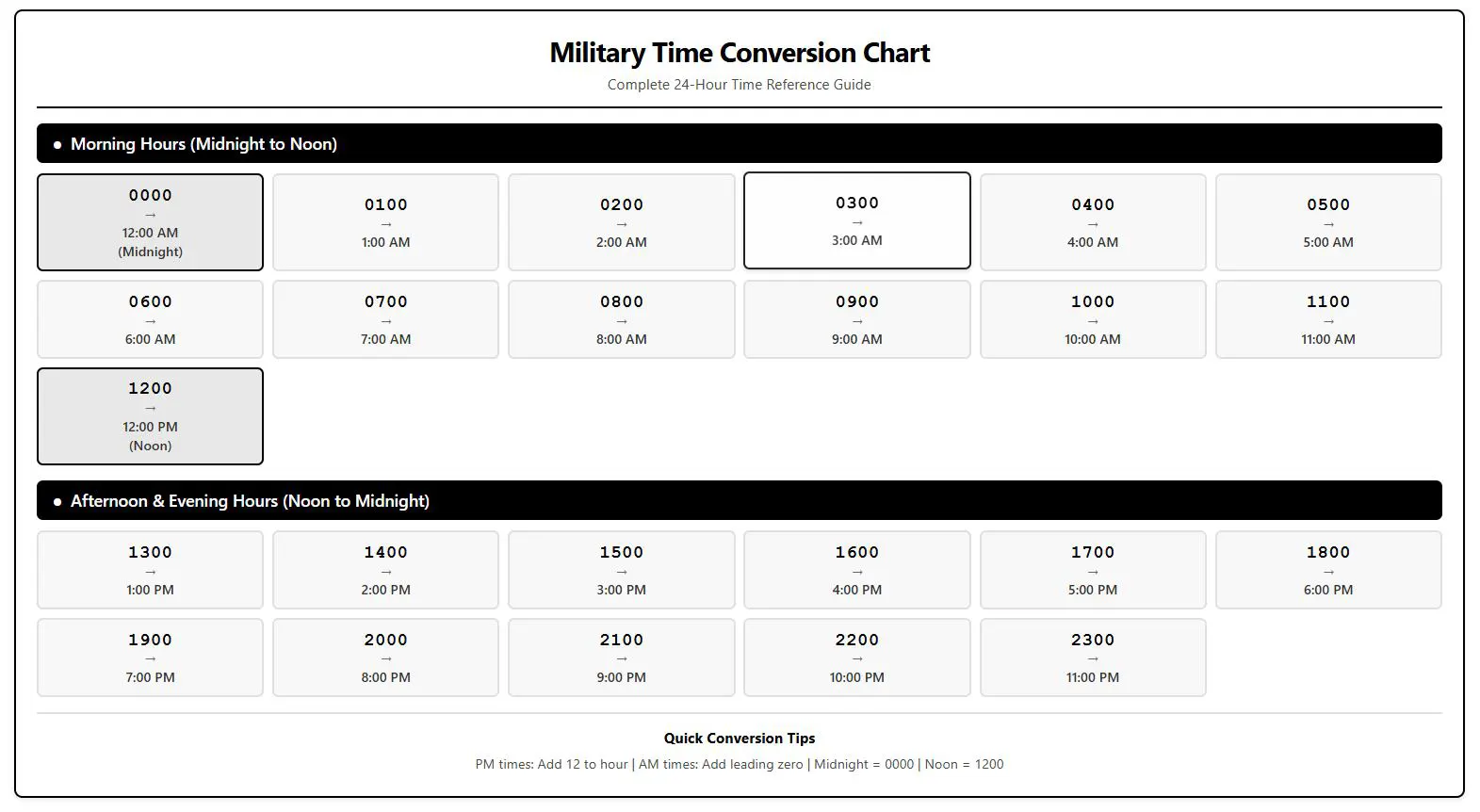
Complete Military Time Conversion Chart
Morning Hours (Midnight to Noon)
- 0000 = 12:00 AM (Midnight)
- 0100 = 1:00 AM
- 0200 = 2:00 AM
- 0300 = 3:00 AM
- 0400 = 4:00 AM
- 0500 = 5:00 AM
- 0600 = 6:00 AM
- 0700 = 7:00 AM
- 0800 = 8:00 AM
- 0900 = 9:00 AM
- 1000 = 10:00 AM
- 1100 = 11:00 AM
- 1200 = 12:00 PM (Noon)
Afternoon and Evening Hours (Noon to Midnight)
- 1300 = 1:00 PM
- 1400 = 2:00 PM
- 1500 = 3:00 PM
- 1600 = 4:00 PM
- 1700 = 5:00 PM
- 1800 = 6:00 PM
- 1900 = 7:00 PM
- 2000 = 8:00 PM
- 2100 = 9:00 PM
- 2200 = 10:00 PM
- 2300 = 11:00 PM
Understanding these conversions becomes second nature with regular use. I’ve found that professionals who frequently work with military time can convert instantly without referring to charts, but keeping a reference handy during the learning phase accelerates proficiency.
Practical Applications in Professional Settings
Military time appears extensively in healthcare, aviation, emergency services, logistics, and international business. In medical environments, I’ve observed that using 24-hour time prevents potentially fatal medication errors. When a prescription reads “administer at 1800 hours,” there’s zero ambiguity about whether that means 6:00 in the morning or evening.
Aviation relies heavily on military time for flight schedules and air traffic control communications. After working with airline scheduling systems, I’ve seen how this standardization prevents confusion across different time zones. A flight departing at 1445 hours leaves no room for interpretation, regardless of which country you’re departing from or arriving in.
The logistics industry has embraced military time for shipping schedules and delivery windows. When coordinating freight deliveries, I’ve appreciated how military time creates clear expectations. A delivery window of 0800-1600 hours communicates precisely eight working hours without the awkward “8 AM to 4 PM” phrasing.
Converting Military Time: Step-by-Step Methods
For hours 0000-1159, conversion to standard time is straightforward. Simply read the first two digits as the hour and the last two as minutes, adding AM. The exception is 0000, which represents midnight and converts to 12:00 AM.
For hours 1200-2359, the process requires subtraction. Take the first two digits, subtract 12, and add PM to create standard time. For example, 1845 becomes 6:45 PM (18 minus 12 equals 6, plus the 45 minutes). I’ve taught this method to numerous colleagues, and most achieve fluency within a week of regular practice.
When writing military time, professionals typically include leading zeros for morning hours (0800 rather than 800) and pronounce times distinctly. We say “zero eight hundred hours” for 0800, not “eight hundred hours.” This convention maintains clarity in verbal communications, especially in noisy environments.
Common Challenges and Solutions
The midnight-to-noon transition often confuses newcomers. I’ve encountered situations where people incorrectly assume 0000 equals the start of a day when it actually represents the end of the previous day and beginning of the next. When setting a timer for specific durations, understanding this distinction becomes crucial.
Another frequent mistake involves minutes. People sometimes attempt to convert minutes alongside hours, but minutes remain constant across both systems. Whether you’re reading 1437 or 2:37 PM, those 37 minutes don’t change. I’ve seen this error particularly when individuals try to apply mathematical operations to the entire four-digit number rather than treating hours and minutes separately.
The “1200 confusion” represents a unique challenge. Unlike other afternoon hours, 1200 doesn’t require subtracting 12—it simply equals 12:00 PM (noon). Similarly, 0000 hours represents 12:00 AM (midnight), not 0:00 AM. These exceptions stem from how we conceptualize the start and middle of the day in standard time format.
Regional Variations and International Standards
While the 24-hour clock system follows consistent principles globally, regional variations exist in how people write and speak military time. European countries commonly use a colon separator (18:45), while military and aviation contexts often omit separators (1845). After coordinating with international teams, I’ve learned to recognize both formats instantly.
ISO 8601, the international standard for date and time representation, specifies the 24-hour format as the preferred time notation. This standardization facilitates clear communication across borders and industries. When drafting international contracts or scheduling global conference calls, I always reference times in 24-hour format to prevent misunderstandings.
Some countries predominantly use 24-hour time in daily life. During projects in Germany and France, I noticed that train schedules, television programming, and business hours universally appear in 24-hour format. This cultural familiarity makes military time feel natural to Europeans, while North Americans often require adjustment periods.
Digital Tools and Military Time
Modern digital devices support both 12-hour and 24-hour time displays. I’ve configured my devices to show military time, which has significantly improved my time awareness and reduced scheduling errors. Most smartphones, computers, and smartwatches allow users to toggle between formats in their settings menus.
Calendar applications and scheduling software typically accommodate both formats, automatically converting between them as needed. When I’m working with project management tools, I appreciate systems that display user-preferred time formats while storing data in standardized 24-hour format backend systems.
For quick conversions and time checks, I frequently reference comprehensive time guides that provide detailed explanations of various time formats and conversion methods. These resources have proven invaluable when training team members or verifying critical timing details.
Military Time in Time Zone Calculations
Combining military time with time zone awareness creates powerful scheduling capabilities. When it’s 1400 hours in New York (EST), it’s 1900 hours in London (GMT) and 0300 hours the next day in Tokyo (JST). Understanding military time simplifies these calculations because you’re working with a single continuous count rather than juggling AM and PM designations across zones.
I’ve developed a habit of mentally converting between time zones using military time. If a conference call is scheduled for 1500 UTC (Coordinated Universal Time), I can quickly calculate that it’s 1000 hours Eastern (UTC-5) or 2300 hours in Sydney (UTC+10, depending on daylight saving time). This fluency has eliminated countless scheduling conflicts in my international work.
The aviation industry uses Zulu time (UTC) expressed in military format for all international operations. Flight plans, weather reports, and air traffic control communications reference times like “departure at 1230 Zulu,” creating a universal temporal reference point regardless of local time zones.
Teaching Military Time Effectively
When training others in military time, I’ve found that practical application accelerates learning more effectively than memorization. Rather than drilling conversion charts, I encourage people to read military time directly without conversion. Seeing 1730 and immediately thinking “late afternoon, near dinner time” builds intuitive understanding faster than calculating “5:30 PM.”
Creating personal reference points helps solidify the system. I ask learners to identify significant daily times in military format: when they wake up, start work, take lunch, and end their day. If someone wakes at 0630, works from 0900 to 1700, and sleeps around 2300, these anchors provide familiar touchstones for other conversions.
Progressive exposure works well for building proficiency. Start by reading times without converting them, then practice writing everyday activities in military format, and finally attempt conversions both directions. Within two weeks of consistent practice, most people achieve comfortable fluency with common military times.
Frequently Asked Questions
How do you read military time out loud?
Reading military time aloud follows specific conventions for clarity. For whole hours, say “zero” for 0, followed by the hour and “hundred hours.” For example, 0900 is “zero nine hundred hours” and 1500 is “fifteen hundred hours.” When minutes are involved, state the full four digits followed by “hours”: 1437 becomes “fourteen thirty-seven hours.” In military contexts, people often drop “hours” in casual conversation, saying simply “fourteen thirty-seven.” I’ve found that pronouncing the leading zero for morning hours prevents confusion in verbal communications.
What does 0000 hours actually mean?
Zero-zero-zero-zero hours represents midnight at the start of a new day. It’s the exact moment when one day ends and another begins. This can initially confuse people because we typically write midnight as 12:00 AM in standard time. When working with daily schedules, 0000 marks the transition point—technically the beginning of the calendar day, though most people are asleep. If an event is scheduled for 0000 hours on January 15th, it occurs at the very first moment of January 15th, immediately after 2359 hours on January 14th.
Is there a difference between military time and 24-hour time?
These terms are often used interchangeably, though subtle distinctions exist. Military time specifically refers to the format used by armed forces, which typically omits colons (1430 rather than 14:30) and requires four digits. The 24-hour clock is the broader international standard, often written with colons in civilian contexts. After working in both military and civilian environments, I’ve noticed that military time tends to be spoken with “hours” appended (“fifteen hundred hours”), while civilian 24-hour time might be read more casually (“fifteen thirty”). Functionally, they represent the same system—a continuous count from 00 to 23—but formatting and pronunciation conventions differ slightly.
How do you convert standard time to military time quickly?
For AM times, add a leading zero if necessary and remove the AM indicator. 6:30 AM becomes 0630. For PM times, add 12 to the hour and remove the PM indicator. 3:45 PM becomes 1545 (3 plus 12 equals 15, plus 45 minutes). The exception is noon: 12:00 PM stays as 1200. For midnight, 12:00 AM converts to 0000. I’ve trained myself to perform this conversion automatically by practicing with my daily schedule. Setting appointments in both formats initially helped build my conversion speed. Now, when someone mentions “2:30 PM,” I immediately think “1430” without conscious calculation.
Why do some organizations require military time?
Organizations adopt military time primarily to eliminate AM/PM confusion, which can have serious consequences in time-critical operations. In healthcare, medication errors have occurred when “2:00” prescriptions were misinterpreted—was that morning or afternoon? Aviation uses military time because international flights cross time zones and date lines, making a continuous 24-hour system essential for safety. Emergency services rely on precise timing for response coordination and incident documentation. After witnessing close calls in hospital settings, I understand why these industries mandate 24-hour time. The system’s clarity outweighs the initial learning curve, especially when human lives depend on accurate timing.
Can digital clocks display military time automatically?
Yes, virtually all modern digital devices support military time display. On smartphones, access your settings menu, find the date and time section, and toggle the 24-hour format option. Computers offer similar settings in their system preferences or control panels. Smartwatches, fitness trackers, and digital appliances typically include this option as well. I recommend enabling 24-hour format across all your devices simultaneously, which creates consistent exposure and accelerates your adaptation. Most devices update their time displays instantly when you make this change, though some applications may require a restart to reflect the new format.