
Understanding the differences between ‘Swiss Made,’ ‘German Made,’ and ‘Japanese Made’ labels helps consumers make informed decisions when purchasing watches, tools, and precision instruments. These country-of-origin designations carry distinct meanings regarding craftsmanship, quality standards, and manufacturing regulations. Each label represents different approaches to engineering, design philosophy, and production methods that directly impact product performance and value.
Key Takeaways
- Swiss Made requires 60% of production costs and assembly in Switzerland, emphasizing traditional craftsmanship
- German Made focuses on precision engineering with strict DIN standards and vertical integration
- Japanese Made prioritizes technological innovation, efficiency, and value-oriented manufacturing
- Each designation follows different legal requirements and quality control processes
- Price points vary significantly, with Swiss typically highest, followed by German, then Japanese
Understanding Swiss Made Standards
The ‘Swiss Made’ label operates under strict legal requirements established by Swiss federal law. Products bearing this designation must meet specific criteria that protect both consumers and Switzerland’s reputation for quality.
Legal Requirements for Swiss Made
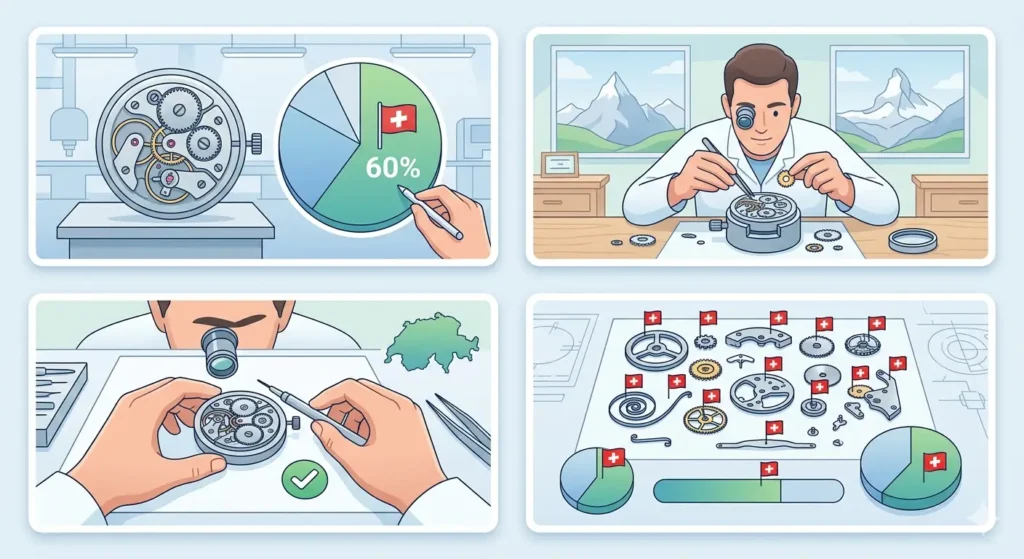
The Swiss Federal Council’s ‘Swissness’ legislation defines clear parameters for using the Swiss Made label. For watches specifically, manufacturers must satisfy several mandatory conditions.
- Step 1: Ensure at least 60% of production costs originate in Switzerland
- Step 2: Complete the movement assembly within Swiss borders
- Step 3: Conduct final inspection and quality control in Switzerland
- Step 4: Verify that the movement itself contains at least 60% Swiss-made components by value
These requirements extend beyond watches to other products. Industrial goods need 60% of manufacturing costs to be Swiss-based, while food products require 80% of raw materials to come from Switzerland.
Swiss Manufacturing Philosophy
Swiss production emphasizes handcrafted excellence and meticulous attention to detail. Master craftsmen often spend years perfecting single components, reflecting a culture that values tradition over rapid innovation. This approach results in products known for longevity, with many Swiss watches functioning flawlessly for generations.
The Swiss watchmaking industry particularly showcases this philosophy. Brands invest heavily in developing in-house movements, maintaining traditional finishing techniques, and preserving centuries-old manufacturing methods. This dedication to heritage craftsmanship contributes to premium pricing but delivers exceptional reliability.
Understanding German Made Standards
The ‘German Made’ or ‘Made in Germany’ label represents precision engineering backed by rigorous industrial standards. Germany’s manufacturing sector built its reputation on technical excellence and systematic quality control.
Legal Requirements for German Made
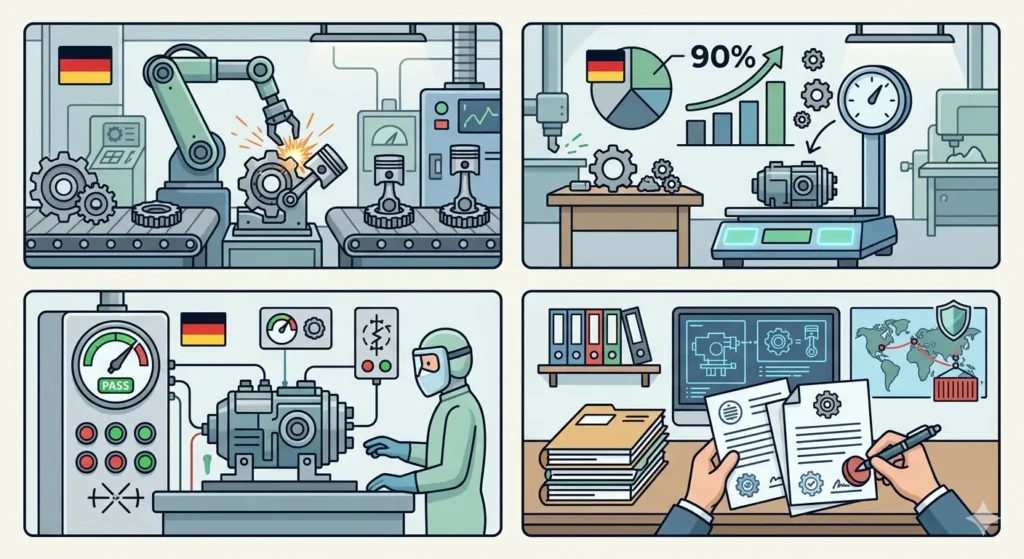
German origin marking follows European Union regulations combined with national standards. The designation requires substantial transformation to occur within Germany, though specific percentage requirements differ from Swiss rules.
- Step 1: Complete the last substantial manufacturing step in Germany
- Step 2: Ensure sufficient value addition occurs within German facilities
- Step 3: Meet applicable DIN (Deutsches Institut für Normung) standards for the product category
- Step 4: Document the manufacturing process for customs and regulatory compliance
Unlike Swiss Made’s strict percentage requirements, German Made focuses on where the product gains its essential characteristics. A watch movement fully assembled and finished in Germany qualifies, even if some components originate elsewhere.
German Engineering Approach
German manufacturing prioritizes functional design and engineering efficiency. Companies invest in advanced machinery and automated processes while maintaining human oversight for quality assurance. This balanced approach delivers consistent results at scale.
The concept of ‘Deutsche Qualitätsarbeit’ (German quality work) permeates manufacturing culture. Engineers design products for durability and serviceability, often incorporating features that simplify maintenance and extend product life. This practical mindset contrasts with Swiss emphasis on artistic finishing or Japanese focus on miniaturization.
Pro Tip: German-made products often provide the best value proposition for those seeking professional-grade quality without luxury pricing. The focus on engineering substance over decorative elements makes these items particularly suitable for demanding work environments.
Understanding Japanese Made Standards
The ‘Japanese Made’ or ‘Made in Japan’ label signifies technological innovation and manufacturing efficiency. Japan’s post-war industrial development created unique production methods that balance quality with accessibility.
Legal Requirements for Japanese Made
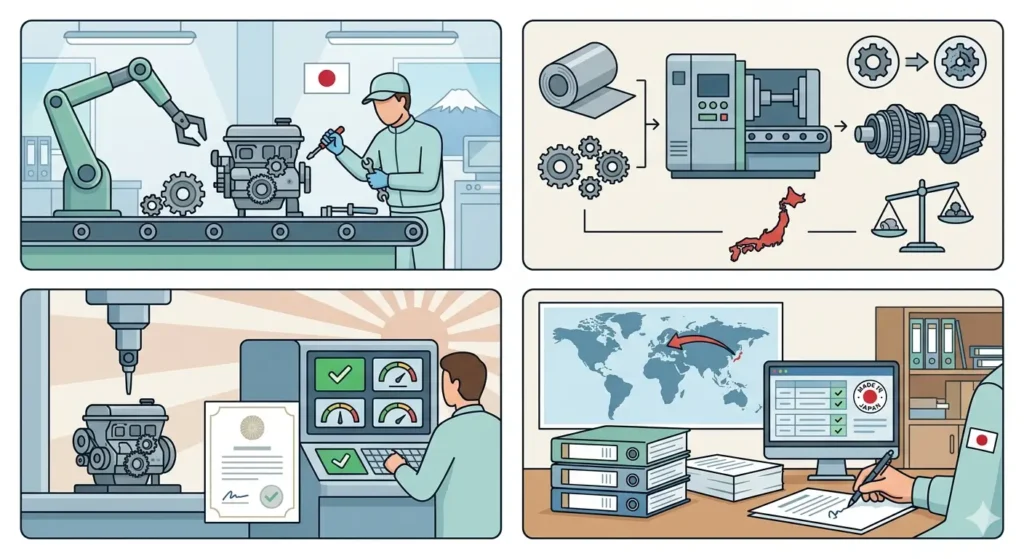
Japan’s country-of-origin rules follow guidelines established by Japanese Customs and align with WTO standards. The requirements focus on substantial transformation within Japanese territory.
- Step 1: Perform final assembly and major manufacturing processes in Japan
- Step 2: Ensure the product undergoes substantial transformation that changes its tariff classification
- Step 3: Meet Japanese Industrial Standards (JIS) where applicable to the product category
- Step 4: Maintain quality control documentation proving Japanese origin
Japanese regulations emphasize where products acquire their essential character rather than requiring specific component percentages. A watch assembled entirely in Japan from globally sourced parts can legitimately carry the Made in Japan label if assembly represents substantial manufacturing work.
Japanese Manufacturing Philosophy
Japanese production methods revolutionized manufacturing through concepts like ‘kaizen’ (continuous improvement) and ‘monozukuri’ (the art of making things). These philosophies drive constant refinement of processes and products.
Manufacturing efficiency receives tremendous focus. Japanese companies excel at optimizing production workflows, reducing waste, and implementing quality control at every step. This systematic approach enables high-quality output at competitive price points, making premium features accessible to broader markets.
The watchmaking sector exemplifies this approach. Japanese manufacturers developed technologies like quartz movements and Spring Drive mechanisms that challenged Swiss dominance through innovation rather than tradition. This forward-thinking mentality extends across industries, from cameras to automotive manufacturing.
Comparing Quality Standards Across Origins
Each manufacturing origin implements different quality control systems that reflect national industrial cultures and regulatory environments. Understanding these differences helps evaluate what each label guarantees.
Swiss Quality Control Methods
Swiss manufacturers employ multi-stage inspection processes that often involve manual verification by skilled technicians. Watchmakers might spend hours examining single timepieces, checking tolerances measured in microns. This labor-intensive approach catches defects that automated systems might miss but increases production costs significantly.
Independent certification bodies like COSC (Contrôle Officiel Suisse des Chronomètres) provide third-party verification for Swiss products meeting specific performance criteria. These optional certifications add credibility beyond basic Swiss Made requirements.
German Quality Control Methods
German quality assurance combines rigorous testing protocols with standardized measurements. DIN standards specify exact tolerances and performance parameters that products must meet. Manufacturers maintain detailed documentation proving compliance throughout production.
Testing facilities often subject products to extreme conditions exceeding normal use cases. This stress testing identifies potential failure points before products reach consumers. The systematic approach ensures consistency across production batches while maintaining high standards.
Japanese Quality Control Methods
Japanese quality control integrates inspection into every manufacturing stage rather than concentrating it at the end. Workers monitor processes continuously, making immediate adjustments to maintain specifications. This ‘built-in quality’ philosophy prevents defects rather than catching them after occurrence.
Statistical process control plays a major role in Japanese manufacturing. Companies track production metrics in real-time, using data analytics to identify trends before they cause quality issues. This proactive approach minimizes waste and maintains consistent output.
Price Differences and Value Propositions
Manufacturing origin significantly impacts pricing, though the relationship between cost and quality varies by product category. Understanding these pricing dynamics helps consumers assess value appropriately.
Swiss Made Pricing Factors
Swiss products typically command premium prices justified by several factors. Labor costs in Switzerland rank among the world’s highest, directly impacting production expenses. The emphasis on hand-finishing and traditional techniques requires skilled craftsmen who command substantial wages.
Brand heritage and marketing also contribute to Swiss pricing. Centuries-old companies leverage their history as part of product value, appealing to consumers who appreciate traditional craftsmanship. This intangible value adds to material and labor costs.
Swiss watches frequently cost 2-5 times more than comparable German or Japanese alternatives with similar technical specifications. The price premium reflects craftsmanship quality, brand prestige, and resale value retention rather than purely functional superiority.
German Made Pricing Factors
German products occupy a middle ground between Swiss luxury and Japanese efficiency pricing. Higher labor costs than Asia but lower than Switzerland create this positioning. Companies focus on delivering professional-grade quality without luxury branding premiums.
Vertical integration common in German manufacturing helps control costs. Many companies produce components in-house rather than outsourcing, maintaining quality while managing expenses. This approach delivers better value for consumers seeking tools rather than status symbols.
Japanese Made Pricing Factors
Japanese manufacturers excel at providing high-quality products at accessible price points. Efficient production methods, economies of scale, and technological innovation enable competitive pricing without compromising standards.
Companies invest heavily in automation and process optimization, reducing per-unit labor costs while maintaining quality. This efficiency focus allows Japanese products to compete on both quality and price, appealing to value-conscious consumers who refuse to sacrifice performance.
When comparing similar products, Japanese-made items often cost 40-60% less than Swiss equivalents while offering comparable or superior technical performance. The savings come from manufacturing efficiency rather than reduced quality.
Design Philosophy Differences
Manufacturing origin influences not just how products are made but also how they’re designed. These philosophical differences affect aesthetics, functionality, and user experience.
Swiss Design Characteristics
Swiss design emphasizes classical aesthetics and timeless appeal. Products feature traditional styling that remains relevant across decades, avoiding trendy elements that quickly date. This conservative approach ensures long-term visual appeal matching physical durability.
Finishing quality receives exceptional attention in Swiss manufacturing. Surfaces are polished, brushed, or decorated with patterns like Côtes de Genève or perlage. These details serve aesthetic purposes rather than functional needs, appealing to consumers who value craftsmanship artistry.
German Design Characteristics
German design follows the ‘form follows function’ principle, prioritizing usability and clarity. Products feature clean lines, logical layouts, and intuitive interfaces. Unnecessary ornamentation is avoided in favor of purposeful design elements that enhance functionality.
Legibility and user-friendliness guide German design decisions. Watch dials emphasize readability through high contrast and clear typography. Tool designs maximize ergonomics and practical utility, reflecting the engineering-first mindset prevalent in German manufacturing culture.
Japanese Design Characteristics
Japanese design balances minimalism with technological sophistication. Products often feature understated aesthetics that conceal complex internal mechanisms. This approach appeals to consumers who appreciate subtle refinement over obvious luxury signals.
Innovation drives Japanese design evolution. Companies regularly introduce new features, materials, and technologies, continuously refining products based on user feedback and technical advances. This progressive approach contrasts with Swiss traditionalism and German conservatism.
Pro Tip: Consider your primary use case when evaluating design philosophy. Swiss designs suit formal occasions and collectors who value tradition. German designs excel in professional environments requiring reliability and clarity. Japanese designs appeal to technology enthusiasts and daily users seeking practical innovation.
Material and Component Sourcing
How manufacturers source materials and components reveals important differences in production philosophy and quality priorities across manufacturing origins.
Swiss Sourcing Practices
Swiss manufacturers often maintain extensive in-house component production. High-end watch brands produce movements, cases, and bracelets within their facilities, ensuring complete quality control. This vertical integration contributes to Swiss Made percentage requirements while maintaining traditional craftsmanship standards.
For components sourced externally, Swiss companies typically purchase from specialized Swiss suppliers within the same industry cluster. This geographical concentration around regions like the Jura Valley creates supply chains that meet Swiss Made criteria while supporting local economies.
German Sourcing Practices
German manufacturers balance in-house production with strategic partnerships. Companies often develop long-term relationships with specialized suppliers, many located within Germany or the European Union. These partnerships ensure quality while allowing manufacturers to focus on core competencies.
Material selection emphasizes durability and proven performance. German companies favor established materials with known properties over experimental alternatives, reflecting the conservative engineering approach that prioritizes reliability.
Japanese Sourcing Practices
Japanese manufacturers excel at global sourcing optimization. Companies identify the best suppliers worldwide for specific components, creating international supply chains that balance quality and cost efficiency. This pragmatic approach enables competitive pricing without quality compromise.
Material innovation receives significant investment in Japanese manufacturing. Companies develop proprietary alloys, ceramics, and composites that offer performance advantages over traditional materials. This technological leadership extends from raw materials through finished products.
Warranty and After-Sales Support
Manufacturing origin influences warranty terms and long-term product support, affecting total ownership costs and user experience beyond the initial purchase.
Swiss After-Sales Approach
Swiss manufacturers typically offer 2-5 year warranties on watches and precision instruments. Service centers maintain stocks of parts for discontinued models spanning decades, enabling repairs long after production ceases. This commitment to longevity support justifies higher initial costs for consumers planning extended ownership.
Service costs for Swiss products run higher than alternatives due to labor expenses and specialized expertise requirements. Routine maintenance on Swiss watches might cost several hundred dollars, though service intervals often extend 5-7 years with proper care. You can track maintenance schedules efficiently using tools like the world time comparison tool to coordinate with service centers across different time zones.
German After-Sales Approach
German companies provide 2-3 year warranties with straightforward repair policies. Service networks combine authorized centers with trained technicians capable of performing maintenance. Parts availability typically extends 10-15 years beyond production discontinuation.
Service costs reflect the practical engineering philosophy, with reasonable pricing for maintenance and repairs. Companies design products for serviceability, allowing technicians to efficiently diagnose and fix issues without extensive disassembly.
Japanese After-Sales Approach
Japanese manufacturers offer competitive warranties ranging from 1-5 years depending on product category and price point. Global service networks provide accessible support in most markets, though parts availability for older models may be more limited than Swiss equivalents.
Replacement often proves more economical than repair for mid-range Japanese products due to efficient manufacturing keeping new product costs competitive. Premium Japanese items receive full service support comparable to European alternatives.
Tips for Choosing the Right Manufacturing Origin
Selecting between Swiss, German, and Japanese manufacturing depends on individual priorities, budget constraints, and intended use cases. These practical considerations help guide appropriate choices.
Consider Your Budget Reality
Establish a realistic budget before shopping. Swiss products require significant investment justified only if traditional craftsmanship and brand heritage matter personally. German options provide professional quality at moderate premiums. Japanese manufacturing delivers exceptional value for performance-focused buyers.
Remember that initial purchase price represents only part of total ownership costs. Factor in potential maintenance expenses, resale value, and replacement frequency when comparing options across price points.
Evaluate Actual Use Requirements
Match product characteristics to real-world needs rather than aspirational scenarios. Daily-wear items benefit from Japanese durability and serviceability. Professional tools requiring precision justify German engineering. Heirloom pieces or formal accessories suit Swiss craftsmanship.
Honest assessment of use patterns prevents overspending on features that provide no practical benefit. A desk worker needs different watch characteristics than a field engineer, regardless of personal style preferences.
Research Brand Reputation Within Origin
Manufacturing origin provides general guidance, but individual brand reputation matters significantly. Not all Swiss brands deliver equal quality, nor do all Japanese manufacturers share identical standards. Research specific companies within each origin category.
Look for brands with established track records in relevant product categories. Newer companies may lack the institutional knowledge that improves quality over time, even when adhering to origin requirements.
Verify Certification Claims
Examine products for proper origin markings and certifications. Authentic Swiss Made, German Made, or Japanese Made labels should be clearly displayed, not vaguely implied through marketing language. Request documentation proving origin compliance if spending significant amounts.
Be wary of ambiguous terms like ‘Swiss movement’ or ‘German technology’ that suggest origin without confirming it. These phrases may indicate partial compliance rather than full manufacturing origin standards.
Consider Long-Term Value Retention
Different origins hold resale value differently. Swiss luxury pieces often maintain value well, sometimes appreciating for limited editions. German products retain reasonable value through reputation for reliability. Japanese items typically depreciate faster but cost less initially.
Plan according to ownership intentions. Collectors and those viewing purchases as investments should consider Swiss options. Users planning extended personal ownership until replacement benefit more from German or Japanese value propositions.
Common Problems and Troubleshooting
Understanding potential issues associated with each manufacturing origin helps consumers make informed decisions and address problems effectively when they arise.
Swiss Made Authentication Issues
Counterfeit Swiss products represent a significant market problem. Fake watches bearing Swiss Made markings flood secondary markets, deceiving unsuspecting buyers. Always purchase from authorized dealers or reputable sellers with authentication guarantees.
Verify Swiss Made claims through manufacturer websites. Legitimate brands provide serial number verification tools and authorized dealer lists. If prices seem too good compared to market rates, skepticism is warranted.
German Made Availability Challenges
Some German manufacturers maintain limited international distribution, making certain products difficult to obtain outside Europe. Research availability in your region before committing to specific brands.
Import costs and warranty complications can affect German products purchased abroad. Verify whether manufacturers honor international warranties or require purchases through domestic channels for full coverage.
Japanese Made vs. Japanese Brand Confusion
Many Japanese brands manufacture certain product lines outside Japan, particularly in Southeast Asia. Labels may read ‘Japan Movt’ (movement) while overall assembly occurs elsewhere. Distinguish between ‘Made in Japan’ and products simply featuring Japanese components.
Check specific model production locations rather than assuming brand origin equals manufacturing location. Companies often produce entry-level items abroad while keeping premium lines domestically manufactured.
Service Center Accessibility
Remote locations may lack authorized service centers for specialized Swiss or German products. Research service availability before purchasing items requiring professional maintenance. Japanese brands typically offer broader service networks due to higher production volumes.
Some manufacturers provide mail-in service options, but shipping costs and insurance for valuable items add expenses and inconvenience. Local service availability should factor into purchase decisions for products requiring periodic maintenance.
Parts Obsolescence Concerns
While Swiss manufacturers excel at long-term parts support, even they eventually discontinue components for older models. German and Japanese manufacturers may obsolete parts more quickly, particularly for superseded technologies.
For critical applications requiring extended operational lifespans, verify manufacturer commitments to parts availability. Some companies guarantee parts support for specific periods, while others make no formal commitments beyond warranty periods.
Frequently Asked Questions
What percentage of a product must be made in Switzerland to qualify as Swiss Made?
At least 60% of production costs must originate in Switzerland for watches and industrial products. The movement assembly and final inspection must also occur within Swiss borders. For food products, the requirement increases to 80% of raw materials sourced from Switzerland. These strict standards protect the Swiss Made label’s integrity and consumer confidence.
Are German Made products better quality than Japanese Made products?
Quality differences depend more on specific brands and price points than manufacturing origin alone. German products emphasize precision engineering and durability, while Japanese products focus on technological innovation and efficiency. Both origins produce excellent quality within their respective philosophies. The ‘better’ choice depends on individual priorities regarding traditional craftsmanship versus modern technology.
Why are Swiss Made watches more expensive than Japanese alternatives?
Swiss watches cost more due to higher labor expenses, hand-finishing techniques, traditional manufacturing methods, and brand heritage premiums. Switzerland’s labor costs rank among the world’s highest, and many luxury brands invest significantly in marketing and prestige positioning. Japanese manufacturers achieve comparable technical performance through automation and efficient processes, enabling lower pricing without quality compromise.
Can a watch be Swiss Made if the movement is from Japan?
No, a watch cannot be labeled Swiss Made if it uses a Japanese movement. Swiss Made requirements specify that at least 60% of the movement’s value must consist of Swiss-made components, and movement assembly must occur in Switzerland. Using a complete Japanese movement violates these standards. However, the watch might be labeled ‘Swiss assembled’ if final assembly occurs in Switzerland with proper disclosure.
How can I verify if a product is genuinely German Made?
Verify German Made claims by checking for proper origin marking on the product and packaging, researching the manufacturer’s production facilities through their official website, and requesting certificates of origin for expensive items. Authorized dealers should provide documentation confirming manufacturing location. Be cautious of terms like ‘German technology’ or ‘German design’ which may indicate partial rather than complete German manufacturing.
Do Japanese Made products last as long as Swiss or German products?
Japanese products can last equally long as Swiss or German alternatives when properly maintained. Longevity depends on build quality, materials, and maintenance rather than manufacturing origin alone. Premium Japanese products often outlast budget European items. The key difference lies in design philosophy – Swiss and German products sometimes prioritize traditional serviceability while Japanese products may emphasize technological advancement and eventual replacement.
What does Made in Germany mean for product warranties?
Made in Germany typically indicates products carry 2-3 year manufacturer warranties with support from authorized service networks. German companies generally maintain parts availability for 10-15 years beyond production discontinuation. Warranty coverage applies internationally for most major brands, though specific terms vary by manufacturer. Always verify warranty conditions before purchasing, especially for expensive items.
Are Swiss Made requirements different for watches than other products?
Yes, Swiss Made requirements vary by product category. Watches must meet the 60% cost threshold with specific movement and assembly requirements. Industrial products also require 60% Swiss production costs. Food products need 80% of raw materials from Switzerland. Each category has tailored regulations reflecting industry-specific characteristics while maintaining the overall Swiss Made standard’s integrity.
Which manufacturing origin offers the best value for money?
Japanese manufacturing typically offers the best value proposition for performance-focused consumers, delivering high quality at competitive prices through efficient production methods. German products provide excellent value for those seeking professional-grade reliability without luxury premiums. Swiss products justify their higher costs for consumers who value traditional craftsmanship, brand heritage, and long-term value retention. The ‘best’ value depends on personal priorities and intended use.
Can manufacturing origin labels be misleading or deceptive?
Yes, some products use ambiguous language that suggests origin without confirming it. Terms like ‘Swiss movement,’ ‘German technology,’ or ‘Japan Movt’ indicate partial origin rather than complete manufacturing. Legitimate Swiss Made, German Made, or Japanese Made labels must meet specific legal requirements. Always examine exact wording carefully and request clarification from sellers if origin claims seem vague or unclear. Reputable manufacturers clearly state manufacturing location.