

Learning how to use the chronograph on a Rolex Daytona opens up the full potential of this legendary timepiece. The Daytona’s chronograph function transforms the watch from a simple time-teller into a precision stopwatch capable of measuring elapsed time with remarkable accuracy. This guide walks through every button, pusher, and subdial to ensure complete mastery of the chronograph features.
Quick Summary Table
| Component | Function | Location |
|---|---|---|
| Top Pusher (2 o’clock) | Start/Stop chronograph | Above crown |
| Bottom Pusher (4 o’clock) | Reset chronograph | Below crown |
| Center Seconds Hand | Elapsed seconds | Main dial center |
| 3 o’clock Subdial | Elapsed hours and minutes | Right side |
| 9 o’clock Subdial | Continuous seconds | Left side |
Understanding the Rolex Daytona Chronograph Layout
The Rolex Daytona features a sophisticated chronograph system with two pushers and three subdials. The pushers sit on either side of the crown at the 2 o’clock and 4 o’clock positions. These screw-down pushers must be unscrewed counterclockwise before operation to activate the chronograph functions.
The dial displays three subdials that work together to measure elapsed time. The subdial at 9 o’clock shows continuous running seconds for standard timekeeping. The subdial at 3 o’clock displays elapsed minutes (smaller track) and elapsed hours (outer track). The large central seconds hand with the red tip serves as the chronograph seconds hand when activated.
Most people find that understanding the pusher locations and subdial functions makes operating the chronograph intuitive. The Tachymeter scale engraved on the bezel adds another dimension, allowing speed calculations based on time and distance.
Operating the Chronograph Function
Starting the Chronograph
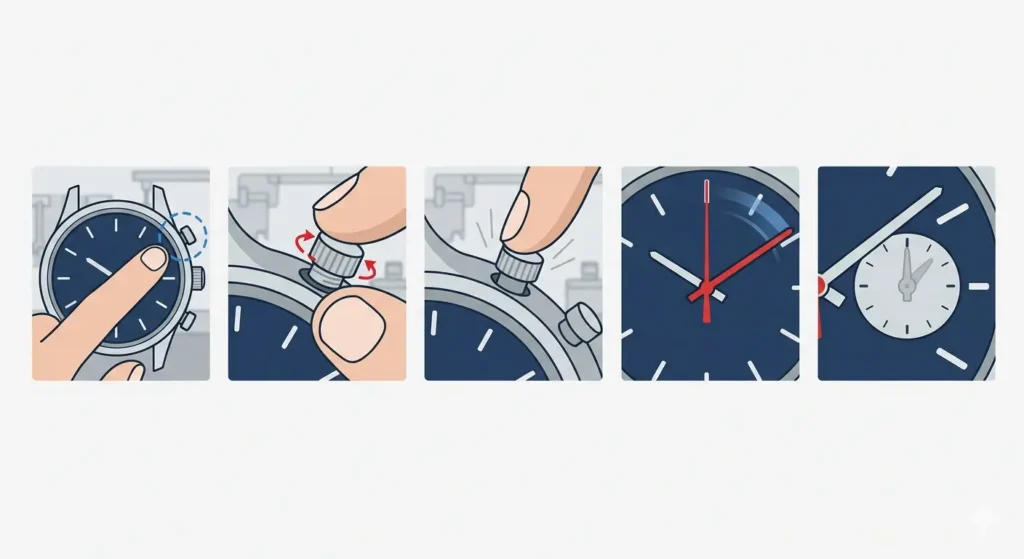
- Step 1: Locate the top pusher at the 2 o’clock position on the case side.
- Step 2: Unscrew the pusher by turning it counterclockwise several turns until it pops out slightly from the case.
- Step 3: Press the pusher firmly once to start the chronograph.
- Step 4: Observe the central chronograph seconds hand begin sweeping around the dial.
- Step 5: Watch the 3 o’clock subdial as the minute counter advances with each passing minute.
The chronograph starts immediately upon pressing the top pusher. The central seconds hand moves smoothly in a sweeping motion, characteristic of mechanical chronographs. This works best when the pusher is fully unscrewed and pressed with deliberate pressure.
Stopping the Chronograph
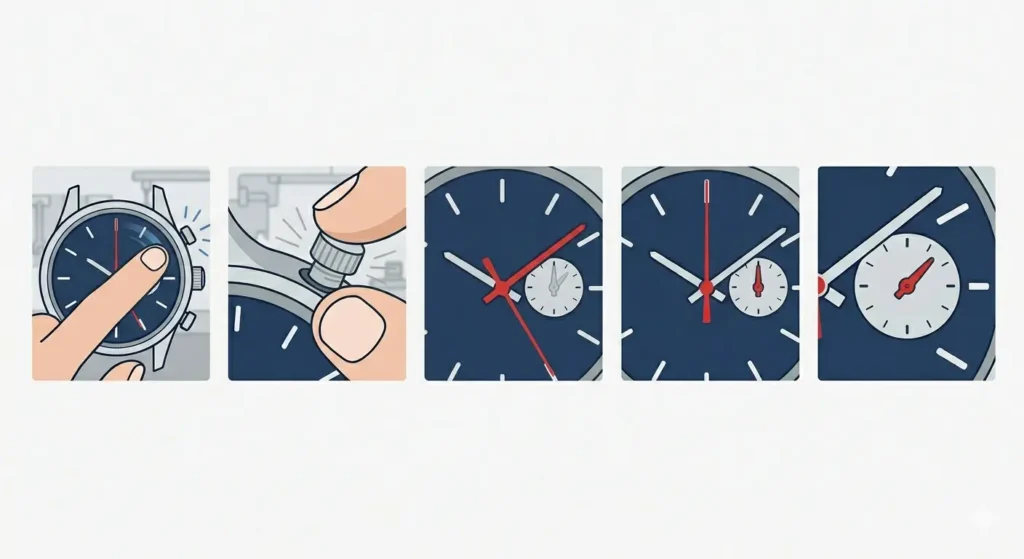
- Step 1: Press the same top pusher at 2 o’clock again while the chronograph is running.
- Step 2: The central seconds hand freezes in place, showing the elapsed seconds.
- Step 3: Read the elapsed time from the stopped positions of all chronograph hands.
- Step 4: The subdial at 3 o’clock displays the elapsed minutes and hours.
Stopping the chronograph preserves the measured time on the dial. The hands remain frozen at their positions, allowing accurate reading of the elapsed duration. To continue timing from where it stopped, simply press the top pusher again to restart.
Resetting the Chronograph
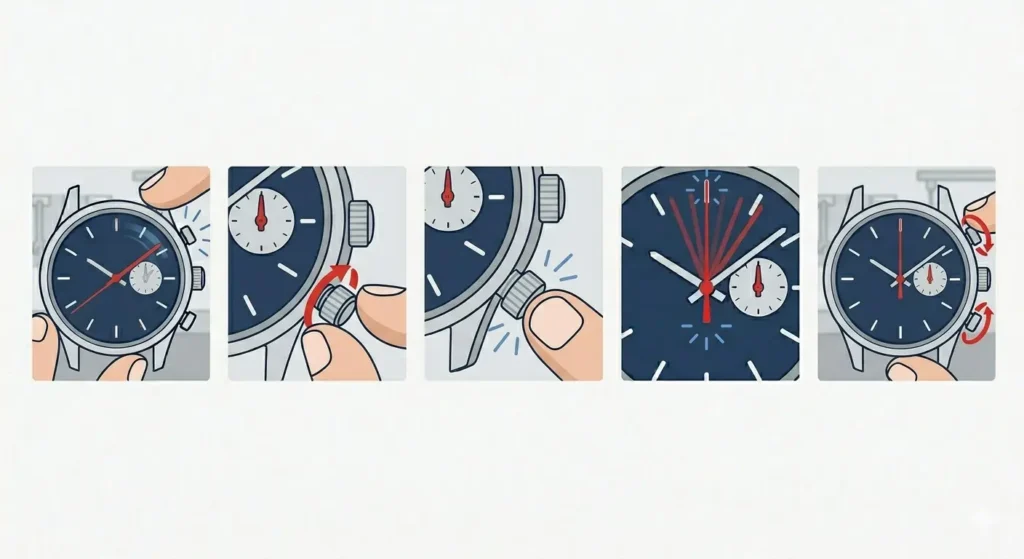
- Step 1: Ensure the chronograph is stopped by pressing the top pusher if still running.
- Step 2: Unscrew the bottom pusher at 4 o’clock by turning counterclockwise.
- Step 3: Press the bottom pusher firmly once.
- Step 4: Watch all chronograph hands instantly return to their zero positions.
- Step 5: Screw both pushers back down clockwise to maintain water resistance.
The reset function only works when the chronograph is stopped. Attempting to reset while running will not engage the mechanism. The key is to always stop first, then reset.
Pro-Tip: Always screw down both pushers after using the chronograph to maintain the watch’s 100-meter water resistance rating. Operating the chronograph near water without secured pushers risks moisture damage to the movement.
Reading Elapsed Time on the Subdials
The 3 o’clock subdial contains two concentric scales that measure different time intervals. The inner scale with smaller markers tracks elapsed minutes up to 30 minutes. Each marker represents one minute, and the hand advances one position every 60 seconds during chronograph operation.
The outer scale on the same subdial measures elapsed hours up to 12 hours. This hand moves much slower, advancing one position every 60 minutes. For timing events shorter than 30 minutes, focus on the central seconds hand and the minute counter. For longer durations, incorporate the hour counter into the reading.
The 9 o’clock subdial remains independent of chronograph operation. This small seconds hand runs continuously as long as the watch is running, providing confirmation that the movement is functioning properly. This dial should not be confused with chronograph functions.
Using the Tachymeter Bezel
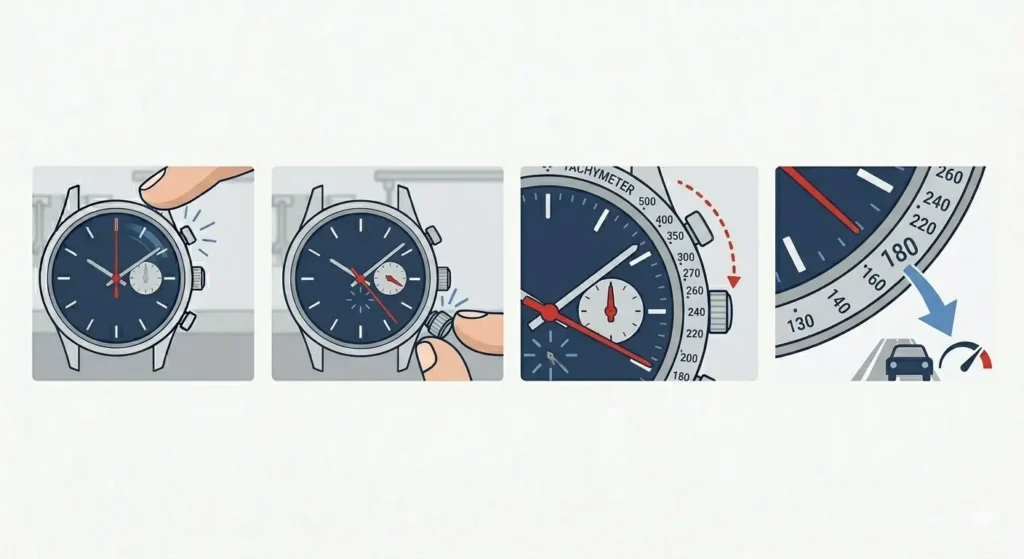
The Tachymeter scale engraved on the Daytona’s bezel calculates average speed over a known distance. This function works in conjunction with the chronograph to provide instant speed readings without manual calculation.
- Step 1: Start the chronograph as an object passes the starting point of a known distance (typically 1 kilometer or 1 mile).
- Step 2: Stop the chronograph when the object reaches the end point of the measured distance.
- Step 3: Note where the central seconds hand points on the Tachymeter scale.
- Step 4: Read the number directly from the bezel – this represents the average speed in units per hour.
The Tachymeter only provides accurate readings for events lasting between 7.2 seconds and 60 seconds. Events shorter than 7.2 seconds exceed the scale’s maximum reading of 500 units per hour. Events longer than 60 seconds fall below the minimum reading of 60 units per hour.
Real-world applications include measuring lap times on a race track, calculating average driving speed between highway markers, or timing production rates in manufacturing. The beauty of the Tachymeter lies in its instant results without requiring additional tools or calculations.
Maintaining Chronograph Accuracy
Regular use keeps the chronograph mechanism lubricated and functioning smoothly. Watches that sit unused for extended periods may develop sluggish chronograph hands or imprecise reset positions. Activating the chronograph monthly helps maintain optimal performance.
The chronograph should reset perfectly to zero positions each time. If the central seconds hand or subdial hands fail to align exactly with their zero markers, the watch requires professional regulation. Small misalignments of one or two seconds indicate the movement needs servicing.
Avoid operating the chronograph pushers underwater or when the crown is unscrewed. Water intrusion through open pushers causes immediate damage to the movement and requires expensive repair. The screw-down pusher system provides excellent protection, but only when properly secured.
Service intervals for chronograph movements typically range from 5 to 10 years, depending on usage patterns. Heavy chronograph users should service more frequently, while occasional users can extend service intervals. Professional watchmakers clean, lubricate, and regulate the chronograph mechanism during service to restore factory specifications.
Pro-Tip: Never attempt to pull out the crown while the chronograph is running. This places excessive stress on the movement and can damage internal components. Always stop and reset the chronograph before adjusting the time or date.
Practical Timing Applications
The Daytona chronograph excels at measuring short to medium duration events. Cooking applications benefit from precise timing of multiple dishes, where the chronograph tracks one item while using an online stopwatch for others. Fitness enthusiasts measure interval training sessions, lap times, and rest periods with the chronograph.
Professional applications include timing meetings, presentations, and work tasks to improve productivity. Photographers use chronographs to time exposures and development processes. Pilots rely on chronographs for flight calculations and fuel consumption estimates.
The 12-hour chronograph capacity suits activities lasting up to half a day. Endurance events, long-distance drives, and extended work sessions all fall within the Daytona’s measurement range. For events exceeding 12 hours, manual recording of complete cycles becomes necessary.
Tips for Optimal Chronograph Use
Press the pushers firmly and deliberately rather than tentatively. Partial presses may not fully engage the mechanism, resulting in missed starts or incomplete resets. The pushers require noticeable pressure to activate, providing tactile feedback when properly pressed.
Establish a consistent routine for pusher operation. Always unscrew both pushers before use, operate the chronograph functions, then screw down both pushers immediately after resetting. This habit ensures water resistance protection and prevents accidental pusher activation.
Keep the crystal clean for clear subdial reading. Fingerprints and smudges obscure the small subdial markers, making elapsed time difficult to read accurately. A microfiber cloth quickly removes oils and maintains visibility.
Practice reading the subdials in various lighting conditions. The polished hands and applied markers perform differently in bright sunlight versus dim indoor lighting. Familiarity with the dial layout enables quick time reading in any environment.
Coordinate the Daytona chronograph with digital tools when precision matters most. Using a clock tab alongside the watch provides verification and backup timing for critical measurements.
Common Problems and Troubleshooting
Chronograph Hands Not Resetting to Zero
Misaligned reset positions indicate the chronograph mechanism requires professional adjustment. Small deviations of one or two positions suggest normal wear, while larger misalignments signal internal issues. Watchmakers correct this during routine service by adjusting the reset hammers and springs.
Attempted DIY corrections often worsen the problem. The reset mechanism involves precise components calibrated to exact specifications. Professional tools and expertise ensure proper alignment without damaging delicate parts.
Pushers Difficult to Operate
Stiff or resistant pushers typically result from dried lubricants or debris in the pusher tubes. Regular use prevents this issue, but infrequently used chronographs develop resistance over time. Professional cleaning and lubrication restore smooth pusher operation.
Never force stuck pushers. Excessive pressure damages internal components and potentially breaks pusher stems. Service addresses the root cause rather than treating symptoms through brute force.
Chronograph Hand Jumping or Stuttering
Irregular hand movement indicates insufficient lubrication or worn components in the chronograph mechanism. The smooth sweeping motion should maintain constant speed without hesitation or jumping. Any deviation from smooth operation requires professional attention.
This symptom often appears gradually as lubricants degrade over years of use. Early intervention prevents accelerated wear and more extensive repairs. Service restores proper hand movement and prevents further damage.
Chronograph Draining Power Reserve Quickly
Running the chronograph continuously consumes more power than standard timekeeping. The additional wheels and springs in motion draw energy from the mainspring, reducing the power reserve duration. This behavior is normal for mechanical chronographs.
For extended chronograph use, wind the watch more frequently to maintain adequate power reserve. Automatic winding may not provide sufficient energy during prolonged chronograph operation, especially with limited wrist movement.
Frequently Asked Questions
Can the chronograph run continuously for days?
The chronograph can run continuously for the full 12-hour capacity and beyond, limited only by the watch’s power reserve. However, continuous chronograph operation accelerates wear on components and should be reserved for necessary timing applications rather than constant use.
Does using the chronograph affect timekeeping accuracy?
Operating the chronograph slightly impacts timekeeping precision due to increased energy consumption from the movement. The effect remains minimal in well-maintained watches, typically less than one second per day. Regular timekeeping stays within COSC chronometer specifications even with chronograph use.
Why must pushers be screwed down after use?
Screw-down pushers maintain the Daytona’s 100-meter water resistance rating by creating sealed barriers against moisture intrusion. Unscrewed pushers expose the movement to water, dust, and contaminants that cause damage. Always secure pushers after chronograph operation to preserve the watch’s protective seals.
How often should the chronograph be serviced?
Rolex recommends servicing every 10 years under normal conditions, but frequent chronograph users should consider 5 to 7-year intervals. Heavy use accelerates lubricant degradation and component wear. Regular service maintains accuracy and prevents costly repairs from neglected maintenance.
Can the time be adjusted while the chronograph is running?
Never adjust the time with the chronograph running. Stop and reset the chronograph before pulling the crown to set the time. Adjusting time during chronograph operation stresses the movement and risks damaging the chronograph mechanism and time-setting components.
What is the shortest time interval the chronograph can accurately measure?
The Daytona chronograph measures time accurately to 1/8 second intervals, the standard for mechanical chronographs. The central seconds hand sweeps smoothly at 8 beats per second, allowing precise measurement of brief events. For timing shorter than one second, the intermediate positions between second markers provide reasonable estimates.
Why does the 9 o’clock subdial run continuously?
The 9 o’clock subdial serves as the small seconds display for regular timekeeping, independent of chronograph functions. This hand runs whenever the watch operates, providing visual confirmation of movement operation. Only the 3 o’clock subdial and central seconds hand participate in chronograph timing.
Can both pushers be unscrewed simultaneously during use?
Both pushers should be unscrewed before operating the chronograph to ensure smooth function. However, keeping unused pushers screwed down when not needed provides extra protection. The practical approach involves unscrewing the top pusher for start/stop operations, then unscrewing the bottom pusher only when reset is required.
How does the chronograph mechanism affect the watch movement?
The chronograph module adds complexity to the base movement with additional wheels, springs, and levers. This sophisticated mechanism operates independently of regular timekeeping when not engaged. Activation couples the chronograph wheels to the movement, adding mechanical load that slightly increases energy consumption.
What happens if the pushers are pressed underwater?
Pressing pushers underwater while screwed down causes no issues, as the screw-down mechanism prevents activation. If pushers are unscrewed underwater, pressing them allows water to enter the case, causing immediate damage to the movement. Moisture exposure requires urgent professional intervention to prevent corrosion and component failure.
Is there a recommended break-in period for new chronograph movements?
New Daytona watches benefit from a brief break-in period where operating the chronograph several times helps lubricants distribute evenly across components. Use the chronograph normally from the start, as Rolex movements come fully lubricated and tested. Avoiding chronograph use provides no benefit and may actually allow lubricants to settle unevenly.
Can the chronograph measure times across midnight?
The chronograph continues measuring elapsed time across midnight without interruption. The 12-hour capacity allows timing events that span from one day into the next. Simply start the chronograph before midnight and stop it the following day, reading the accumulated hours, minutes, and seconds from the subdials. For timing comparisons across different time zones, tools like a world time comparison tool provide additional context.