
A unidirectional dive bezel is one of the most practical timing tools on a dive watch, designed to help track elapsed time safely and accurately. Whether timing a dive, monitoring an activity, or simply tracking intervals, understanding how to use a unidirectional dive bezel for timing ensures precise measurements every time. This guide covers everything needed to master this essential watch feature.
Quick Summary Table
| Feature | Purpose |
| Unidirectional Rotation | Rotates counterclockwise only to prevent accidental time extension |
| Zero Marker | Triangle at 12 o’clock position for alignment |
| Minute Markings | Graduated scale from 0-60 minutes |
| Primary Use | Track elapsed time for diving, cooking, parking, or any timed activity |
| Safety Feature | One-way rotation ensures time is never overestimated |
Understanding the Unidirectional Dive Bezel
The unidirectional dive bezel rotates only counterclockwise, a critical safety feature for divers. This design prevents accidental bumps from extending the measured time, which could lead to dangerous situations underwater. The bezel features a triangular marker at the 12 o’clock position and minute graduations around the entire circumference.
Most dive bezels display clear markings for the first 15-20 minutes, as these intervals are most critical for diving safety. The remaining markings extend to 60 minutes, allowing for comprehensive time tracking across various activities.
How to Use a Unidirectional Dive Bezel Step-by-Step
Basic Timing Method
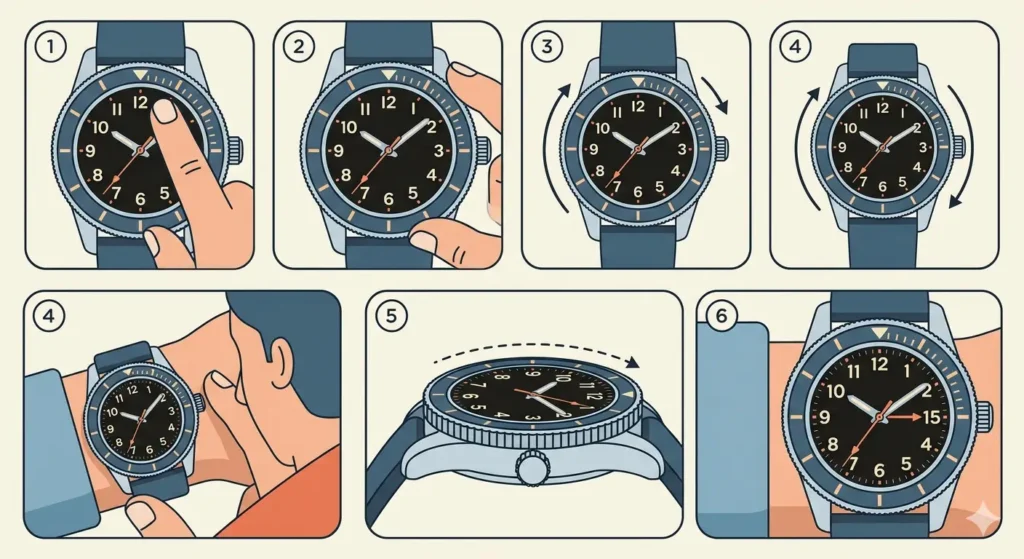
- Step 1: Locate the triangular zero marker on the bezel at the 12 o’clock position
- Step 2: Grip the bezel firmly between thumb and forefinger on opposite sides
- Step 3: Rotate the bezel counterclockwise until the zero marker aligns perfectly with the minute hand
- Step 4: Note the current time on the watch face as the starting point
- Step 5: Allow the minute hand to move naturally while the bezel remains stationary
- Step 6: Read the elapsed time by checking which bezel marking the minute hand points to
The minute hand acts as the pointer, moving across the bezel’s fixed markings to display how much time has passed since the bezel was set.
Alternative Timing Method for Specific End Times
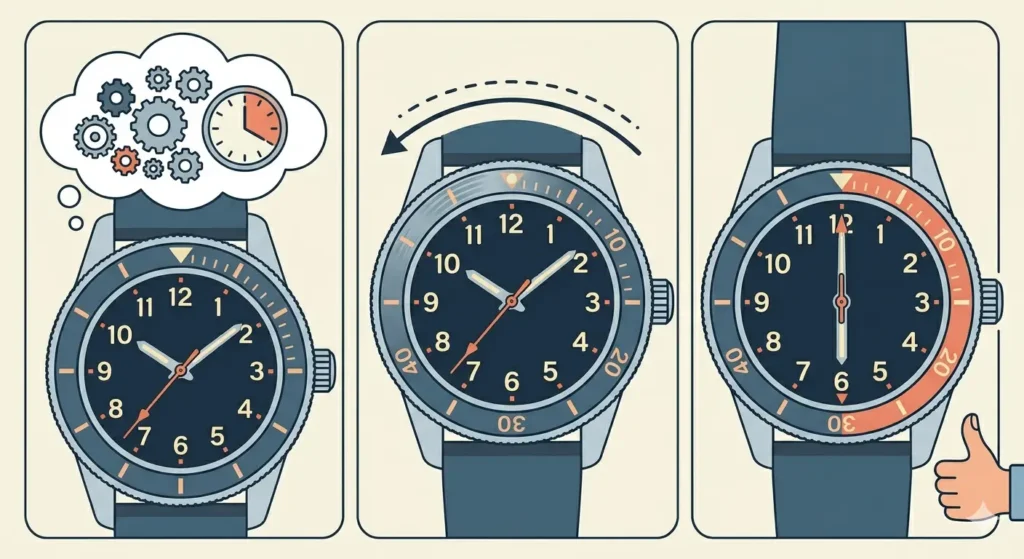
- Step 1: Calculate the desired duration (for example, 20 minutes from now)
- Step 2: Rotate the bezel counterclockwise so the zero marker points to where the minute hand will be at the end time
- Step 3: When the minute hand reaches the zero marker, the designated time has elapsed
This method works exceptionally well for activities with fixed durations, such as parking meters or cooking timers.
Pro-Tip: Always rotate the bezel slightly past the minute hand, then adjust it back to the exact position. This technique compensates for the bezel’s one-way mechanism and ensures the most accurate alignment possible.
Reading Elapsed Time on the Bezel
Once the bezel is set, reading elapsed time becomes straightforward. The minute hand travels across the bezel’s numbered markings, displaying how many minutes have passed since the initial setting.
For the first 15-20 minutes, most bezels show individual minute markings, making it easy to track time precisely. After this point, markings typically appear at 5-minute intervals up to 60 minutes. To determine elapsed time, simply check where the minute hand currently points on the bezel scale.
For activities requiring timing beyond 60 minutes, track complete rotations of the minute hand mentally or with an online stopwatch as a backup reference.
Practical Applications Beyond Diving
While designed for underwater use, the unidirectional bezel serves countless everyday purposes:
- Cooking and baking timers for precise recipe execution
- Parking meter tracking to avoid fines
- Exercise interval timing for workouts and training sessions
- Meeting duration monitoring for better time management
- Medication schedules requiring specific time intervals
- Photography exposure tracking for long-exposure shots
Many professionals rely on dive bezels throughout the day, finding them more convenient than reaching for a phone or separate timer device.
Why the Bezel Only Rotates One Direction
The counterclockwise-only rotation serves as a crucial safety mechanism. If a diver accidentally bumps the bezel during a dive, the one-way rotation can only decrease the apparent elapsed time, never increase it. This means the diver would surface earlier than planned rather than staying underwater longer than safe air supply allows.
This same principle applies to any time-sensitive activity where underestimating elapsed time is safer than overestimating it. The mechanical design uses a spring-loaded pawl system that catches on precisely machined teeth, creating the characteristic clicking sound while preventing backward rotation.
Bezel Accuracy and Limitations
The unidirectional bezel provides accurate timing within the limits of the watch movement itself. Since the bezel is manually aligned and relies on the minute hand’s position, accuracy depends on proper setting and the watch’s inherent precision.
Most quality dive watches maintain accuracy within -10 to +15 seconds per day, which translates to minimal error over short timing intervals. For activities requiring split-second precision, consider using a dedicated clock tab alongside the bezel for verification.
The bezel’s one-minute graduation increments mean readings are estimates within approximately 30 seconds before and after each marking. This level of precision satisfies most practical timing needs but may not suit applications requiring sub-minute accuracy.
Tips for Effective Bezel Use
- Clean the bezel regularly to maintain smooth rotation and prevent debris from affecting alignment
- Rotate the bezel through its full range occasionally to distribute lubricant and prevent seizing
- Avoid forcing the bezel if resistance is felt, as this may indicate sand or debris in the mechanism
- Set the bezel slightly before starting an activity rather than trying to align it while the activity begins
- Use the bezel’s luminous markers for visibility in low-light conditions
- Double-check alignment after setting by viewing the bezel from multiple angles
- Practice setting the bezel with gloved hands if planning to use it while diving
Pro-Tip: When timing critical activities, set the bezel conservatively by rounding down to the nearest minute mark. This builds in a small safety margin, especially important for diving or any situation where running over time creates risk.
Common Problems and Troubleshooting
Bezel Feels Stiff or Won’t Rotate
Stiffness typically indicates dirt, salt, or dried lubricant in the bezel assembly. Rinse the watch under fresh water while rotating the bezel back and forth. For persistent issues, professional servicing may be needed to clean and relubricate the mechanism.
Bezel Rotates Too Freely or Skips Positions
Loose rotation suggests worn teeth or a weakened spring mechanism. This requires professional repair, as the bezel insert may need replacement. Continued use with a loose bezel compromises timing accuracy and safety.
Bezel Markings Are Difficult to Read
Faded markings occur with age and UV exposure. Ceramic bezels resist fading better than aluminum. For improved visibility, ensure adequate lighting or use the watch’s luminous elements in low light. Some aftermarket bezel inserts offer enhanced contrast and can be professionally installed.
Bezel Accidentally Rotates During Activity
Accidental rotation happens when clothing or equipment catches the bezel. Position the watch on the inside of the wrist for better protection, or choose activities where the watch face is less exposed to contact. Some watches feature recessed bezels that reduce accidental movement.
Difficulty Aligning Bezel Precisely with Minute Hand
Precise alignment improves with practice. Use good lighting, stabilize both arms, and approach the final position slowly. The clicking mechanism means perfect alignment may require stopping at the closest detent position rather than forcing exact placement.
Frequently Asked Questions
What is the main purpose of a unidirectional dive bezel?
The primary purpose is to track elapsed time safely during diving and other activities. The unidirectional rotation ensures that accidental bumps can only reduce the apparent elapsed time, preventing dangerous situations where someone might think less time has passed than actually has.
Can a dive bezel be used to tell time in different time zones?
No, a dive bezel is designed specifically for timing elapsed intervals, not for displaying different time zones. For comparing times across locations, a world time comparison tool provides better functionality.
How accurate is timing with a dive bezel?
Bezel timing accuracy depends on the watch movement’s precision and proper alignment. With quality watches accurate to within seconds per day, the bezel provides reliable timing for intervals up to 60 minutes, with precision to the nearest minute based on the graduation markings.
Why does the bezel make clicking sounds when rotated?
The clicking sound comes from a spring-loaded pawl mechanism that catches on precisely machined teeth inside the bezel assembly. Each click represents one position increment, typically corresponding to one minute on the timing scale, and provides tactile feedback for accurate setting.
Can a unidirectional bezel be converted to rotate both directions?
While technically possible through modification, converting a unidirectional bezel eliminates its critical safety feature. This modification is strongly discouraged as it defeats the design’s purpose and could create dangerous situations during timed activities, especially diving.
How often should a dive bezel be serviced or maintained?
Rinse the bezel with fresh water after exposure to salt water or chlorine, and rotate it regularly to maintain smooth operation. Professional servicing during regular watch maintenance (typically every 3-5 years) includes cleaning and lubricating the bezel mechanism to ensure proper function.
What is the difference between ceramic and aluminum bezel inserts?
Ceramic bezels offer superior scratch resistance and color permanence compared to aluminum. Aluminum bezels are lighter and more traditional but can fade and scratch over time. Both materials function identically for timing purposes, with the choice primarily affecting durability and aesthetics.
Can a dive bezel be used for timing activities longer than 60 minutes?
Yes, but it requires tracking complete 60-minute rotations mentally or with supplementary tools. Each time the minute hand completes a full circle and returns to the zero marker, another hour has elapsed. This method works for longer intervals though dedicated chronographs offer better solutions for extended timing.
What should be done if the bezel becomes misaligned during an activity?
If the bezel moves during an activity, the safest approach is to reset it to the current minute hand position and begin timing from that moment. Since the bezel only rotates counterclockwise, any accidental movement makes the elapsed time reading appear less than actual, providing a safety margin.
Are there any activities where a dive bezel should not be used for timing?
Avoid relying solely on a dive bezel for activities requiring precision beyond one-minute increments, such as scientific experiments, professional photography requiring exact exposure times, or competitive sports timing. The bezel excels at practical, everyday timing but specialized chronographs or digital timers better serve applications demanding sub-second accuracy.