

How to tell if your watch needs service is a question every watch owner should know the answer to. Regular maintenance keeps timepieces running accurately and prevents costly repairs down the line. This guide provides clear indicators and step-by-step methods to determine when professional servicing becomes necessary.
Quick Summary Table
| Warning Sign | What It Means | Action Needed |
|---|---|---|
| Timekeeping errors (±5+ seconds/day) | Movement needs adjustment or lubrication | Service within 1-2 months |
| Condensation under crystal | Water seal compromised | Immediate service required |
| Stopping or hesitation | Power reserve issue or mechanical fault | Service within 2 weeks |
| Unusual noises (rattling, grinding) | Loose components or worn parts | Service within 1 month |
| Crystal fogging briefly | Minor moisture intrusion | Service within 1 week |
| Last service 3-5 years ago | Routine maintenance interval | Schedule service soon |
Step-by-Step Guide to Check if Your Watch Needs Service
Method 1: Test Timekeeping Accuracy
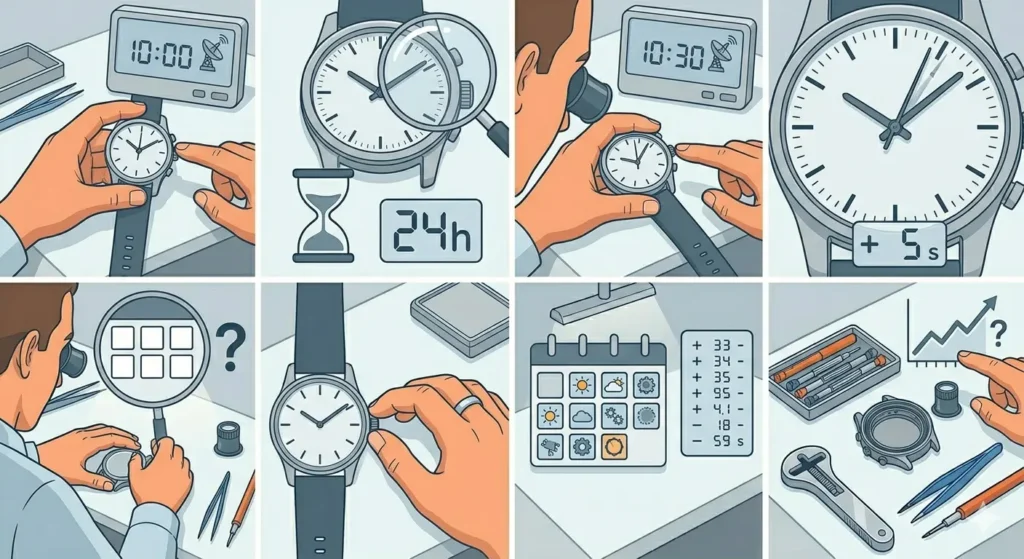
The most fundamental test involves comparing the watch against a reliable time source. This method works for both mechanical and quartz watches.
- Step 1: Set the watch to match a precise time source like an atomic clock or smartphone time down to the exact second.
- Step 2: Wait 24 hours without adjusting the watch.
- Step 3: Compare the watch time to the same reference source.
- Step 4: Calculate the difference in seconds gained or lost.
- Step 5: Repeat this test for 5-7 days to establish a pattern.
Pro-Tip: Mechanical watches losing or gaining more than 5 seconds per day need servicing. Quartz watches showing any variation beyond 1-2 seconds per month require attention. Keep the watch in the same position during testing for consistent results.
Method 2: Examine the Watch Crystal and Case
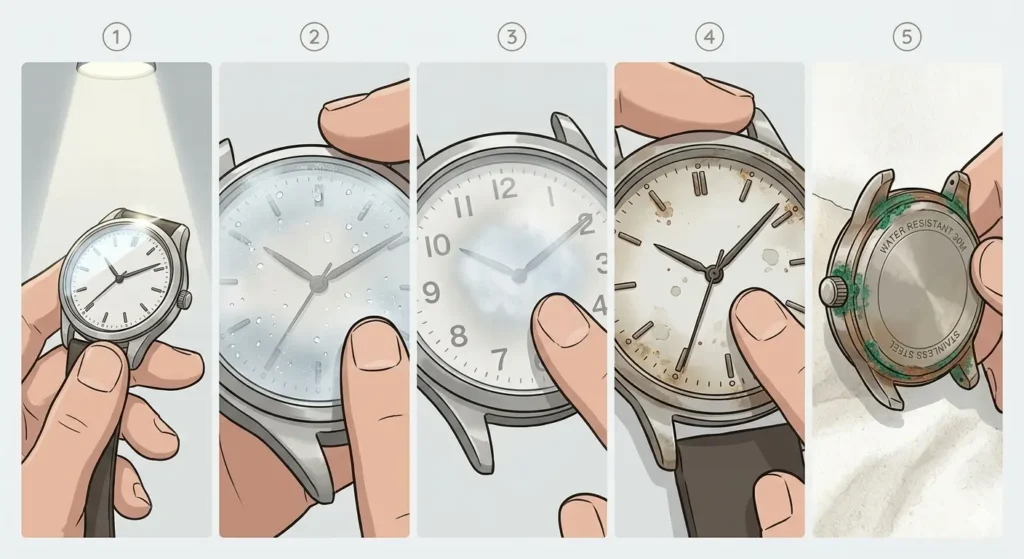
Visual inspection reveals water damage and seal degradation before internal components fail.
- Step 1: Hold the watch under bright light at different angles.
- Step 2: Look for any moisture droplets, fog, or condensation inside the crystal.
- Step 3: Check for cloudiness or haziness on the inner crystal surface.
- Step 4: Inspect the dial for water spots, discoloration, or rust marks.
- Step 5: Examine the case back and crown for visible corrosion or green oxidation.
Even brief fogging that disappears quickly indicates moisture has entered the case. This requires immediate professional attention to prevent rust and dial damage.
Method 3: Listen for Unusual Sounds
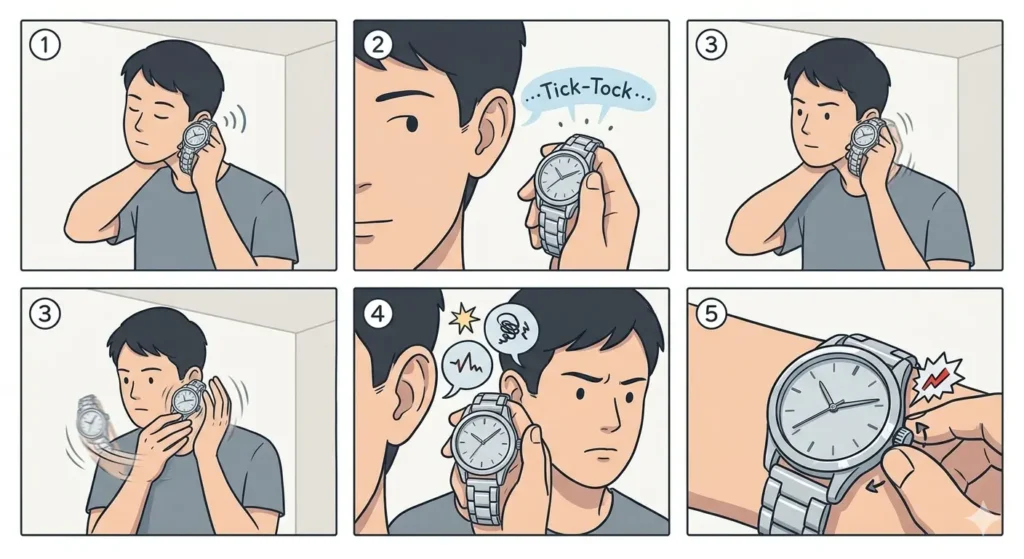
Abnormal noises signal mechanical problems that worsen without intervention.
- Step 1: Hold the watch close to the ear in a quiet room.
- Step 2: Listen for the normal ticking rhythm (should be consistent and even).
- Step 3: Shake the watch gently near the ear.
- Step 4: Note any rattling, clicking, or loose component sounds.
- Step 5: Wind the watch (if manual) and listen for grinding or scraping during winding.
Healthy watches produce a smooth, rhythmic ticking. Rattling suggests a loose rotor or broken parts. Grinding during winding indicates worn gears or insufficient lubrication.
Method 4: Test the Power Reserve
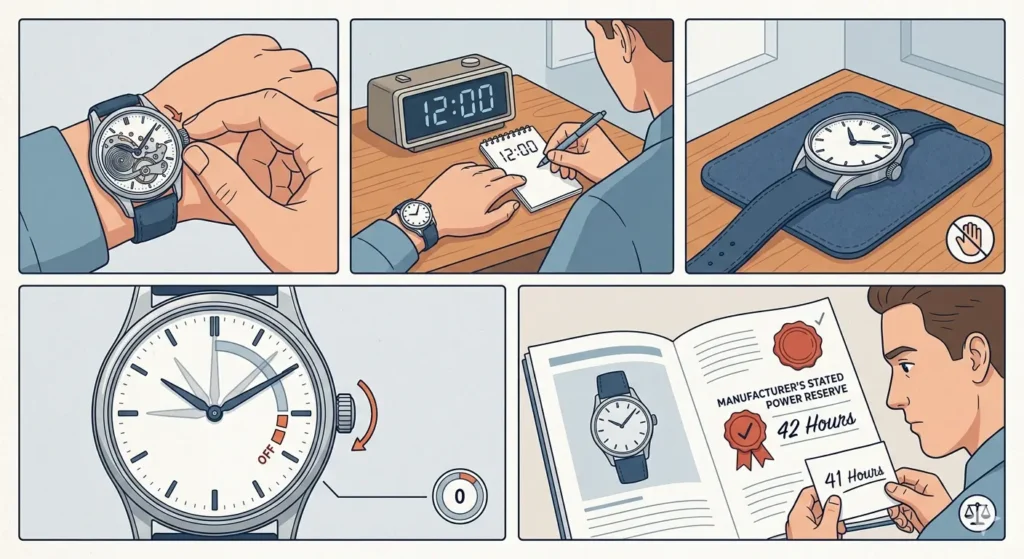
This test applies to automatic and manual mechanical watches, revealing movement health.
- Step 1: Fully wind the watch (manual) or wear it for a full day (automatic).
- Step 2: Note the exact time when placing the watch down.
- Step 3: Leave the watch stationary without movement.
- Step 4: Check how many hours pass before the watch stops completely.
- Step 5: Compare the result to the manufacturer’s stated power reserve.
Most mechanical watches should run 38-48 hours when fully wound. Significantly shorter power reserve (under 30 hours) indicates the movement needs cleaning and lubrication.
Method 5: Check Crown and Pusher Function
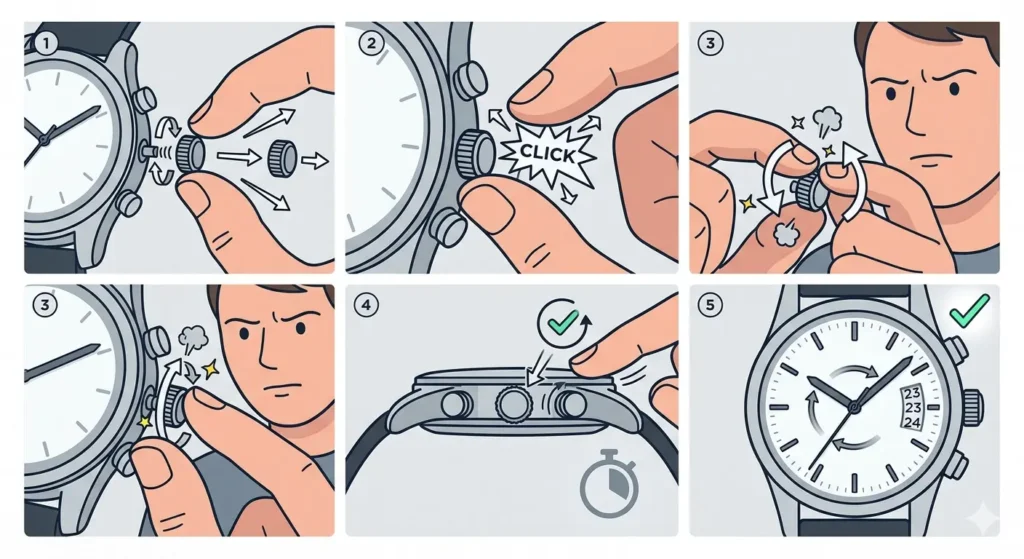
Operating smoothness reveals seal condition and internal mechanism health.
- Step 1: Unscrew the crown (if screw-down type) and pull to each position.
- Step 2: Feel for smooth, defined clicks between positions.
- Step 3: Turn the crown in both directions, noting any resistance or grinding.
- Step 4: Test all chronograph pushers (if applicable) for smooth depression and return.
- Step 5: Verify all functions (date change, time setting) work correctly.
Stiff crowns, grinding sensations, or pushers that stick indicate dried lubricants or worn seals requiring service.
Method 6: Monitor for Starting and Stopping Issues
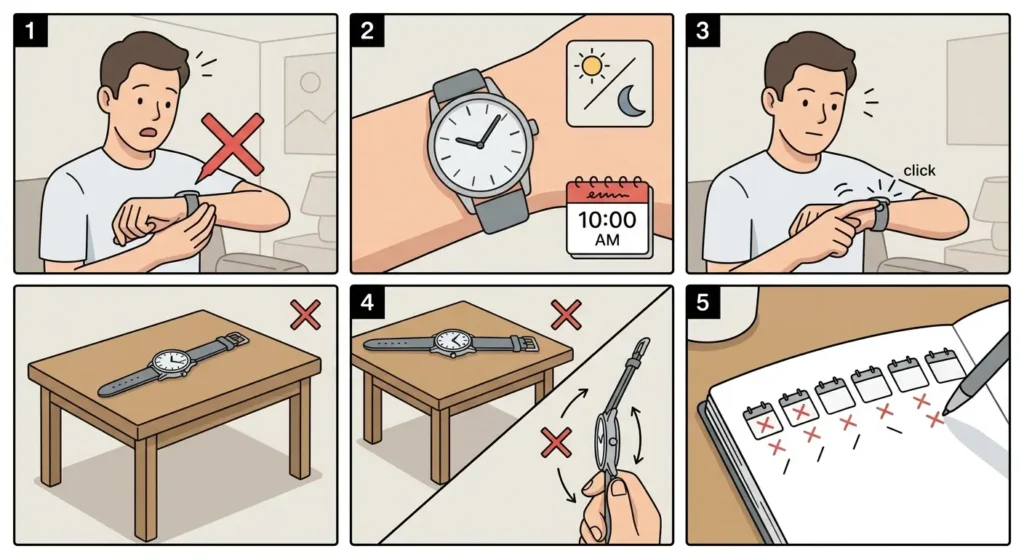
Intermittent operation points to serious mechanical problems.
- Step 1: Track instances when the watch stops unexpectedly.
- Step 2: Note the time of day and circumstances when stopping occurs.
- Step 3: Record if the watch hesitates before starting again.
- Step 4: Test if certain positions cause the watch to stop (lay flat vs. vertical).
- Step 5: Document the frequency of stopping over one week.
Position-dependent stopping suggests a worn balance wheel pivot or damaged jewel. Frequent random stopping indicates multiple movement issues requiring comprehensive service.
Method 7: Review Service History and Age
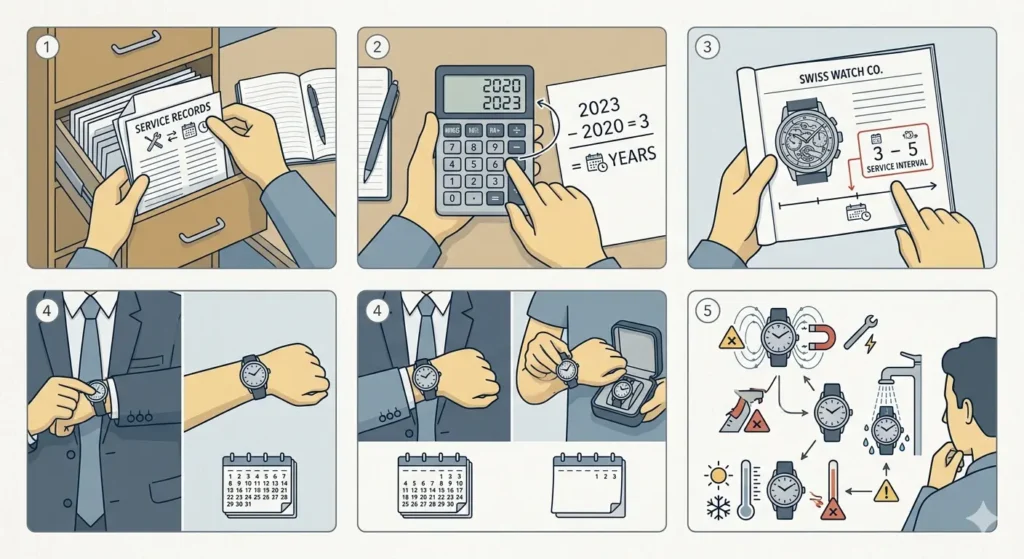
Preventive maintenance intervals prevent unexpected failures.
- Step 1: Locate service records or paperwork from previous maintenance.
- Step 2: Calculate years since the last complete service.
- Step 3: Check the manufacturer’s recommended service interval (typically 3-5 years).
- Step 4: Consider usage frequency (daily wear vs. occasional use).
- Step 5: Factor in exposure to magnetic fields, water, or extreme temperatures.
Pro-Tip: Even if a watch runs perfectly, lubricants deteriorate over time. Service intervals exist to prevent damage, not just fix problems. Watches worn daily need servicing at the shorter end of manufacturer intervals.
Tips for Maintaining Your Watch Between Services
Proper daily care extends service intervals and prevents premature wear.
- Wind manual watches at the same time daily, preferably in the morning when off the wrist
- Remove watches before activities involving strong magnetic fields (MRI machines, large speakers)
- Have water resistance tested annually if the watch gets wet regularly
- Store automatic watches in a watch winder if not worn for extended periods
- Avoid exposing watches to extreme temperature changes (hot tub to cold pool)
- Clean the case and bracelet monthly with a soft cloth and mild soap
- Keep watches away from chemicals like perfume, lotions, and household cleaners
- Use timing tools to track accuracy trends over weeks
Common Problems That Indicate Service is Needed
Date Wheel Misalignment
When date numbers appear partially cut off or misaligned in the window, the date wheel mechanism needs adjustment. This often results from impact or worn positioning springs.
Bracelet or Clasp Looseness
While not a movement issue, loose bracelets can cause the watch to fall and suffer severe damage. Tightening screws and replacing worn pins prevents this risk.
Magnetization Symptoms
Sudden timekeeping changes (gaining 5+ minutes daily) often indicate magnetization from electronics. Professional demagnetization takes minutes and restores accuracy immediately.
Oxidation on the Dial
Brown or green spots on the dial signal moisture intrusion and oxidation. This requires immediate service to prevent permanent dial damage and movement corrosion.
Second Hand Skipping
In quartz watches, the second hand jumping multiple seconds (usually 2-5) indicates low battery. In mechanical watches, any skipping suggests damaged gears or low power reserve.
Luminous Material Degradation
Fading lume does not affect function but indicates the watch’s age. Relumination during service restores nighttime legibility.
Bezel Malfunction
Unidirectional bezels that spin freely both directions or lock up completely need service to restore proper operation and safety for dive timing.
Frequently Asked Questions
How often should a mechanical watch be serviced?
Mechanical watches require complete servicing every 3-5 years depending on the manufacturer and usage. Rolex recommends 10 years for newer models, while most Swiss brands suggest 5 years. Daily wear watches need servicing more frequently than occasional-use timepieces.
Can a watch run fine but still need service?
Yes, watches often function normally while lubricants deteriorate internally. Dried oils cause friction and accelerated wear invisible to users. Following manufacturer service intervals prevents damage even when performance seems perfect.
What happens if a watch is never serviced?
Without service, lubricants dry out and components wear against each other. This leads to damaged pivots, worn gears, broken parts, and eventually complete movement failure requiring expensive repairs or replacement.
How much does watch servicing typically cost?
Basic quartz watch service costs $50-$150, while mechanical watch service ranges from $200-$1000+ depending on complexity. Chronographs and complicated movements cost more due to additional parts and labor time required.
Should a watch be serviced if it stops working?
A stopped watch definitely requires service, but the longer it sits unrepaired, the more damage accumulates. Internal oils congeal, and parts can seize. Prompt service after failure prevents secondary damage and reduces repair costs.
Do quartz watches need less maintenance than mechanical?
Quartz watches require service less frequently (5-10 years) but still need it. Battery acid can leak and damage circuits. Seals deteriorate over time regardless of movement type. Regular battery changes and occasional seal replacement keep quartz watches running.
How accurate should a mechanical watch be to avoid service?
COSC-certified chronometers should stay within -4 to +6 seconds daily. Standard mechanical watches performing within -10 to +30 seconds daily generally do not need service for timekeeping alone. Compare performance using precision time references for accurate measurement.
Can water damage be fixed during regular service?
Minor water intrusion caught early can be remedied during service by replacing seals and cleaning affected parts. Severe water damage with rust requires expensive restoration including dial refinishing, hand replacement, and complete movement rebuilding.
Is it better to service a watch early or wait until problems appear?
Preventive service following manufacturer intervals costs less than repair service after problems develop. Early servicing replaces worn parts before they damage other components, ultimately saving money and preserving the watch’s value.
What should be included in a complete watch service?
Complete service includes full disassembly, ultrasonic cleaning of all parts, inspection for wear, replacement of worn components, lubrication, reassembly, timing adjustment, seal replacement, and water resistance testing. Partial services skip some steps and cost less but provide less protection.