

Setting up your first watch tool kit is one of the most important steps before attempting any watch repair or maintenance. The right tools make all the difference between a clean, successful job and a damaged movement. This guide walks through exactly what to get, how to organize everything, and how to get started the right way.
Key Takeaways
- A basic watch tool kit includes case openers, screwdrivers, tweezers, a movement holder, and a loupe
- Quality matters more than quantity – a few reliable tools outperform a large cheap set
- Workspace setup is just as important as the tools themselves
- Always work on a watch mat to prevent scratches and lost parts
- Proper storage and organization keeps tools in working condition longer
Step-by-Step Guide to Setting Up Your First Watch Tool Kit
Essential Tools to Include in Your Kit
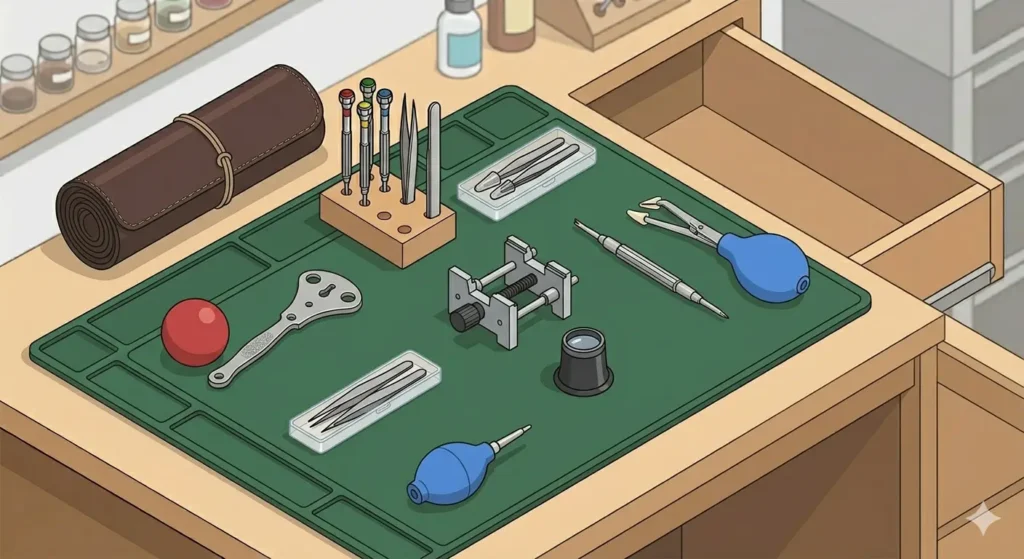
Before anything else, getting the right tools is the foundation. Buying a cheap all-in-one kit might seem like a good start, but most of those sets use low-grade steel that strips screws and damages case backs. The key is to invest in a few quality pieces rather than a drawer full of tools that do not hold up.
Here are the must-have tools for any beginner watch kit:
- Watch case back opener: Both a friction ball type and a notched wrench cover most cases
- Precision screwdrivers: A set with interchangeable blades in sizes 0.6mm, 0.8mm, 1.0mm, 1.2mm, and 1.6mm is the standard starting range
- Fine-tip tweezers: Anti-magnetic stainless steel, ideally a #3 and #5 style
- Movement holder or movement cushion: Keeps the movement stable while working
- Loupe or optivisor: A 5x or 10x loupe is standard for close-up work
- Spring bar tool: Essential for strap changes and bracelet removal
- Watch hand remover: A lever-type hand puller protects the dial during disassembly
- Dust blower: A rubber air blower keeps dust off movements and crystals
- Watch mat: A thick rubber or silicone mat prevents scratches and stops parts from rolling away
Choosing the Right Screwdrivers
Screwdrivers are the most used tool in any watch kit. Most people find that a rotating head screwdriver set – where the top spins freely while the handle is held steady – gives far better control than a standard style. Bergeon and Horotec are trusted brands used by professional watchmakers. The blades must match the screw head exactly; a blade that is too wide will slip and gouge the surrounding surface.
Keep a few spare blades on hand. Blades dull faster than expected, and a worn blade is the most common cause of stripped watch screws.
Selecting a Loupe or Magnifier
A loupe sits against the eye socket and holds in place while both hands stay free. Most beginners start with a 5x magnification, which gives a clear view of the dial, hands, and larger movement components. Moving up to a 10x loupe helps when working with smaller movements or inspecting jewels and pivots more closely.
An optivisor is a head-mounted magnifier that works well for longer sessions since it reduces eye strain. This works best when doing extended disassembly work rather than quick case-back inspections. Whichever is chosen, optical quality matters – cheap magnifiers distort edges and make precise work harder, not easier.
Setting Up Your Workspace
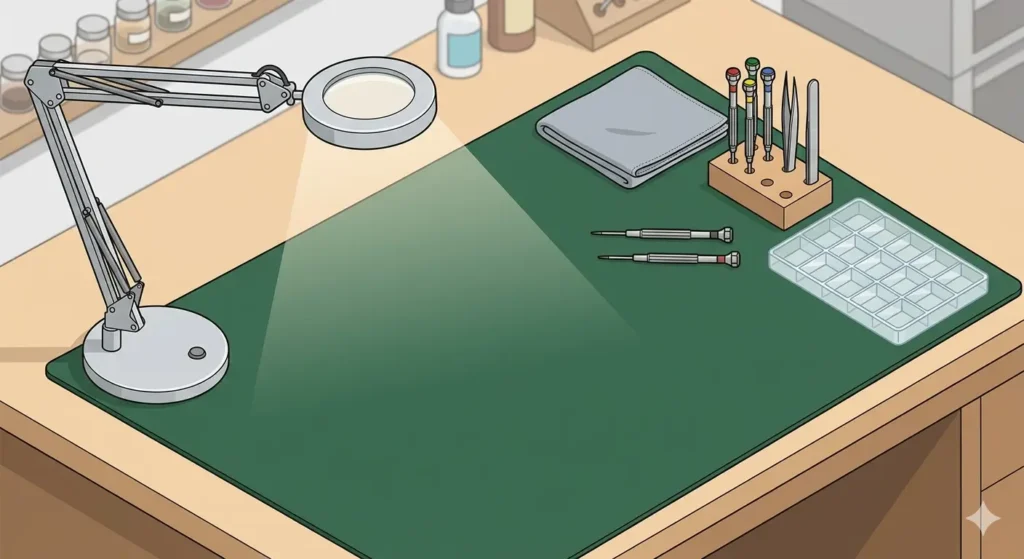
Tool quality only goes so far if the workspace is not set up properly. A clean, stable, well-lit surface is non-negotiable. Watch parts are tiny and can vanish in seconds on a cluttered desk.
- Step 1: Place a large watch mat across the work surface. This catches loose parts and protects cases and crystals from scratches.
- Step 2: Set up a dedicated light source angled slightly to the side. Direct overhead lighting creates glare on polished surfaces. A daylight LED lamp rated around 5000K-6500K gives the most accurate colour rendering.
- Step 3: Place parts trays or a sectioned tray within easy reach. Small clear containers or a dedicated watch parts tray keeps screws, springs, and hands organized during disassembly.
- Step 4: Keep a clean microfiber cloth nearby for wiping tools and handling cases without leaving fingerprints.
- Step 5: Store tweezers and screwdrivers upright in a holder or lay them flat on the mat. Never leave them loose where they can roll and bend.
Pro-Tip: When tracking time on a project or logging how long a service takes, using an online stopwatch keeps everything accurate without needing a separate device cluttering the workspace.
Organizing and Storing Your Tools
Proper storage extends the life of every tool in the kit. Precision screwdrivers especially need to be stored where the blades are protected from contact with other metal objects.
- Use a screwdriver stand or roll-up leather pouch to keep blades separated
- Store tweezers in a protective case or individually wrapped in tissue to prevent tip damage
- Keep the watch mat rolled or flat in a clean drawer, not folded, to avoid permanent creases
- Case openers and spring bar tools can be stored in a divided tray or small toolbox
- Always cap or cover any tool with an exposed point when not in use
Building the Kit Over Time
Starting with the essentials is the right approach. Resist the urge to buy every specialty tool upfront. Most beginner watch work – strap changes, battery replacements, case back removal – only needs the core kit.
As skills grow, tools like an ultrasonic cleaner, timing machine, case press, or mainspring winder become more relevant. Add them as specific needs come up rather than all at once. A focused, high-quality kit of ten tools beats a cluttered drawer of thirty mediocre ones every time.
For anyone working across multiple time zones or coordinating watch service logs with international clients, a world time comparison tool is a practical addition to the digital side of the workflow.
Pro-Tip: Label or color-code different screwdriver blade sizes using small colored dots or nail polish on the handles. This saves significant time during reassembly when the correct size needs to be grabbed quickly without stopping to measure.
Tips for Getting the Most Out of Your Watch Tool Kit
- Always use the correct size screwdriver blade – measure the screw slot before choosing
- Clean tweezers regularly with isopropyl alcohol to remove oils and residue that can transfer to movements
- Never force a case back – a proper opener matched to the case style does all the work
- Work slowly at first – speed comes naturally with practice, and rushing causes most beginner mistakes
- Keep a small notebook at the workstation to record which screws came from which position during disassembly
- Replace screwdriver blades at the first sign of wear or rounding – a fresh blade is far cheaper than a stripped screw
Common Problems and How to Fix Them
Fix 1: Screwdriver Blade Keeps Slipping
This usually means the blade is too wide for the screw slot, or the blade is worn and no longer holds its edge. Match the blade width exactly to the screw and replace worn blades immediately. Applying very slight downward pressure while turning also helps keep the blade seated.
Fix 2: Case Back Will Not Open
Snap-back cases sometimes require more grip than expected. A friction ball opener works well for most snap backs – press firmly and twist. For screw-down case backs, make sure the correct notches on the wrench are matched to the indentations on the case back. Using the wrong notch positions can round the case back edge over time.
Fix 3: Spring Bar Tool Scratching the Lug
This happens when the tool tip slips off the spring bar end. Hold the tool at a low angle and work slowly. Some spring bar tools have a forked tip on one end specifically for this – use that side rather than the pointed pin end when access allows.
Fix 4: Parts Disappearing During Disassembly
A common frustration. The solution is a proper work mat with slightly raised edges, combined with always working over the mat rather than to the side of it. Moving slowly and placing each removed part immediately into a parts tray prevents the ‘launch effect’ where small springs and screws fly across the room.
Fix 5: Tweezers Leaving Marks on Parts
Tweezers with too much spring tension, or tips that are not properly aligned, can mark soft metal parts. Check that both tips meet evenly when closed. For delicate dial work, wrap the tweezer tips in a very small piece of soft tissue to add a buffer layer.
Frequently Asked Questions
What is the minimum number of tools needed to start a basic watch tool kit?
A functional beginner kit needs at minimum: a case back opener, a set of precision screwdrivers (sizes 0.6mm to 1.6mm), a pair of fine tweezers, a spring bar tool, a watch mat, and a loupe. These seven items cover the most common watch tasks including strap changes, battery replacements, and basic movement inspection.
Is it better to buy an all-in-one watch tool kit or individual tools?
Individual tools from reputable brands generally outperform all-in-one kits at similar price points. All-in-one kits often include many tools that go unused while the most-used tools – especially screwdrivers – tend to be lower quality. Building the kit piece by piece around quality essentials is the smarter approach for anyone serious about watch work.
What brands are recommended for beginner watch tools?
Bergeon and Horotec are the most respected brands for precision screwdrivers, tweezers, and case openers. For budget-conscious beginners, Cousins UK house brand tools offer reasonable quality for basic tasks. Avoid unbranded multi-piece sets sold for very low prices, as the steel quality is typically insufficient for precise watch work.
Do watch tools need to be anti-magnetic?
For tweezers, yes – anti-magnetic stainless steel is strongly preferred. Regular steel tweezers can pick up a slight magnetic charge over time and transfer it to movement components, which causes timekeeping problems in mechanical watches. Most quality tweezers sold for watch work are already anti-magnetic, but it is worth confirming before purchasing.
How should precision screwdrivers be maintained?
The rotating head on quality screwdrivers contains a small bearing that benefits from an occasional drop of light oil. Blades should be inspected regularly and replaced when the tip shows any rounding or width reduction. Store screwdrivers upright or in a roll pouch to keep blade tips away from other metal surfaces.
What magnification level is best for a beginner watch loupe?
A 5x loupe is the most practical starting point. It provides enough magnification for case inspection, dial work, and general movement viewing without the very narrow focal depth of higher magnifications. A 10x loupe becomes more useful when inspecting jewel settings, fine pivots, or hairspring conditions.
Can a watch tool kit be used for all types of watches?
A standard beginner kit covers most quartz and basic mechanical watches. Dress watches, dive watches with screw-down crowns, and vintage pocket watches may require additional specialty tools such as specific case back wrench sizes, crown-setting tools, or crystal press sets. The core kit handles the majority of common tasks across modern watch types.
What is the best surface to work on when using a watch tool kit?
A dedicated watch mat made from rubber or silicone is the standard choice. It prevents scratching on polished surfaces, provides enough friction to stop parts from sliding, and cushions dropped components. Some watchmakers prefer a pegwood board for movement work. A flat, non-slip surface that contrasts with small metal parts makes the workspace much safer for small components.
How much should a quality beginner watch tool kit cost?
Buying quality individual tools, a solid beginner kit covering screwdrivers, tweezers, a loupe, case back opener, spring bar tool, and watch mat typically ranges from $80 to $200 USD depending on brand choices. This investment pays off quickly compared to replacing stripped screws or damaged dials caused by inferior tools.
Where is the best place to buy watch tools?
Specialist watch supply retailers are the most reliable source. Cousins UK, Esslinger, and Jules Borel are widely used by hobbyists and professionals. Local jewellery supply shops sometimes carry basics as well. Purchasing from watch-specific suppliers ensures the tools meet the tolerances required for precision work, unlike general purpose tool retailers.