
Learning how to read G-Shock model numbers unlocks the ability to identify any watch’s generation, series, and features at a glance. G-Shock model numbers follow a specific alphanumeric system that reveals everything from the watch’s family line to its color variant, making it essential knowledge for collectors, buyers, and enthusiasts who want to verify authenticity and understand what they own.
Key Takeaways
- G-Shock model numbers use a standardized format: Module Number, Series Code, Generation Number, and Variant Code
- The first letter indicates the watch family (G for G-Shock, GA for Analog-Digital, DW for Digital Watch)
- Numbers following the letters reveal the generation and specific model within that series
- The final digit or letter combination indicates the color variant
- Case back engravings provide the most accurate model identification
- Understanding this system helps verify authenticity and identify exact specifications
Understanding the G-Shock Model Number Structure
Every G-Shock watch carries a model number that follows Casio’s systematic naming convention. This alphanumeric code appears on the case back, instruction manual, and original packaging. The structure breaks down into four main components that work together to create a unique identifier for each watch.
The basic format looks like this: [Series Letters][Generation Number][Variant Code]. For example, in the model number DW-5600E-1V, each segment tells a specific part of the watch’s story. This standardized system has remained consistent since G-Shock’s inception in 1983, though variations exist for special editions and collaborations.
Locating the Model Number on the Watch
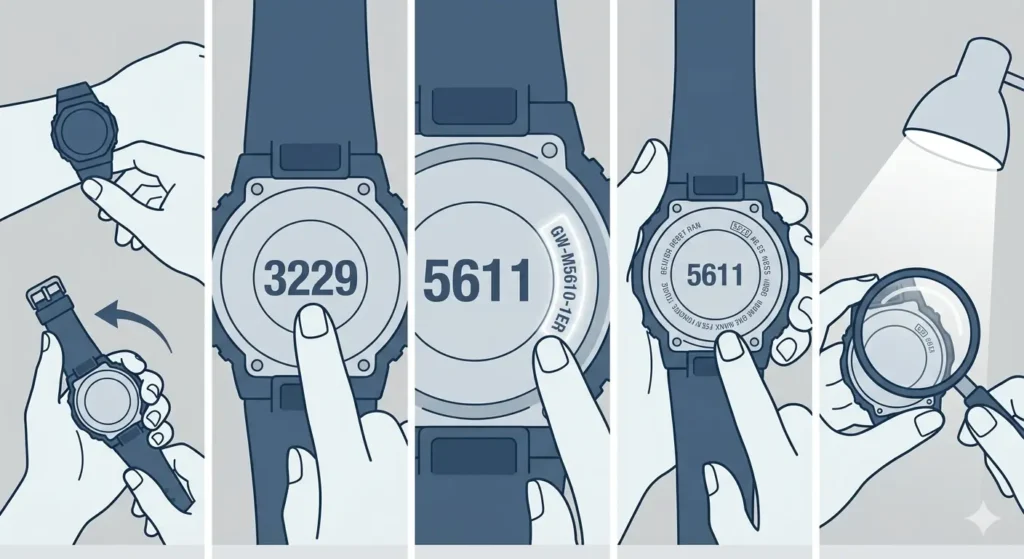
The case back holds the primary source for accurate model identification. Flip the watch over and look for engraved text that includes both the module number and the full model designation.
- Step 1: Remove the watch from the wrist and turn it over to view the case back
- Step 2: Look for a four-digit module number (like 3229 or 5611) prominently displayed
- Step 3: Find the full model number near the module number, typically engraved in smaller text
- Step 4: Check the area around the edge of the case back if the center portion shows only the module number
- Step 5: Use adequate lighting or a magnifying glass for smaller engravings on compact models
Some G-Shock models also display abbreviated model information on the watch face or dial, though this rarely shows the complete designation. The packaging and instruction manual provide additional confirmation, with the model number printed on labels and documentation.
Decoding the Series Letters
The letter prefix identifies which G-Shock family the watch belongs to, indicating its primary display type and design philosophy. Each series carries distinct characteristics that define its functionality and aesthetic.
Common Series Codes
DW (Digital Watch): The original G-Shock designation for fully digital displays. Models like the iconic DW-5600 represent the classic square design that started the brand. These watches feature LCD screens showing time, date, and various functions without analog hands.
GA (Analog-Digital): Combination watches featuring both analog hands and digital displays. The GA-2100, known as the ‘CasiOak,’ exemplifies this hybrid approach. These models appeal to those wanting traditional watch aesthetics with digital functionality.
GW (G-Wave): Indicates atomic timekeeping capability with radio-controlled synchronization. GW models automatically adjust to atomic clock signals in supported regions, maintaining exceptional accuracy. The solar-powered charging typically accompanies this designation.
GD (Digital): Standard digital models that may lack some premium features found in DW series. GD watches often represent more affordable entry points into the G-Shock lineup while maintaining core shock resistance.
MTG (Metal Twisted G-Shock): Premium line combining metal construction with resin components. MTG models target professionals seeking elevated aesthetics without sacrificing G-Shock durability. These watches incorporate multiple materials for refined appearance.
MRG (Metal Refined G-Shock): The flagship series representing the highest tier of G-Shock craftsmanship. MRG models use titanium construction, sapphire crystals, and advanced finishing techniques. These watches command premium prices reflecting their luxury positioning.
Pro Tip: The series letters alone reveal major features before checking detailed specifications. This quick identification helps when comparing models or verifying listings match their descriptions accurately.
Breaking Down the Generation Number
The numeric portion following the series letters indicates which generation or model line the watch belongs to within that family. Lower numbers typically represent earlier designs, while higher numbers indicate newer releases or distinct model lines.
For the DW-5600 series, the ‘5600’ designates the iconic square case design that debuted in 1987. This number has become synonymous with the classic G-Shock aesthetic. Meanwhile, the ‘6900’ in DW-6900 identifies the round case with three circular subdials, another beloved design language.
Generation numbers help track evolutionary improvements within a series. The GA-100 introduced the oversized analog-digital format, while the GA-110 refined that design with subtle enhancements. Understanding these progressions helps identify which iteration offers desired features.
Interpreting Model Evolution
Casio sometimes uses sequential numbering to indicate updates within the same basic design. The DW-5600E improved upon the original DW-5600C with an electroluminescent backlight. The DW-5600HR added a high-definition LCD for enhanced visibility. Each iteration maintains the core 5600 identity while introducing specific improvements.
Special edition numbers often deviate from standard sequences. Collaboration models might use unique numbering that references the partner brand or theme. Anniversary editions frequently incorporate meaningful digits related to the celebration, like ’35’ for a 35th anniversary model.
Understanding Variant Codes
The final segment of a G-Shock model number specifies the color scheme and minor variations that distinguish otherwise identical watches. This code typically consists of a dash followed by numbers and sometimes letters.
Common variant patterns include:
- -1: Standard black colorway, the default option for most models
- -2: Blue color scheme or blue accent variant
- -3: Gray or silver coloring
- -4: Red accents or red-based color scheme
- -7: White or light-colored variant
- -9: Gold or premium metallic finish
Letter suffixes provide additional specificity. The ‘V’ in DW-5600E-1V indicates a specific regional variant or packaging configuration. Some models use ‘A’ for Asian market versions, ‘C’ for certain color combinations, or ‘D’ for updated revisions.
Limited editions often feature unique variant codes that break from standard patterns. The DW-5600NASA-4 uses ‘4’ to indicate the red color matching the collaboration theme, while special packaging and markings distinguish it from regular -4 variants.
Identifying Module Numbers
The module number represents the internal movement or electronic caliber powering the watch. This four-digit code determines the available functions, settings options, and operational characteristics regardless of external appearance.
Module numbers appear prominently on the case back and match specific instruction manual versions. When needing guidance for setting world time features or configuring alarms, the module number identifies the correct reference manual.
Common Module Numbers and Features
Module 3229: Powers the classic DW-5600 series with standard G-Shock functions including stopwatch, countdown timer, alarm, and EL backlight. This movement represents the straightforward digital G-Shock experience without advanced complications.
Module 5611: Found in solar-powered models with Multi-Band 6 atomic timekeeping. This module adds automatic time synchronization to solar charging capability, eliminating battery replacement and manual time adjustment in supported regions.
Module 5549: Drives GA-2100 series watches with analog-digital display. This movement manages both hand movement and digital functions while maintaining the slim profile that defines the CasiOak line.
Understanding module numbers helps identify functional equivalents across different case designs. Two watches sharing the same module number offer identical features despite appearing visually distinct. This knowledge aids in selecting models based on capability rather than aesthetics alone.
Special Edition and Collaboration Naming
Collaborative releases and special editions often append additional identifiers to standard model numbers. These extensions reference the partnership, theme, or limited nature of the release.
The DW-5600NASA-4 clearly indicates the NASA collaboration through its suffix. Similarly, the GA-2100THB-7A includes ‘THB’ to denote the ‘Tone-on-Tone Beige’ color series. These extra codes help distinguish limited releases from standard production models sharing the same base design.
Anniversary models might use ‘TH’ for ‘anniversary’ (from Japanese) or incorporate year digits. The DW-5040RX-7 celebrates specific milestones with unique numbering that breaks from typical sequences. Collectors recognize these patterns as indicators of special significance.
Retail exclusive models sometimes carry unique suffixes indicating distribution channels. ‘JR’ might denote Japanese retail exclusive, while other codes indicate department store collaborations or online-only releases. These markers help track rarity and distribution scope.
Regional Variations and Market Codes
G-Shock model numbers occasionally include subtle differences based on intended market. Japanese Domestic Market (JDM) models might use slightly different variant codes compared to international releases, though functionality remains identical.
The same watch sold in different regions might show codes like DW-5600E-1VDF (international), DW-5600E-1V (US market), or DW-5600E-1JF (Japan). The base model designation remains consistent while suffixes indicate packaging language, warranty coverage, and regional distribution.
Multi-Band 6 models designed for atomic timekeeping display region-specific compatibility. North American models synchronize with Fort Collins, Colorado signals, while European versions connect to Mainflingen, Germany transmitters. The functionality adapts to regional infrastructure despite identical model foundations.
When purchasing internationally, understanding these regional codes ensures compatibility with local atomic time signals and warranty support. Time synchronization features work optimally when the watch matches the intended region’s broadcast specifications.
Tips for Model Number Research
Effective research starts with accurate transcription of the complete model number from the case back. Missing even a single digit or letter leads to incorrect identification or failed searches.
- Photograph the case back clearly with adequate lighting to reference later
- Cross-reference the module number with official Casio documentation for feature confirmation
- Search the complete model number including variant code for precise results
- Compare listed specifications against what the model number indicates to verify authenticity
- Check multiple sources when researching limited editions or older discontinued models
Official Casio websites provide the most reliable reference for current production models. For discontinued or vintage pieces, established collector communities and specialty retailers offer archived information. The module number search often yields instruction manual PDFs that confirm specifications when other resources prove limited.
Pro Tip: When buying pre-owned watches, verify the case back model number matches the seller’s listing exactly. Discrepancies between advertised model and actual engraving signal potential authenticity issues or listing errors that warrant clarification before purchase.
Common Problems When Reading Model Numbers
Worn engravings on heavily used watches can make model number identification challenging. The case back experiences regular contact with surfaces, causing text to fade over years of wear.
Fix 1: Dealing With Faded Engravings
Proper lighting angle helps reveal worn text. Hold the watch under bright light while tilting it to create shadows within engraved grooves. The contrast between lit surfaces and shadowed recesses makes faded numbers readable.
Gentle cleaning removes accumulated dirt obscuring text. Use a soft toothbrush with mild soap and water to clean the case back, then dry thoroughly. Debris often fills engraved areas, reducing contrast and legibility.
Magnification tools assist with reading extremely worn or small engravings. Smartphone cameras with macro capability or handheld magnifiers reveal details invisible to naked eyes. Taking multiple photos under different lighting conditions captures various angles for comparison.
Fix 2: Verifying Suspicious Model Numbers
Counterfeit watches sometimes display model numbers that don’t exist in official Casio catalogs. Cross-referencing the complete model number with official sources confirms legitimacy.
Check whether the module number matches the model designation. Casio uses specific module numbers for particular model lines consistently. Mismatched pairings suggest either counterfeit production or incorrect identification.
Compare the physical watch features against specifications for that model number. If the case back claims DW-5600E-1V but the watch has analog hands, obvious discrepancies indicate authentication issues requiring expert evaluation.
Fix 3: Distinguishing Similar Model Numbers
Models with nearly identical numbers sometimes differ only by a single character. The GA-2100-1A1 and GA-2100-1A feature subtle case finish differences that the variant code distinguishes. Careful attention to every character prevents confusion between closely related models.
Creating a reference list of owned watches with complete model numbers prevents mix-ups in multi-watch collections. This becomes especially important when storing watches in cases where similar models sit together. Quick reference to exact variant codes eliminates guesswork.
Frequently Asked Questions
Where exactly is the model number located on a G-Shock watch?
The model number appears engraved on the case back of every G-Shock watch. Look for alphanumeric text near the center or along the edge of the metal case back plate. Most models display both the four-digit module number and the complete model designation in this location.
What does the first letter in a G-Shock model number mean?
The first letter or letter combination indicates the watch series and primary display type. DW stands for Digital Watch, GA means Analog-Digital combination, GW indicates radio-controlled atomic timekeeping capability, and MTG represents Metal Twisted G-Shock premium models. This prefix immediately identifies the watch family.
Can two G-Shock watches have the same model number?
No, each unique combination of series code, generation number, and variant designation identifies a specific G-Shock configuration. While multiple watches share the same base model (like DW-5600E), the complete model number including variant code (such as DW-5600E-1V versus DW-5600E-9V) distinguishes different color options and regional versions.
What is the difference between model number and module number?
The model number identifies the specific watch variant including case design and color scheme. The module number refers to the internal electronic movement or caliber that powers the watch functions. Multiple different model numbers can share the same module number when they use identical internal movements despite different external appearances.
How can someone tell if a G-Shock model number is authentic?
Verify the model number appears in official Casio catalogs or documentation. Cross-reference the module number with the model designation to ensure proper pairing. Check that physical features match published specifications for that model. Counterfeit watches often display non-existent model numbers or mismatched module-model combinations.
Do G-Shock model numbers reveal the manufacturing year?
Model numbers do not directly indicate manufacturing year. The production date appears separately on the case back, typically as a code showing month and year. However, knowing when Casio introduced specific model lines helps estimate age – for example, GA-2100 series debuted in 2019, so any GA-2100 necessarily dates from that year forward.
Why do some G-Shock models have letters after the variant number?
Letter suffixes indicate regional market versions, packaging variations, or minor specification differences. Common examples include ‘V’ for certain international variants, ‘JF’ for Japanese market models, ‘DR’ for specific distribution channels, and ‘A’ for Asian market versions. These codes help Casio track distribution while maintaining functional equivalence across regions.
What does the number following the series letters indicate?
The numeric portion represents the generation or specific model line within that series family. Lower numbers typically indicate earlier designs, while higher numbers represent newer releases or distinct model lines. For example, ‘5600’ designates the classic square G-Shock case, while ‘6900’ identifies the round case with triple subdial layout.
Can someone use the model number to find the instruction manual?
The module number provides the most reliable way to locate the correct instruction manual. Casio organizes user guides by module number rather than model number, since multiple models sharing the same module use identical instructions. Find the four-digit module number on the case back, then search Casio’s support website using that number for the appropriate manual.
Do limited edition G-Shocks follow the same numbering system?
Limited editions follow the base numbering structure but often add unique suffixes indicating the collaboration or special theme. These extensions help distinguish limited releases from standard production models. While the core model designation follows standard patterns, the additional codes provide specific identification for collectors and enthusiasts tracking special releases.