
A scratched watch case can make even a quality timepiece look worn and neglected. The good news is that polishing scratches out of a watch case at home is entirely doable – no watchmaker visit required. With the right tools, a bit of patience, and a clear step-by-step process, most surface scratches can be removed or significantly reduced in under an hour.
Quick Summary
- Surface scratches on metal watch cases can be polished out at home using metal polish, fine-grit sandpaper, or a polishing cloth.
- Different finishes (brushed vs. polished) require different techniques – matching the original finish is key.
- Always remove the watch strap and protect the crystal and gaskets before starting.
- Deep gouges may need professional attention, but light to moderate scratches respond well to home polishing.
- The full process typically takes 30 to 60 minutes depending on scratch depth and case material.
Step-by-Step Guide to Polishing Scratches Out of a Watch Case
What You Will Need
- Microfiber cloths (at least 2-3)
- Metal polish (such as Polywatch, Autosol, or Brasso for metal cases)
- Fine-grit sandpaper (400, 800, and 1200 grit for deeper scratches)
- Painter’s tape or masking tape
- A soft toothbrush
- Mild dish soap and warm water
- A spring bar tool or small flathead screwdriver (to remove the strap)
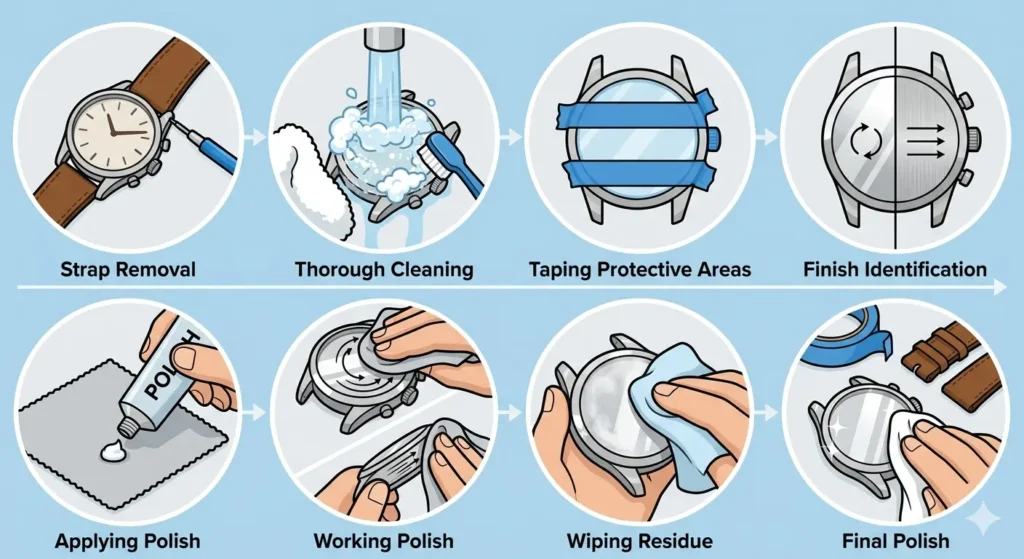
- Step 1: Remove the watch strap or bracelet using a spring bar tool. This protects the strap from polish chemicals and gives full access to the case edges and lugs.
- Step 2: Clean the watch case thoroughly with mild dish soap and warm water. Use a soft toothbrush to get into the crevices. Dry it completely with a microfiber cloth.
- Step 3: Apply painter’s tape over the watch crystal, pushers, crown, and any gasket areas. These parts should never come into contact with abrasive polish.
- Step 4: Identify the finish on the case. Polished (mirror-like) surfaces need a circular buffing motion. Brushed (matte/satin) finishes require straight-line strokes in the direction of the grain.
- Step 5: Apply a small pea-sized amount of metal polish onto a microfiber cloth. For light scratches, start directly with polish. For deeper scratches, begin with 800-grit sandpaper, then progress to 1200-grit before moving to the polishing stage.
- Step 6: Work the polish into the scratched area using firm but controlled pressure. For polished cases, use small circular motions. For brushed cases, work only in straight lines following the original grain direction.
- Step 7: Wipe away the polish residue with a clean microfiber cloth and inspect the surface. Repeat the polishing step as needed until the scratch is no longer visible or has been significantly reduced.
- Step 8: Do a final buff with a clean, dry microfiber cloth to restore the shine. Remove the painter’s tape carefully and reattach the strap.
Pro-Tip: Always work in small sections and check progress frequently. Over-polishing a single spot can thin the metal or create an uneven surface, especially on thinner stainless steel cases.
Polishing by Watch Case Material
Stainless Steel Cases
Stainless steel is the most forgiving material for home polishing. Metal polishes like Autosol or Mothers Mag work well. Light scratches usually respond after just one or two passes with polish. The key is to keep strokes consistent and avoid mixing circular and straight-line techniques on the same surface.
Titanium Cases
Titanium is harder than steel and more scratch-resistant, but it is also harder to restore. The metal does not respond as dramatically to standard polishes. A specialized titanium polish or a very fine abrasive cloth works best. Expect the process to take longer and require more passes.
Gold and Gold-Plated Cases
Solid gold cases can be polished gently with a soft cloth and a very mild jewelry polish. Gold-plated cases are a different story – aggressive polishing can wear through the plating entirely. Stick to a polishing cloth only, no abrasives, and use very light pressure.
PVD and DLC Coated Cases
Physical Vapor Deposition (PVD) and Diamond-Like Carbon (DLC) coatings are extremely thin. Once scratched, the coating itself is damaged and cannot be restored at home. Polishing these cases will only remove more coating. Professional re-coating is the correct solution here.
How to Restore a Brushed Finish
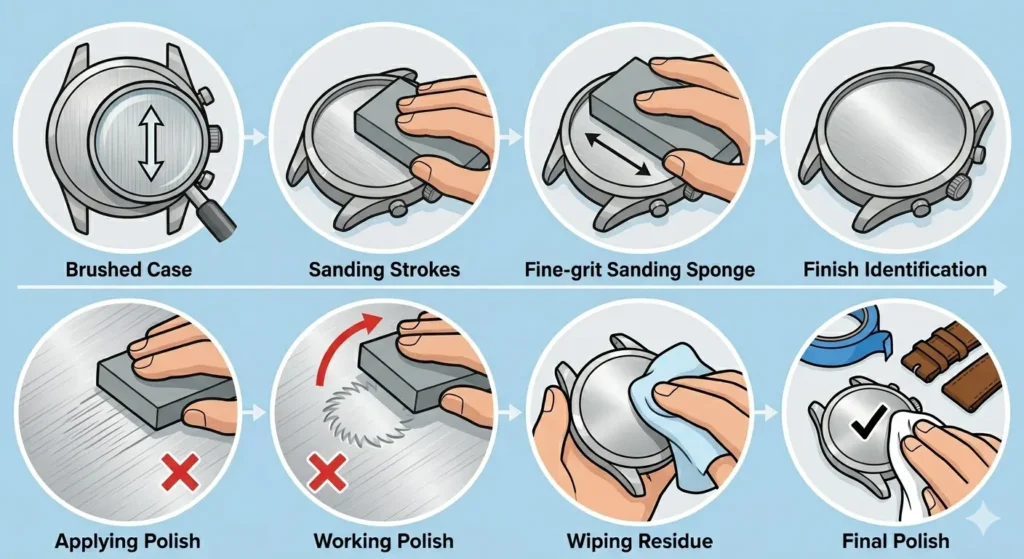
Restoring a brushed finish is where most beginners make mistakes. The goal is to recreate the fine directional lines that give a brushed surface its appearance. This works best when done with a Scotch-Brite pad or fine-grit sandpaper (1200 to 2000 grit), always moving in one consistent direction.
- Step 1: Identify the direction of the existing brush lines on the case surface.
- Step 2: Using a fine-grit sanding sponge or Scotch-Brite pad, make smooth, even strokes in that exact direction from one end of the surface to the other.
- Step 3: Avoid stopping mid-stroke or changing direction, as this will create visible inconsistencies.
- Step 4: Wipe clean with a microfiber cloth and inspect under good lighting. Repeat until the finish looks uniform.
Pro-Tip: Use a piece of tape to mark the grain direction on the case before starting. It is easy to lose track of the angle when working up close, and even a slight deviation will be visible once the case is cleaned up.
Tips for Best Results
- Work under good, direct lighting – natural daylight or a bright lamp makes scratches and progress much easier to see.
- Less is more with polish. A small amount on a microfiber cloth is always better than a heavy application.
- Check the case with a loupe or magnifying glass between passes to track progress without over-polishing.
- Keep a dry cloth nearby to wipe residue frequently. Polish dries quickly and can become harder to remove if left too long.
- If timing is part of the work session – say, testing how long each polish pass takes – a reliable online stopwatch can help track intervals accurately without picking up the phone.
- For multiple watches being done in the same session, use a clock tab in the browser to keep track of overall time without interruption.
Common Problems and How to Fix Them
The Scratch Is Still Visible After Multiple Passes
If the scratch is still visible after 5 to 6 rounds of polishing, it is likely a deep gouge rather than a surface scratch. Drop down to a coarser sandpaper (600 or 800 grit) to level the area first, then work back up through finer grits before finishing with polish. This process removes more metal but is more effective on deeper damage.
The Surface Looks Uneven or Cloudy After Polishing
This usually happens when polish residue was not fully removed between passes, or when too much pressure was applied unevenly. Wipe the surface clean with a fresh microfiber cloth, apply a very small amount of polish, and do one final light buff using consistent pressure across the whole panel.
The Brushed Finish Looks Shiny in One Spot
This happens when a polished surface accidentally creates a mirror effect on a brushed area. The fix is to re-brush that section using a fine Scotch-Brite pad or 1500-grit sandpaper in the correct grain direction. Take time to blend the new brushing into the surrounding area by extending the strokes beyond the affected zone.
The Watch Crystal Got Scratched During the Process
If polish got onto a mineral or sapphire crystal and caused micro-scratches, a dedicated crystal polish like Polywatch can address this on acrylic and some mineral crystals. Sapphire crystals are extremely hard and nearly impossible to scratch with standard metal polish, so if scratches appear on sapphire, they were likely already present.
Polish Got Into a Gap Around the Crown or Pushers
This is avoidable with proper taping but fixable if it happens. Use a soft toothbrush and warm soapy water to work the residue out of the gap. A toothpick or sharpened cotton swab can help loosen stubborn dried polish from tight spaces without damaging the crown seal.
Frequently Asked Questions
Can any watch case be polished at home?
Most stainless steel and solid metal cases can be polished at home with good results. However, PVD-coated, DLC-coated, and gold-plated cases require extra caution or professional handling to avoid permanent damage to the finish.
How deep of a scratch can be removed at home?
Light surface scratches and moderate scratches respond well to home polishing. Deep gouges that catch a fingernail significantly are harder to fully remove without professional tools, though their appearance can still be reduced.
Will polishing affect water resistance?
Home polishing itself does not affect water resistance as long as the crown, pushers, and case back gaskets are not disturbed. However, if a watch has not had its gaskets replaced in several years, it is a good idea to have water resistance tested after any external work.
How often can a watch case be polished?
Polishing removes a small amount of metal with each session. For most watches, once every one to two years is reasonable. Over-polishing can soften case edges, round off lugs, and reduce the crispness of the case design over time.
Does polishing affect the value of a vintage watch?
Yes, significantly. Collector-grade vintage watches with original unpolished finishes are more valuable than polished examples. For vintage pieces, it is strongly recommended to leave the original patina intact and consult a specialist before any polishing work.
What is the best metal polish for watch cases?
Autosol and Mothers Mag and Aluminum Polish are popular choices for stainless steel. Polywatch is preferred for crystal polishing. For general case work, a purpose-made watch polish from brands like Cape Cod or Selvyt cloths also deliver clean results without aggressive abrasion.
Can toothpaste be used to polish a watch case?
Toothpaste is sometimes suggested as a DIY alternative, and it can work on very light scratches due to its mild abrasive content. However, it is inconsistent, can leave residue in crevices, and is far less effective than a proper metal polish. A dedicated product is always the better choice.
How do you protect a polished watch from future scratches?
Adhesive watch case protector films (similar to screen protectors) can be applied to polished surfaces. These are nearly invisible and provide a decent barrier against everyday contact scratches. Removing and replacing the bracelet for formal occasions also helps keep the lugs and case back scratch-free during sports or outdoor activities.
Is it safe to polish a watch case without removing it from the strap?
It is not recommended. Polish can stain leather straps, damage rubber, and get trapped in bracelet links. Removing the strap before starting protects it and gives full access to the case sides and lug areas where scratches commonly accumulate.
When should polishing be left to a professional?
Deep structural gouges, scratches near the crystal edge, heavily worn plating, and any damage on high-value or vintage watches are best handled by a professional watchmaker or restoration specialist. The risk of making damage worse outweighs the cost savings of doing it at home.