
Installing a quick-release watch strap takes just minutes and requires no tools. This guide walks through the complete process of removing an old strap and attaching a new one using the quick-release mechanism found on modern watch bands.
Key Takeaways
- Quick-release straps use spring-loaded bars that compress with a lever for easy removal
- The entire process takes 2-3 minutes per strap
- No tools are required – just fingers and gentle pressure
- Compatible straps must match the watch lug width (measured in millimeters)
- The release lever is always located on the underside of the strap near the spring bar
Step-by-Step Installation Guide
Removing the Old Quick-Release Strap
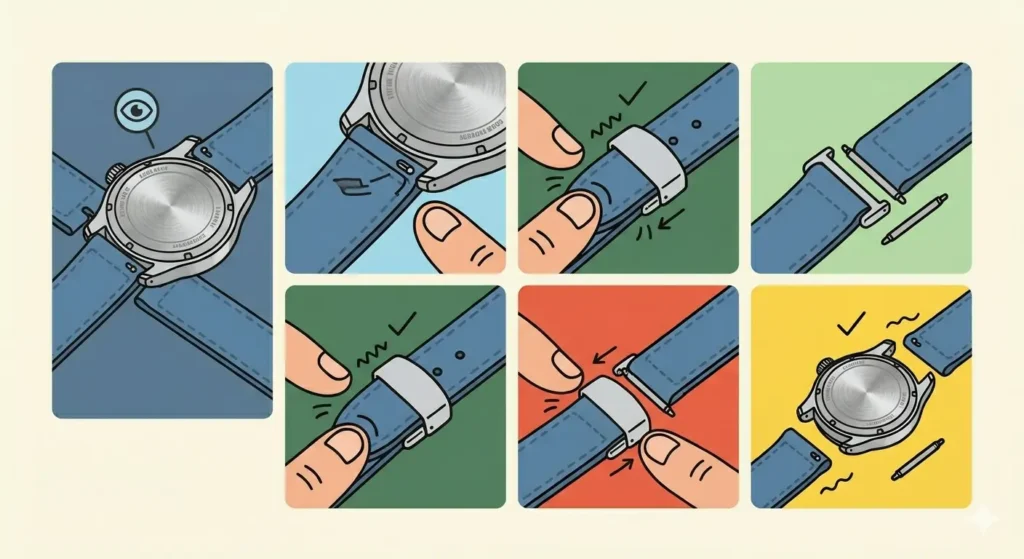
- Step 1: Flip the watch over so the case back faces up and the strap is visible from underneath.
- Step 2: Locate the small lever on the underside of the strap, positioned right next to where the spring bar connects to the watch lug.
- Step 3: Slide the lever toward the center of the strap while gently pulling the strap away from the watch case. This compresses the spring bar and releases it from the lug hole.
- Step 4: Once one side releases, pull that end completely out of the lug.
- Step 5: Repeat the process on the opposite side of the same strap piece.
- Step 6: Remove the second strap piece (the other half) using the same lever-and-pull technique.
Pro-Tip: Always work over a soft surface like a towel or mousepad. If the spring bar slips during removal, it won’t scratch the watch case or disappear into carpet fibers.
Installing the New Quick-Release Strap
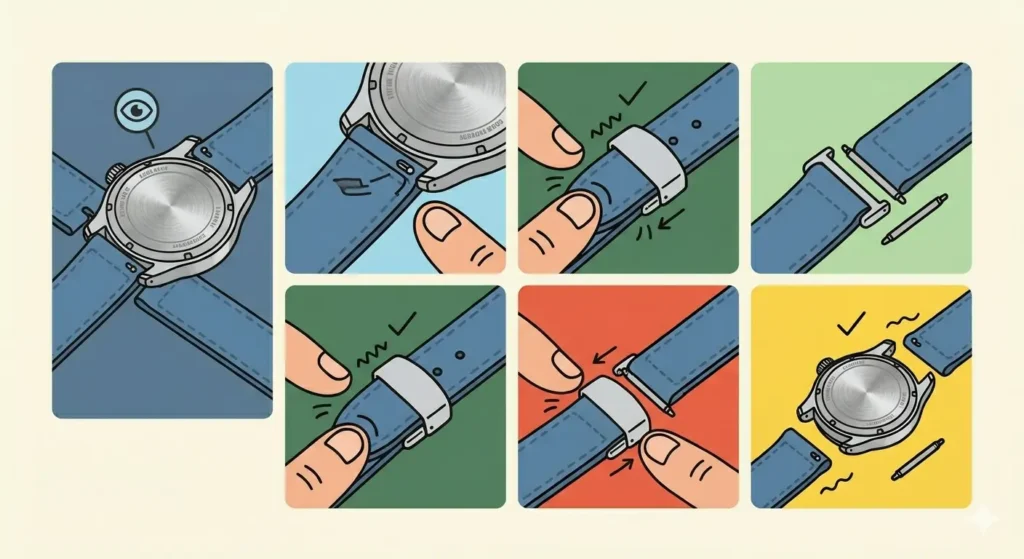
- Step 1: Identify which strap piece goes on top (12 o’clock position) and which goes on bottom (6 o’clock position). The longer piece typically goes on the 6 o’clock side for most watches.
- Step 2: Hold the new strap piece at an angle and insert one end of the spring bar into the lug hole on one side of the watch case.
- Step 3: While keeping that end secured in the lug hole, locate the quick-release lever on the opposite end of the strap.
- Step 4: Slide the lever toward the center of the strap to compress the spring bar, making it shorter.
- Step 5: While holding the lever compressed, align the free end of the spring bar with the opposite lug hole.
- Step 6: Guide the spring bar into the lug hole, then release the lever. The spring bar should snap into place with a slight click.
- Step 7: Gently tug on the strap to confirm it’s securely attached. The strap should not pull free from the lugs.
- Step 8: Repeat steps 2-7 for the second strap piece on the other side of the watch case.
Verifying Proper Installation
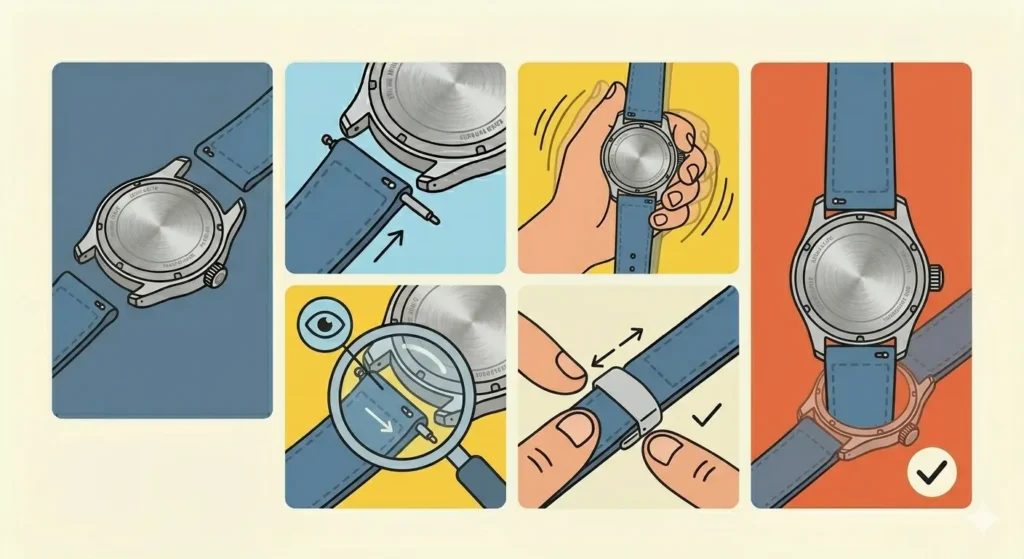
- Step 1: Hold the watch by the case and shake it gently. The straps should remain firmly attached with no movement at the connection points.
- Step 2: Visually inspect each spring bar to ensure it sits completely inside both lug holes, not resting on the edge.
- Step 3: Try sliding each strap side to side. There should be minimal lateral movement – just the natural play between the spring bar and lug holes.
The installation is complete when both strap pieces sit flush against the watch case and resist gentle pulling. Most people find that this process becomes even faster after changing straps a few times, often taking less than a minute per side.
Tips for Smooth Strap Changes
Match the lug width correctly: Measure the distance between the watch lugs in millimeters before purchasing a new strap. Common sizes include 18mm, 20mm, 22mm, and 24mm. A strap that’s even 1mm too wide or narrow won’t fit properly.
Work in good lighting: The quick-release lever is small and easier to manipulate when clearly visible. Natural daylight or a bright desk lamp helps locate the mechanism quickly.
Apply steady pressure: The lever needs firm, consistent pressure to compress the spring bar fully. Hesitant or partial compression may cause the spring bar to slip out of position.
Keep track of orientation: Some straps have a specific top and bottom. Check for any text, patterns, or buckle positions that indicate correct orientation before installation.
Avoid forcing the mechanism: If the spring bar doesn’t slide into the lug hole easily, the lever may not be compressed enough. Never force the connection, as this can damage the spring mechanism or scratch the watch case.
Similar to checking the world time comparison tool before scheduling international calls, taking a moment to verify strap compatibility saves time and prevents frustration during installation.
Common Problems and Solutions
The Lever Won’t Compress the Spring Bar
This happens when debris or dried adhesive blocks the lever mechanism. Clean the underside of the strap connection point with a dry cloth. If the lever still won’t move, the spring bar mechanism may be damaged and the strap needs replacement.
Spring Bar Keeps Popping Out of the Lug Hole
The spring bar may be too short for the lug width, or the lever isn’t releasing fully after compression. Confirm the strap matches the watch lug width. When installing, hold the compressed lever until the spring bar is completely seated in the lug hole, then release slowly.
Strap Feels Loose After Installation
One or both ends of the spring bar may be resting on the edge of the lug hole rather than inside it. Remove the strap and reinstall, ensuring the spring bar clicks fully into both lug holes. A properly installed strap will have minimal side-to-side movement.
Can’t Locate the Quick-Release Lever
The lever sits on the underside of the strap, very close to where the spring bar meets the lug. Rotate the strap and look for a small protruding piece near the connection point. Some straps have subtle levers that blend with the strap material.
New Strap Doesn’t Fit Despite Matching Lug Width
Some watches have curved or recessed lugs that require specific strap designs. Check if the strap ends are shaped for straight lugs while the watch has curved ones, or vice versa. Purchasing straps designed specifically for the watch model ensures proper fit.
Timing strap changes can be as precise as using a online stopwatch – with the right technique, the entire process follows a predictable rhythm.
Frequently Asked Questions
What is a quick-release watch strap?
A quick-release watch strap features a spring bar with an integrated lever mechanism that allows strap removal and installation without tools. The lever compresses the spring bar when pushed, releasing it from the watch lugs instantly.
Do all watch straps have quick-release mechanisms?
No, many traditional watch straps use standard spring bars that require a spring bar tool for removal. Quick-release straps are a modern convenience feature found primarily on interchangeable strap systems and sport watches manufactured in recent years.
Can quick-release straps be used on any watch?
Quick-release straps work on any watch with standard drilled lugs, provided the lug width matches the strap width. However, some watches with integrated bracelets or specialized lug designs may not accommodate standard quick-release straps.
How do I know what size quick-release strap to buy?
Measure the distance between the watch lugs (the two protruding arms where the strap attaches) in millimeters. This measurement, typically ranging from 16mm to 26mm, indicates the required strap width. Most watch specifications list the lug width in the product documentation.
Are quick-release straps as secure as traditional straps?
Yes, properly installed quick-release straps are equally secure. The spring bar mechanism provides the same tension and holding force as traditional spring bars. The quick-release feature affects only the installation method, not the security once installed.
How often should quick-release straps be replaced?
Replace quick-release straps when the spring bar mechanism becomes stiff, fails to compress smoothly, or if the strap material shows significant wear. The spring mechanism typically lasts for dozens of strap changes, but heavy use or exposure to water and chemicals can shorten lifespan.
Can the quick-release mechanism break or fail?
The mechanism can fail if the lever is bent, the spring loses tension, or internal components corrode. This usually happens after years of use or from forcing the lever beyond its normal range of motion. A failing mechanism will feel loose, sticky, or completely immobile.
Is it possible to install a quick-release strap upside down?
Technically yes, but the strap will appear backwards and the quick-release lever will be on the wrong side. The lever should always be on the underside of the strap (facing the wrist) for proper function and aesthetics.
What should I do if the spring bar falls out during installation?
Pick up the spring bar immediately and inspect it for damage. If the ends are intact and the spring still compresses, reinsert it into the strap’s spring bar channel and attempt installation again. Work over a contained area to prevent losing small components.
Do quick-release straps cost more than regular straps?
Quick-release straps typically cost slightly more due to the integrated spring bar mechanism. The price difference is usually minimal (a few dollars), and many users find the convenience worth the small premium over traditional straps that require tools for changing.
Final Thoughts
Installing a quick-release watch strap is one of the simplest watch maintenance tasks anyone can perform. The process requires no special tools, takes only minutes, and opens up endless customization options for any watch with standard lugs. Just like keeping a clock tab open for quick time reference, mastering quick-release strap changes makes watch customization effortless and accessible.