

A watch crown that has popped out is one of the most common issues watch owners face – and the good news is that it is almost always fixable at home in just a few minutes. Whether it slipped out accidentally or got snagged on something, knowing how to push it back in correctly can save a trip to the watchmaker. This guide covers exactly what to do, step by step, so the watch is running properly again in no time.
Quick Summary
- A popped-out crown is usually caused by accidental pulling or a worn-out crown tube
- Most crowns can be pushed or screwed back into place without tools
- Always check which crown position it came from before reinserting
- Screw-down crowns require a gentle clockwise turn to lock back in
- After fixing, reset the time and date using the crown positions carefully
- If the crown feels loose or keeps popping out, a watchmaker visit is recommended
How to Fix a Watch Crown That Popped Out
Before jumping into the fix, it helps to understand the two main crown types: a standard push-pull crown (common on dress watches and fashion watches) and a screw-down crown (common on dive watches and sport models). The method is slightly different for each, so identifying the crown type first saves time and prevents damage.
Fix 1: Push-Pull Crown (Standard Crown)
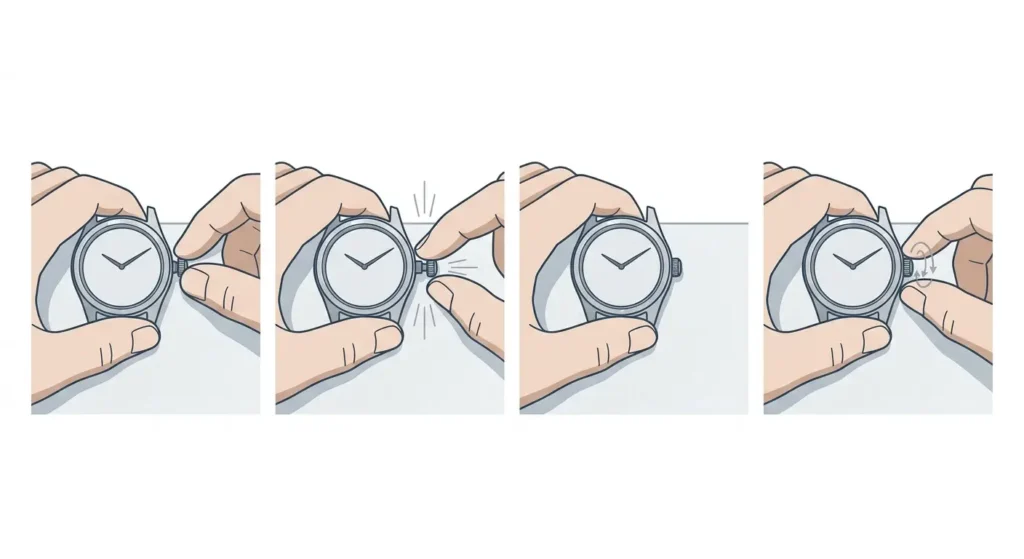
This is the most common type. The crown simply pulls out to different positions – usually two or three – to adjust the time, date, or winding. When it pops out, it has likely just moved into an extended position or come loose from the stem.
- Step 1: Hold the watch firmly in one hand with the crown side facing up. Make sure the watch is on a flat, stable surface or held securely to avoid dropping it.
- Step 2: Locate the crown – it is the small knob on the side of the case, usually at the 3 o’clock position. Check whether it is fully detached or just pulled out to an extended position.
- Step 3: If the crown is still attached but pulled out, gently push it straight inward toward the case. Apply steady, even pressure without forcing it at an angle.
- Step 4: You should feel a soft click as it settles back into the first (home) position. This means the crown is properly seated.
- Step 5: Give the crown a gentle turn to make sure it winds smoothly or clicks into adjustment positions as expected. This confirms the stem is properly engaged.
Fix 2: Screw-Down Crown (Dive Watch or Sport Watch)
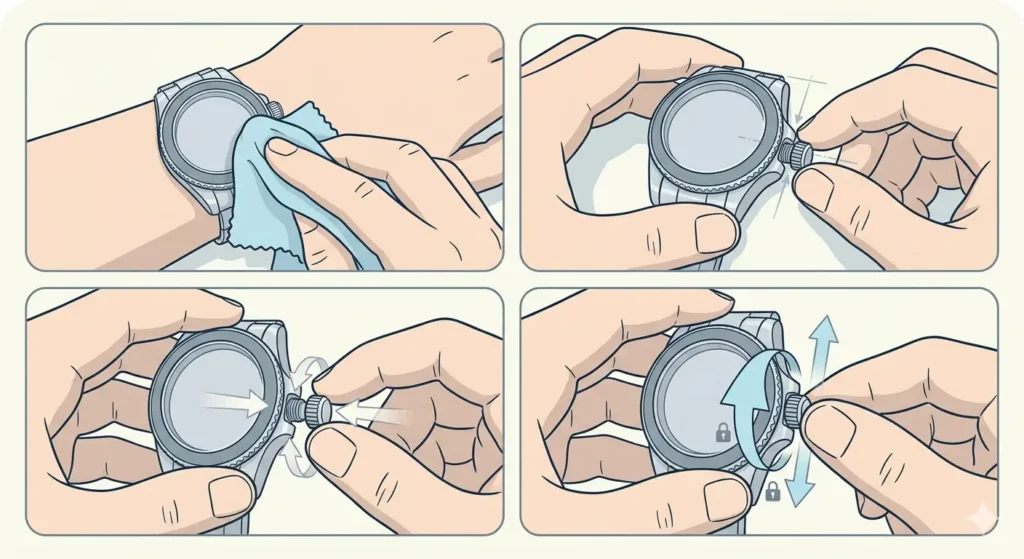
Screw-down crowns are designed to lock into the case for water resistance. They can pop out if they were left unscrewed or if the threads are worn. The process to fix them involves both pushing and turning.
- Step 1: Make sure the watch is dry and clean before handling the crown area. Moisture or debris in the crown tube can make reinsertion harder and reduce water resistance.
- Step 2: Hold the watch steady and align the crown directly with the crown tube opening on the case. The crown must go in straight – do not angle it.
- Step 3: Gently push the crown into the tube while turning it counterclockwise (to the left). This engages the threads without cross-threading them.
- Step 4: Once the threads catch, switch to turning clockwise (to the right) and tighten the crown until it is snug against the case. Do not overtighten – firm finger pressure is enough.
- Step 5: Tug gently on the crown to confirm it is locked in place. A properly secured screw-down crown will not pull out easily.
Pro-Tip: When reinserting a screw-down crown, always start by turning counterclockwise first until a slight ‘drop’ or ‘give’ is felt – this means the threads have aligned correctly. Skipping this step and going straight to tightening is the most common cause of cross-threading, which can permanently damage the crown tube.
Resetting the Time and Date After Fixing the Crown
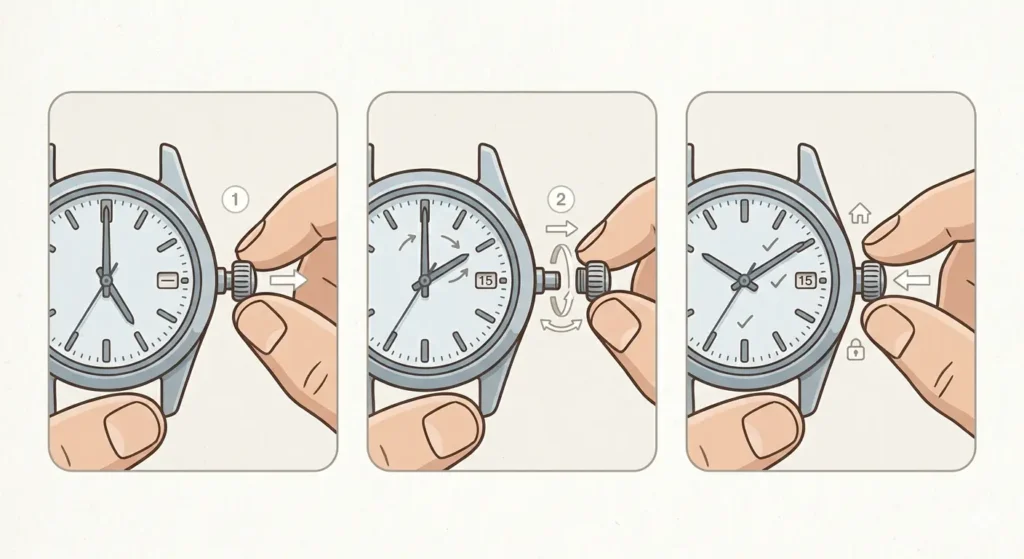
Once the crown is back in place, the time and date may need resetting – especially if the crown accidentally moved the hands or date wheel while it was loose. Here is how to do it correctly.
- Step 1: Pull the crown out to the first click (Position 1) to adjust the date. Turn the crown clockwise or counterclockwise depending on the watch – most date wheels advance in one direction only.
- Step 2: Pull the crown out to the second click (Position 2) to set the time. Turn the hands to the correct time using a reliable world time comparison tool for accuracy, especially when traveling across time zones.
- Step 3: Push the crown back in to the home position (fully in) when finished. For screw-down crowns, screw it back down clockwise until snug.
For watches with a running seconds hand, aligning the seconds to a reference like an online stopwatch makes it easy to set the time precisely to the second.
Pro-Tip: Never adjust the date using the date-setting position (crown Position 1) between approximately 9 PM and 2 AM. During this window, most mechanical watches are internally engaging the date mechanism, and forcing the date wheel manually during this period can damage the date gears – a costly repair.
Tips for Keeping the Crown in Good Condition
- Always push the crown fully back in after adjusting the time or date – leaving it in an extended position lets moisture and dust into the case.
- For screw-down crowns, develop a habit of tightening the crown before any water exposure. Even a splash can compromise water resistance with an unsecured crown.
- Avoid pulling the crown forcefully. If it does not come out smoothly, do not yank – this is the most common way the stem disconnects inside the movement.
- Have the gaskets (seals around the crown tube) replaced every 2 to 3 years on water-resistant watches, especially dive watches. Old gaskets harden and lose their seal.
- If the crown feels wobbly or spins without engaging the winding mechanism, bring the watch to a watchmaker promptly before the crown falls out completely.
Common Problems When Fixing a Watch Crown
Crown Goes In but Keeps Popping Out
This usually means the detent spring inside the movement is worn or broken. The detent is a small internal spring that holds the crown in each position. This is not a DIY repair – it requires a watchmaker to open the case back and replace the spring.
Crown Feels Loose or Wobbly After Reinserting
Looseness after reinsertion often points to a damaged crown tube or worn crown stem threads. Try tightening the crown gently once more. If the wobble persists, avoid using the crown until it is professionally inspected, as continuing to use a loose crown can damage the stem or movement.
Crown Is Fully Detached and Will Not Go Back In
If the crown has fully separated from the stem inside the watch, it cannot be reattached without opening the case. The stem connects to the movement internally, and reinserting it requires removing the case back and using watchmaking tools to re-engage the stem. This is a job for a professional watchmaker.
Crown Turns But Does Not Wind or Adjust the Time
This indicates the stem has disengaged from the movement or the keyless works (the setting mechanism) has a broken component. Stop using the crown immediately to avoid further damage and take the watch to a watchmaker.
Screw-Down Crown Is Stuck and Will Not Unscrew
A stuck screw-down crown is usually caused by dirt, corrosion, or overtightening. Apply very gentle counterclockwise force – do not use pliers or tools without watchmaker experience, as these can strip the crown or damage the case. If it will not budge with finger pressure, a watchmaker has specialized tools to handle this safely.
Frequently Asked Questions
Can a watch crown be fixed without taking it to a watchmaker?
Yes, in most cases. If the crown has simply popped out to an extended position or unscrewed, it can be pushed or screwed back in at home following the steps above. However, if the crown is fully detached from the internal stem or the movement is damaged, a watchmaker is required.
Why does a watch crown pop out in the first place?
The most common causes are accidental snagging on clothing, bumping the crown against a surface, forgetting to screw down a screw-down crown, or internal wear on the detent spring that holds the crown in position.
Is it safe to wear a watch with the crown popped out?
It is best to avoid wearing the watch until the crown is properly reseated. A loose or extended crown allows dust and moisture into the case, which can damage the movement. For water-resistant watches, any exposure to water with an unsecured crown can cause serious internal damage.
How do I know if my watch has a screw-down crown or a regular crown?
A screw-down crown typically has visible threads around its base and will not pull outward freely – it must be unscrewed first before it can be pulled to adjustment positions. A standard push-pull crown pulls out directly without any turning required to release it.
Will fixing the crown myself void the watch warranty?
Simply pushing a popped-out crown back into its normal position will not void a warranty in most cases. However, opening the case back or using tools on the movement would typically void the warranty. Always check the manufacturer’s warranty terms when in doubt.
How often should the crown gasket be replaced?
For watches used in water, the crown gasket should be inspected and replaced every 2 to 3 years as part of routine water resistance testing. Gaskets deteriorate over time due to compression, UV exposure, and contact with chemicals like sunscreen or saltwater.
What tools are needed to fix a popped-out watch crown at home?
For most standard push-pull crowns, no tools are needed – just clean fingers and a stable surface. For screw-down crowns, some watchmakers recommend using a rubber grip pad or soft cloth to improve grip, but this is optional. Avoid using metal tools like pliers, as they can scratch or damage the crown.
Can a stripped crown thread be fixed at home?
No. Stripped threads on the crown or crown tube require professional repair. In some cases, the crown tube can be replaced, or a new crown can be fitted. Attempting to fix stripped threads at home risks making the damage worse and compromising the watch’s water resistance.
What happens if the watch crown stem breaks inside the movement?
A broken stem inside the movement means the watch cannot be wound, set, or adjusted until it is repaired. This requires a watchmaker to open the case, remove the movement, and replace the stem – a moderately complex repair but one that is well within standard watchmaker capabilities.
How long does it take to fix a popped-out watch crown?
If the crown simply popped out to an extended position or unscrewed, reinserting it takes under a minute. Resetting the time and date adds another minute or two. If the issue is more complex – such as a disconnected stem or damaged tube – professional repair typically takes a few days depending on the watchmaker and parts availability.