
Changing the strap on a Swatch watch is a straightforward process that takes just a few minutes. Whether the current band is worn out or a fresh style is desired, this guide walks through each step to swap Swatch watch straps safely and efficiently.
Quick Summary Table
| Task | Details |
|---|---|
| Tools Needed | Spring bar tool or small flathead screwdriver |
| Time Required | 3-5 minutes |
| Difficulty Level | Easy |
| Strap Types | Silicone, leather, metal, NATO |
| Key Step | Compress spring bars to release old strap |
Tools and Materials Needed
Before starting the strap replacement process, gather these essential items:
- Spring bar tool (preferred) or small flathead screwdriver
- New Swatch watch strap that fits the watch model
- Soft cloth or towel to protect the watch face
- Good lighting to see the spring bar mechanism clearly
Most Swatch watches use standard spring bars that measure 16mm, 17mm, or 18mm in width. Check the lug width of the specific watch model to ensure the replacement strap fits properly.
Removing the Old Swatch Watch Strap
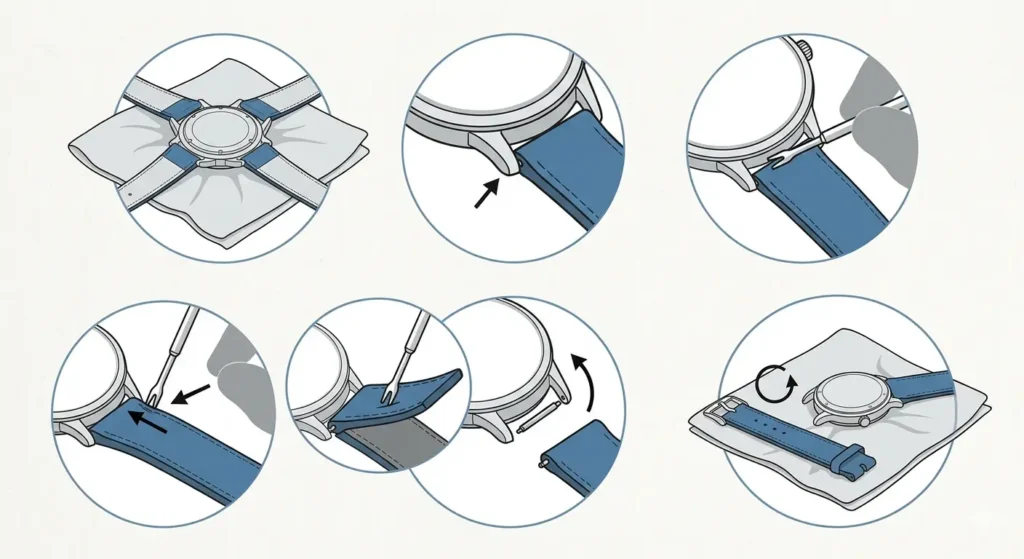
The removal process requires careful handling to avoid scratching the watch case or damaging the spring bars.
- Step 1: Place the watch face-down on a soft cloth to protect the crystal from scratches.
- Step 2: Locate the small gap between the strap and the watch lug where the spring bar sits.
- Step 3: Insert the forked end of the spring bar tool (or flathead screwdriver) into this gap.
- Step 4: Push the tool toward the center of the strap to compress the spring bar.
- Step 5: While holding pressure on the spring bar, gently angle the strap away from the watch case.
- Step 6: Once one end of the spring bar releases from the lug hole, pull the strap completely free.
- Step 7: Repeat the same process on the opposite side of the watch to remove the other half of the strap.
The spring bars may remain attached to the old strap or stay inside the watch lugs. If they stay in the lugs, carefully remove them by compressing one end and pulling them out.
Pro Tip: Work slowly and apply steady pressure when compressing spring bars. Rushing this step can cause the tool to slip and scratch the watch case or send the spring bar flying across the room.
Installing the New Watch Strap
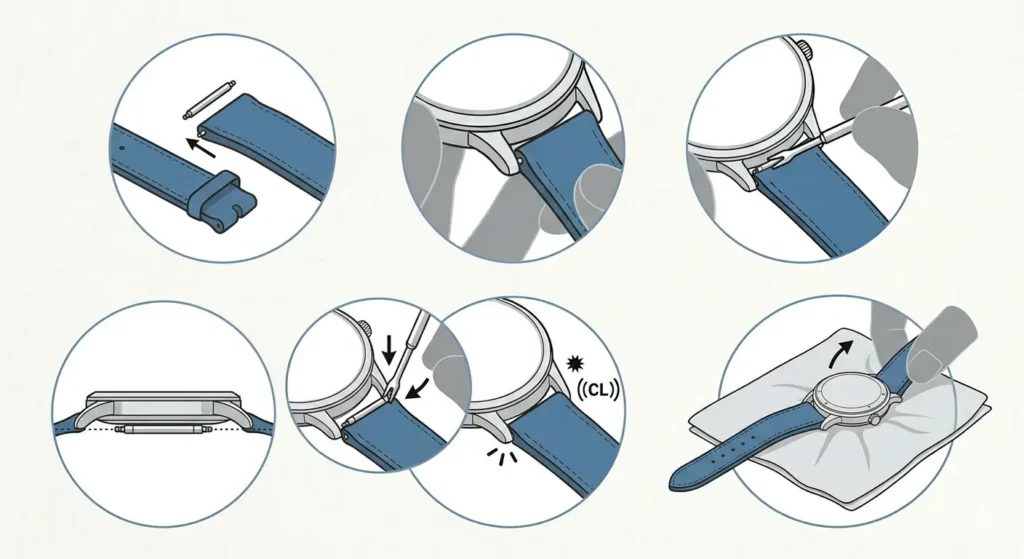
Attaching the new strap follows a similar process in reverse, with attention to proper spring bar placement.
- Step 1: Check that the spring bars are attached to the new strap. If not, insert them into the holes at each end of the strap.
- Step 2: Hold the watch upright and position one end of the spring bar into the lug hole on one side.
- Step 3: Use the spring bar tool to compress the opposite end of the spring bar.
- Step 4: While keeping the spring bar compressed, align it with the opposite lug hole.
- Step 5: Guide the compressed end into the lug hole and release the tool slowly.
- Step 6: Listen for a small click sound, which indicates the spring bar has seated properly in both lug holes.
- Step 7: Gently tug on the strap to ensure it’s securely attached before repeating the process on the other side.
For NATO-style straps or one-piece bands, the installation differs slightly. Thread the strap through both sets of lugs, passing behind the watch case, then secure the buckle.
Verifying Proper Installation
After attaching the new strap, perform these checks to ensure everything is secure:
- Pull firmly on both sides of the strap to test that spring bars are fully seated
- Wiggle the strap gently – there should be minimal movement between the strap and lugs
- Inspect both spring bar ends to confirm they’re visible in the lug holes
- Check that the strap hangs straight and isn’t twisted at the attachment point
The strap should feel solid and stable. Any looseness or excessive movement indicates the spring bars aren’t properly installed and need adjustment. Checking your work carefully prevents the watch from accidentally detaching during wear, which is when most people use tools like a stopwatch for timing activities.
Tips for a Successful Strap Change
These practical tips make the strap replacement process smoother and help avoid common mistakes:
- Work in a well-lit area with a clean, flat surface to prevent losing small spring bars
- Keep a small container nearby to hold removed spring bars and prevent them from rolling away
- Apply light pressure when using tools – excessive force can bend or break spring bars
- Match the strap orientation correctly (the buckle end typically goes on the 6 o’clock side)
- Choose straps specifically designed for Swatch watches when possible for the best fit
- Clean the watch lugs with a soft cloth before installing the new strap to remove dirt and oils
- Replace spring bars every few strap changes, as they wear down over time
When comparing different time zones during travel, having a comfortable and secure watch strap ensures the timepiece stays safely on the wrist.
Pro Tip: Always test the spring bar mechanism on the new strap before throwing away the old one. This gives a backup option if the new strap’s spring bars are defective or don’t fit properly.
Common Problems and Solutions
Even with careful work, some issues may arise during strap replacement. Here’s how to address them:
Spring Bar Won’t Compress
If the spring bar feels stuck or won’t compress, try these solutions:
- Check that the tool is positioned correctly in the gap between strap and lug
- Apply a small amount of lubricant to the spring bar mechanism
- Replace the spring bar if it’s corroded or damaged
Strap Feels Loose After Installation
A loose strap indicates the spring bars aren’t fully seated. Fix this by:
- Removing the strap completely and checking the spring bar condition
- Ensuring the spring bar ends align perfectly with the lug holes during installation
- Replacing worn spring bars that no longer provide adequate tension
Tool Keeps Slipping
If the spring bar tool slides off repeatedly:
- Clean any oils or moisture from the watch case and tool
- Use a tool with a narrower fork that fits better in the gap
- Angle the tool slightly upward to maintain contact with the spring bar
Watch Case Gets Scratched
To prevent or minimize scratches:
- Wrap tape around the tip of a flathead screwdriver if using one instead of a proper spring bar tool
- Work more slowly and maintain better control of the tool
- Position the watch face-down on a thick, soft cloth during the entire process
Frequently Asked Questions
How often should Swatch watch straps be replaced?
Silicone and rubber Swatch straps typically last 2-3 years with regular wear, while leather straps may need replacement every 1-2 years. Metal bracelets can last much longer but may require link adjustments over time. Replace any strap that shows signs of cracking, tearing, or excessive wear.
Can any watch strap fit a Swatch watch?
Swatch watches require straps that match the specific lug width of the model, which ranges from 16mm to 18mm for most models. Standard watch straps with the correct width will fit, but Swatch-branded straps are designed to match the case profile perfectly.
What size spring bars do Swatch watches use?
Most Swatch watches use spring bars that are either 16mm, 17mm, or 18mm wide, depending on the model. The spring bar length must match the distance between the watch lugs. Measure the lug width with a caliper or ruler to ensure proper sizing.
Is it safe to change a Swatch strap without a spring bar tool?
While possible to use a small flathead screwdriver or even a paperclip in emergencies, a dedicated spring bar tool is much safer and reduces the risk of scratching the watch case or damaging components. Spring bar tools cost very little and make the process significantly easier.
Do Swatch watches have quick-release spring bars?
Most Swatch watches use standard spring bars rather than quick-release versions. However, some newer models may feature quick-release mechanisms that allow strap changes without tools. Check the specific model specifications to confirm the spring bar type.
Can leather straps be installed on Swatch diving watches?
While technically possible to install leather straps on any Swatch watch, leather isn’t recommended for diving or sports models designed for water exposure. Leather deteriorates quickly when wet. Silicone, rubber, or NATO nylon straps are better choices for water-resistant Swatch watches.
What happens if a spring bar breaks during installation?
A broken spring bar renders the watch unwearable until replaced. Spring bars are inexpensive and available at watch supply stores or online. Always purchase extra spring bars in the correct size to keep as backups, especially when planning to change straps frequently.
How tight should the spring bar feel when installed?
Properly installed spring bars should hold the strap firmly with no wiggle room, but the strap should still be able to pivot slightly at the lugs for comfortable wrist movement. If the strap feels completely rigid or moves loosely, the spring bars may be the wrong size or not seated correctly.
Can vintage Swatch straps be installed on newer models?
As long as the lug width matches between the vintage strap and newer watch model, older Swatch straps can be installed on contemporary models. However, verify that the spring bars are in good condition, as older spring bars may have weakened over time and should be replaced.
Should the watch be wound before changing the strap?
The watch doesn’t need to be wound or in any particular state before changing the strap. However, if using a digital clock or timing tool to track the replacement process, having the watch running can help confirm it still functions properly after the strap change is complete.