
Adjusting the Glidelock clasp on a Rolex watch is a straightforward process that allows for precise sizing adjustments without removing links. The Glidelock system, featured on models like the Submariner, Sea-Dweller, and Deepsea, enables 2mm incremental adjustments up to approximately 20mm, making it perfect for daily comfort changes or accommodating a wetsuit.
Quick Summary Table
- Adjustment Range: Up to 20mm in 2mm increments
- Tools Required: None – completely tool-free adjustment
- Time Needed: Less than 30 seconds
- Models with Glidelock: Submariner, Sea-Dweller, Deepsea, GMT-Master II (select models)
- Reversible: Yes, adjustments can be made tighter or looser anytime
Step-by-Step Guide to Adjusting the Glidelock Clasp
Loosening the Glidelock Clasp
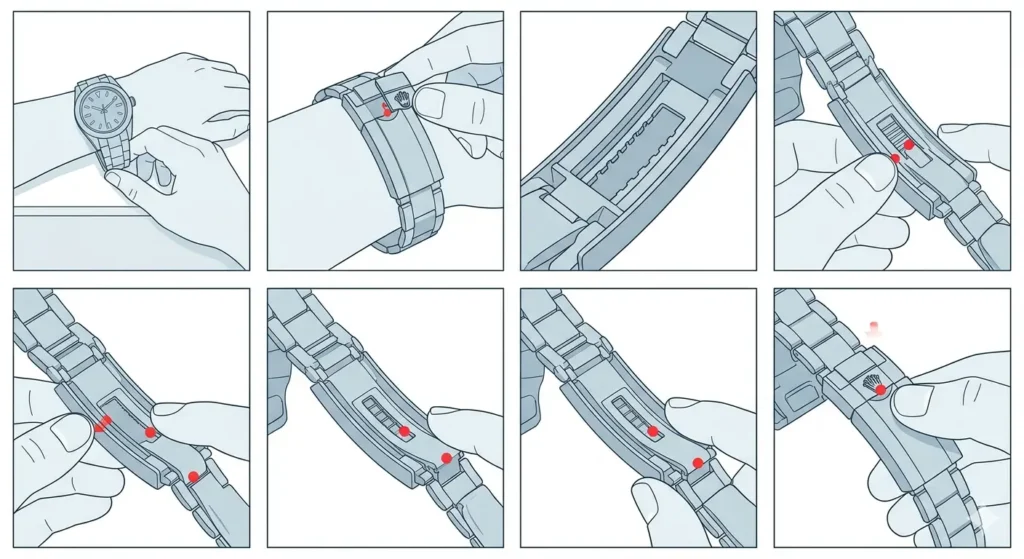
- Step 1: Remove the watch from the wrist to work comfortably with the clasp mechanism.
- Step 2: Open the main clasp by lifting the Rolex crown logo cover until it clicks open completely.
- Step 3: Locate the Glidelock mechanism on the interior side of the clasp – this appears as a grooved track with visible notches.
- Step 4: Identify the small metal tab or lever on the side of the clasp extension piece (the part that slides into the clasp housing).
- Step 5: Gently pull the metal tab or extension piece away from the clasp housing while simultaneously sliding it outward to extend the bracelet length.
- Step 6: Move the extension to the desired notch position – each notch represents approximately 2mm of adjustment.
- Step 7: Release the tab to lock the extension piece securely into the selected notch position.
- Step 8: Close the clasp by pressing it down firmly until it clicks shut.
Pro Tip: Most people find that extending the Glidelock by 2-4mm (1-2 notches) provides comfortable daily wear, while 6-10mm works better during warmer weather when wrists naturally expand. For activities like timing workouts with precision, ensuring proper fit prevents the watch from sliding during movement.
Tightening the Glidelock Clasp
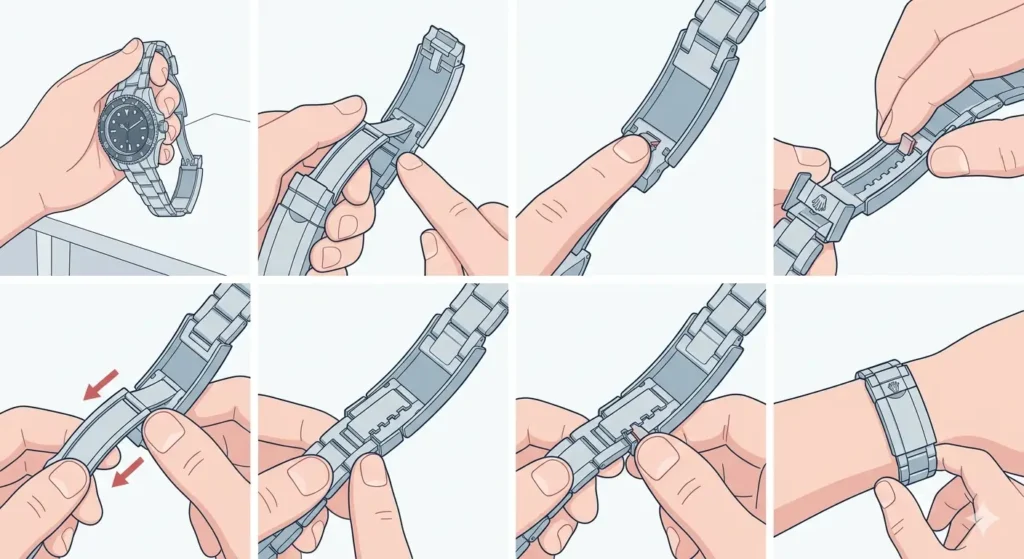
- Step 1: Take the watch off and open the main clasp completely by lifting the Rolex crown cover.
- Step 2: Examine the Glidelock track inside the clasp to see the current extension position.
- Step 3: Locate the metal tab on the extension piece that locks into the notched track.
- Step 4: Pull the tab gently to release the locking mechanism from its current notch.
- Step 5: Slide the extension piece back toward the clasp housing to reduce the bracelet length.
- Step 6: Position the extension at the desired notch closer to the clasp body for a tighter fit.
- Step 7: Allow the locking mechanism to snap securely into the selected notch position.
- Step 8: Close the clasp firmly and test the fit on the wrist before making further adjustments.
Understanding the Glidelock Mechanism
The Glidelock system represents Rolex’s innovative approach to bracelet adjustment, eliminating the need for tools or professional assistance. This patented mechanism features a rack-and-pinion style track hidden beneath the clasp, allowing the bracelet to extend or contract smoothly. The system includes ten notches, each providing 2mm of adjustment, totaling 20mm of flexibility. This design particularly benefits divers who need to wear their Rolex over a wetsuit, but it also accommodates natural wrist size fluctuations throughout the day due to temperature, activity level, or water retention.
The mechanism works through a spring-loaded locking tab that engages with precision-cut grooves in the extension track. When the tab is pulled, it disengages from the current groove, allowing smooth sliding movement. Releasing the tab causes it to automatically lock into the nearest groove, securing the adjustment. This self-locking feature ensures the bracelet stays at the selected length during wear, preventing accidental loosening.
Tips for Optimal Glidelock Adjustment
Finding the Right Fit
The ideal watch fit allows one finger to slide comfortably between the bracelet and wrist. The watch should sit snugly without restricting blood flow or leaving deep imprints on the skin. For most people, positioning the watch about one inch up from the wrist bone provides the best balance of comfort and security. When checking fit, keeping track of different time zones for travel purposes becomes easier when the watch stays properly positioned.
Seasonal Adjustments
Wrist size naturally changes with temperature and humidity. During summer months or in warm climates, wrists tend to expand slightly, requiring 1-2 notches of additional extension. Conversely, cold weather often causes slight wrist contraction, making a tighter setting more comfortable. Many Rolex owners develop a routine of adjusting their Glidelock clasp seasonally rather than daily.
Activity-Based Sizing
Different activities demand different fits. For sports or physical work, a slightly tighter fit prevents excessive watch movement and potential impact damage. For desk work or relaxation, a looser fit improves comfort during extended wear. The Glidelock system makes switching between these settings quick and convenient.
Pro Tip: The beauty of the Glidelock system lies in its reversibility – there’s no wrong adjustment. Experiment with different notch positions throughout the day to discover personal comfort preferences. Some watch enthusiasts use digital time displays alongside their Rolex to compare accuracy while finding the perfect fit position.
Maintenance Considerations
Keep the Glidelock mechanism clean by occasionally rinsing the clasp area with fresh water, especially after exposure to saltwater or chlorine. Dirt or debris in the track can interfere with smooth operation. Avoid forcing the extension piece if resistance is felt – this usually indicates the tab hasn’t fully released from its notch. Gentle manipulation and ensuring the clasp is fully open typically resolves any stiffness.
Common Problems and Solutions
Fix 1: Extension Piece Won’t Slide
When the extension piece refuses to move smoothly along the track, the locking tab likely hasn’t fully disengaged. Open the clasp completely and ensure the tab is pulled out sufficiently before attempting to slide the extension. Sometimes, a slight wiggle while pulling the tab helps release it from a stubborn notch. Debris accumulation can also cause sticking – clean the track thoroughly with a soft brush and rinse with water.
Fix 2: Clasp Feels Loose or Unstable
If the clasp feels wobbly after adjustment, the extension piece hasn’t properly locked into a notch position. Open the clasp and reposition the extension, ensuring the locking mechanism audibly clicks into place. Each notch should provide a definite click and secure hold. If looseness persists across all positions, professional servicing may be needed to inspect the locking mechanism’s spring tension.
Fix 3: Difficulty Identifying the Correct Notch
Finding the right notch position requires trial and error. Start with the middle position (5th notch) and wear the watch for several hours. Adjust one notch tighter or looser based on comfort. Mark the preferred position mentally by counting notches from either the fully extended or fully retracted position, making future adjustments faster.
Fix 4: Clasp Won’t Close After Adjustment
When the clasp refuses to close after extending the Glidelock, the extension may be too long for the current bracelet configuration. Retract the extension by 1-2 notches and test the closure. Alternatively, the main clasp components might not be aligned properly – ensure both halves of the clasp meet evenly before pressing down to secure.
Frequently Asked Questions
Can the Glidelock adjustment damage the clasp mechanism?
No, the Glidelock system is designed for frequent adjustments and normal use won’t damage the mechanism. The spring-loaded locking system is engineered to withstand thousands of adjustment cycles. However, forcing the extension piece while the tab is engaged or exposing the mechanism to excessive dirt can cause premature wear. Regular cleaning and gentle handling ensure long-term reliability.
How many times can the Glidelock be adjusted before it wears out?
Rolex designs the Glidelock mechanism to last the lifetime of the watch with proper care. The precision-engineered components can handle daily adjustments for decades without significant wear. Most service centers report seeing Glidelock mechanisms that function perfectly even after 15-20 years of regular use. The key to longevity is avoiding forceful manipulation and keeping the mechanism clean.
Does adjusting the Glidelock void the Rolex warranty?
Absolutely not – the Glidelock system is specifically designed for user adjustment without tools. Making adjustments is considered normal operation and is explicitly mentioned in Rolex user manuals. The warranty covers manufacturing defects in the Glidelock mechanism itself, and user adjustments don’t affect warranty coverage unless damage occurs from improper force or modification.
Can the Glidelock be adjusted while wearing the watch?
While technically possible, adjusting the Glidelock while wearing the watch is challenging and not recommended. The process requires opening the clasp completely and manipulating small components with precision. Removing the watch takes only seconds and provides better control, reducing the risk of dropping the watch or misaligning the mechanism during adjustment.
Which Rolex models feature the Glidelock clasp?
The Glidelock system appears on professional Rolex dive watches including the Submariner (both date and no-date versions), Sea-Dweller, Deepsea, and select GMT-Master II models. The system is standard on Oyster bracelets paired with these models manufactured from approximately 2008 onward. Older models or non-professional sports watches typically feature different clasp systems like the Oysterclasp or Easylink.
What’s the difference between Glidelock and Easylink extensions?
The Glidelock offers 20mm of adjustment in 2mm increments through ten notch positions, while the Easylink provides a simple 5mm extension with a folding link. Glidelock requires opening the clasp for adjustment, whereas Easylink can be flipped open from the clasp’s folded position. Many professional Rolex models feature both systems, allowing up to 25mm of total micro-adjustment without removing bracelet links.
Is it normal for the Glidelock to make clicking sounds?
Yes, hearing distinct clicks when locking the extension piece into notch positions is completely normal and actually indicates proper function. Each click confirms the locking mechanism has engaged securely. However, rattling sounds during wear or excessive play in the extension piece may indicate looseness requiring professional attention. The clicks should only occur during adjustment, not during normal wear.
How should the Glidelock be cleaned and maintained?
Clean the Glidelock mechanism by rinsing with lukewarm fresh water, particularly after exposure to saltwater, chlorine, sweat, or dirt. Use a soft-bristled brush to gently clean the grooved track and extension piece. Avoid harsh chemicals, ultrasonic cleaners, or high-pressure water directly on the mechanism. Annual professional servicing typically includes thorough Glidelock cleaning and lubrication as part of routine watch maintenance.
Can additional links be removed if the Glidelock adjustment isn’t enough?
Yes, if even the fully retracted Glidelock position leaves the bracelet too loose, authorized Rolex service centers can remove additional bracelet links. This permanent adjustment should be done professionally using proper tools to avoid damaging the bracelet. Conversely, if the fully extended Glidelock is too tight, additional links can be added. Always consult authorized service centers for link adjustments to maintain warranty coverage and bracelet integrity.
Does water resistance get affected by Glidelock adjustments?
No, proper Glidelock adjustments don’t compromise the watch’s water resistance rating. The mechanism is engineered to maintain seal integrity across all extension positions. The clasp itself isn’t a water entry point – the case back, crown, and crystal provide water resistance. However, ensure the clasp closes completely and securely after adjustment, as an improperly closed clasp could allow the watch to detach during water activities.