

Demagnetizing a mechanical watch at home can restore accurate timekeeping when your timepiece starts running fast or erratically due to magnetic interference. This step-by-step guide shows exactly how to safely remove magnetism from watch components using simple, affordable tools available to anyone.
Quick Summary Table
| Time Required | 2-5 minutes |
| Cost | $15-$50 (demagnetizer tool) |
| Difficulty Level | Easy – No technical skills needed |
| Tools Needed | Watch demagnetizer, clean surface |
| Success Rate | 95%+ when done correctly |
Step-by-Step Demagnetization Process
What This Guide Covers
This tutorial focuses exclusively on the demagnetization process itself. The method works for virtually all mechanical watches, from vintage pieces to modern automatics, and requires no watch repair experience.
Tools Required
- Electronic watch demagnetizer (also called a demagnetizing coil or degausser)
- Clean, flat, non-metallic surface
- The magnetized watch
Pro Tip: Purchase a demagnetizer specifically designed for watches rather than bulk demagnetizers meant for screwdrivers or larger tools. Watch-specific models provide the right strength and control for delicate timepiece components.
The Demagnetization Steps
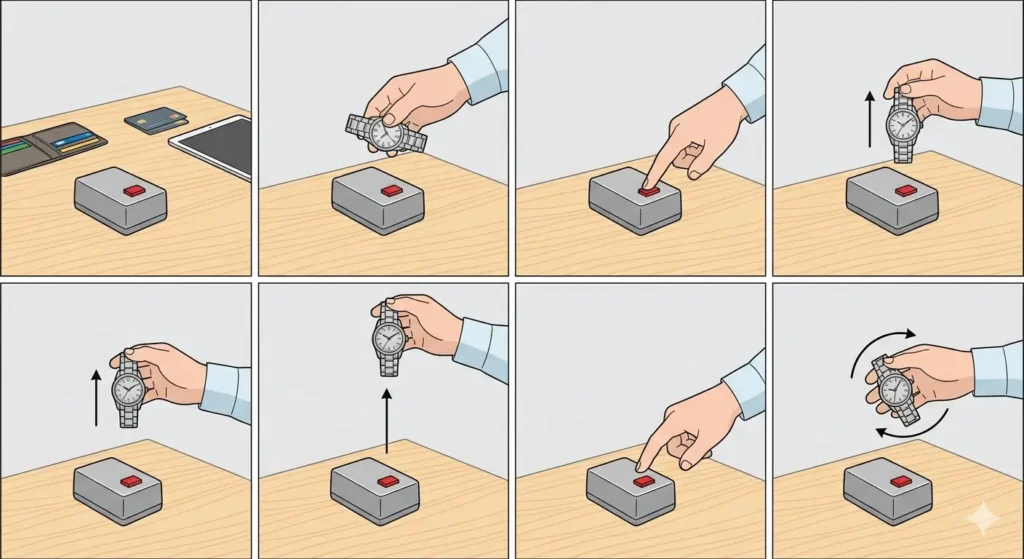
- Step 1: Place the demagnetizer on a stable, non-metallic surface away from other watches, electronics, or magnetic storage devices. Keep credit cards, hard drives, and other magnetic media at least 3 feet away.
- Step 2: Remove the watch from your wrist. If the watch has a metal bracelet, keep it attached – the entire watch needs demagnetizing, not just the movement.
- Step 3: Hold the watch firmly in one hand, positioning it 2-3 inches above the demagnetizer’s surface. The watch should be parallel to the demagnetizer, not perpendicular.
- Step 4: Press and hold the demagnetizer’s button. Most models have a simple push-button operation that activates the magnetic field.
- Step 5: While keeping the button pressed, slowly move the watch in a straight line away from the demagnetizer. Move smoothly and steadily, extending your arm fully until the watch is at least 2 feet away from the device.
- Step 6: Once the watch reaches full extension (2+ feet away), release the demagnetizer button. This sequence is critical – always release the button when the watch is far from the device, never when it’s close.
- Step 7: Repeat the process 2-3 times from different angles. Rotate the watch 90 degrees between passes to ensure all internal components get properly demagnetized.
Critical Timing Detail
The entire motion from Steps 4-6 should take approximately 3-5 seconds. Moving too quickly reduces effectiveness, while moving too slowly wastes time without added benefit. Think of it like using a stopwatch – smooth, consistent timing produces the best results.
Verification After Demagnetization
Testing the Results
After completing the demagnetization process, verify success by monitoring the watch’s timekeeping over 24 hours. A properly demagnetized mechanical watch should return to its normal rate of accuracy, typically within +/- 10-30 seconds per day depending on the movement quality.
Most watch enthusiasts find that checking accuracy becomes easier when using time comparison tools to measure drift against a reference standard.
When to Repeat
If the watch still runs fast after one demagnetization session, repeat the entire process. Some heavily magnetized watches require 2-3 complete demagnetization cycles, especially if exposed to strong magnetic sources like MRI machines or industrial magnets.
Tips for Best Results
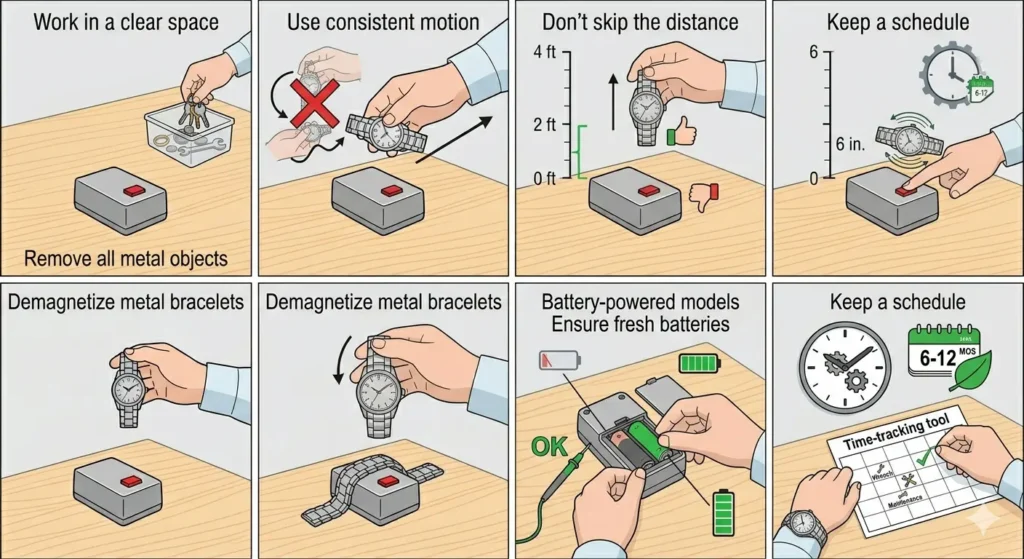
- Work in a clear space: Remove all metal objects from your work area, including jewelry, keys, tools, and other watches.
- Use consistent motion: The smooth, straight withdrawal motion matters more than speed. Jerky or circular movements reduce effectiveness.
- Demagnetize metal bracelets: If the watch has a steel bracelet, make sure it passes through the demagnetizer field as well, as bracelet components can hold magnetism.
- Don’t skip the distance: Always move the watch at least 2 feet away before releasing the button. Releasing too close can re-magnetize components.
- Temperature consideration: Perform demagnetization at room temperature. Extreme cold or heat can affect both the watch and demagnetizer performance.
- Battery-powered models: If using a battery-powered demagnetizer, ensure fresh batteries. Weak batteries produce insufficient field strength for complete demagnetization.
- Keep a schedule: For watches worn daily near electronics, consider preventive demagnetization every 6-12 months, similar to how people track maintenance with time-tracking tools.
Pro Tip: Never open the watch case before demagnetizing. The process works through the case back and doesn’t require exposure of internal components. Opening the case introduces dust risk and voids warranties on many modern watches.
Common Problems and Solutions
Watch Still Runs Fast After Demagnetizing
If the watch continues gaining significant time after 2-3 demagnetization attempts, the timekeeping issue likely stems from a different cause – such as a worn mainspring, damaged balance wheel, or needed regulation. This indicates a trip to a watchmaker is necessary rather than repeated demagnetization.
Demagnetizer Doesn’t Turn On
Check the power source first. Plug-in models need secure electrical connections, while battery-operated units require charged batteries. Most demagnetizers have no on/off switch beyond the activation button – if nothing happens when pressing the button, the power supply is the usual culprit.
Uncertainty About Watch Distance
If unsure whether the watch moved far enough during withdrawal, err on the side of greater distance. Pulling the watch 3-4 feet away causes no harm, while stopping at only 1 foot can leave residual magnetism.
Multiple Watches Need Demagnetizing
Process one watch completely before starting another. Don’t place multiple watches near the demagnetizer simultaneously, as this can cause cross-magnetization between timepieces.
Frequently Asked Questions
How do I know if my mechanical watch is magnetized?
The most common sign is the watch suddenly running fast – typically gaining several minutes per day when it previously kept good time. Other indicators include erratic timekeeping, the second hand jumping or stuttering, or the watch stopping and starting randomly. A compass placed near the watch will deflect noticeably if strong magnetism is present.
Can I use a bulk demagnetizer meant for tools?
While technically possible, tool demagnetizers often produce excessive magnetic field strength that can potentially damage delicate watch components. Watch-specific demagnetizers cost only $15-30 and provide appropriate, controlled demagnetization safe for all mechanical movements. The small investment protects valuable timepieces.
Will demagnetizing harm my watch?
No. Proper demagnetization using the straight-line withdrawal method poses zero risk to mechanical watch movements, cases, crystals, or gaskets. The process is completely safe and reversible – if done incorrectly, the worst outcome is simply ineffective demagnetization requiring another attempt.
How often should I demagnetize my watch?
Only demagnetize when the watch shows symptoms of magnetization. Most watches never need demagnetizing in their entire lifetime. However, people working around strong magnetic fields (hospitals, electronics manufacturing, speaker systems) may need demagnetization every few months as preventive maintenance.
Do quartz watches need demagnetizing?
Rarely. Quartz movements use far fewer metal components and those present are less susceptible to magnetization. If a quartz watch does become magnetized (extremely uncommon), the same demagnetization process works, though the issue almost never occurs in practice.
Can I demagnetize a watch without removing it from the bracelet?
Yes, and this is actually recommended. The entire watch – case, movement, dial, hands, and bracelet – should be demagnetized together as a complete unit. Metal bracelets can hold magnetism just like movement components, so keeping everything assembled ensures thorough demagnetization.
What if I release the button too early?
Releasing the demagnetizer button while the watch is still close (under 1 foot away) can leave the watch partially magnetized or even re-magnetize components. If this happens, simply repeat the entire process, making certain to extend the watch fully before releasing the button.
Does watch orientation matter during demagnetization?
Yes, somewhat. Passing the watch through the demagnetizer field from multiple angles (rotating 90 degrees between passes) ensures all internal components – balance wheel, pallet fork, escape wheel, and mainspring – receive equal treatment. Three passes from different orientations typically achieves complete demagnetization.
Can I demagnetize vintage watches safely?
Absolutely. Demagnetization works identically on vintage and modern mechanical watches. The process was actually more necessary in past decades before antimagnetic watch designs became common. Vintage movements respond perfectly to standard demagnetization procedures.
Why does my watch keep getting magnetized?
Modern environments contain numerous magnetic sources: smartphone speakers, laptop cases with magnetic clasps, iPad covers, wireless charging pads, magnetic phone mounts, headphones, purse clasps, and even some furniture latches. Identifying and avoiding the magnetism source prevents repeated magnetization better than frequent demagnetization.