
A Guide to Rolex Reference Numbers reveals how these unique identifiers unlock essential details about any Rolex watch, from model type to production era. Understanding reference numbers helps verify authenticity, estimate value, and identify specific features. This comprehensive guide explains where to find them, how to decode them, and what each segment reveals about a Rolex timepiece.
Key Takeaways
- Rolex reference numbers are unique 4-6 digit codes that identify specific watch models and their characteristics
- Reference numbers appear on the case between the lugs at 12 o’clock position (modern models) or on warranty papers
- The first digits indicate the model family (Submariner, Datejust, Daytona), while subsequent digits reveal materials, bezels, and dial variations
- Reference numbers changed format around 2000, transitioning from 5-digit to 6-digit systems
- Knowing how to read reference numbers helps authenticate watches and determine production periods
Understanding Rolex Reference Numbers
Rolex reference numbers function as DNA for each watch model. These numerical codes contain specific information about the case material, bezel type, bracelet style, and dial configuration. Every authentic Rolex carries a reference number that corresponds to its exact specifications as originally manufactured.
The reference number system evolved over decades. Vintage Rolex watches from the 1950s-1980s typically use 4-digit references, while modern pieces utilize 5 or 6-digit codes. The transition to longer reference numbers allowed Rolex to accommodate more model variations and materials like platinum, Everose gold, and Rolesor combinations.
Where to Find the Reference Number
Locating the reference number depends on the watch’s production year. Modern Rolex watches (post-2005) display the reference number engraved on the inner rehaut (the ring between the dial and crystal) at the 12 o’clock position. Earlier models require removing the bracelet to access the number.
For watches manufactured before 2005, the reference number sits between the lugs at the 12 o’clock position. Removing the bracelet reveals this engraving on the case. The serial number appears on the opposite side at 6 o’clock. Both engravings are typically small and require good lighting to read clearly.
Alternative locations include the warranty card or certificate of authenticity. These documents always list the complete reference number. Original purchase receipts and service records also contain this information. When buying pre-owned watches, verify the reference number matches across all documentation.
How to Decode a Rolex Reference Number
Rolex reference numbers follow a logical structure where each digit or digit group represents specific attributes. Breaking down these segments reveals comprehensive details about the watch.
Method 1: Decoding 4-Digit References (Vintage Models)
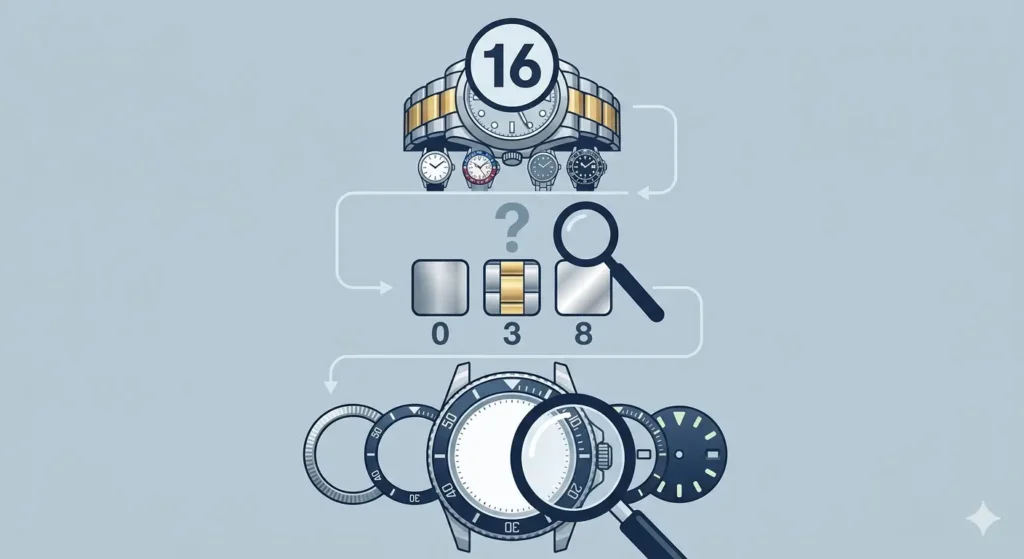
Vintage Rolex watches use straightforward 4-digit references. The first one or two digits identify the model family, while remaining digits indicate variations.
- Step 1: Identify the model family from the first digits (1 = Oyster Perpetual, 5 = GMT-Master, 6 = Datejust/Day-Date, 16 = Submariner)
- Step 2: Check the third digit for case material (0 = stainless steel, 3 = steel and gold, 8 = white gold)
- Step 3: Read the fourth digit for bezel and dial variations
Example: Reference 1680 indicates a Submariner (16) in stainless steel (8) with a date function (0).
Method 2: Decoding 5-Digit References
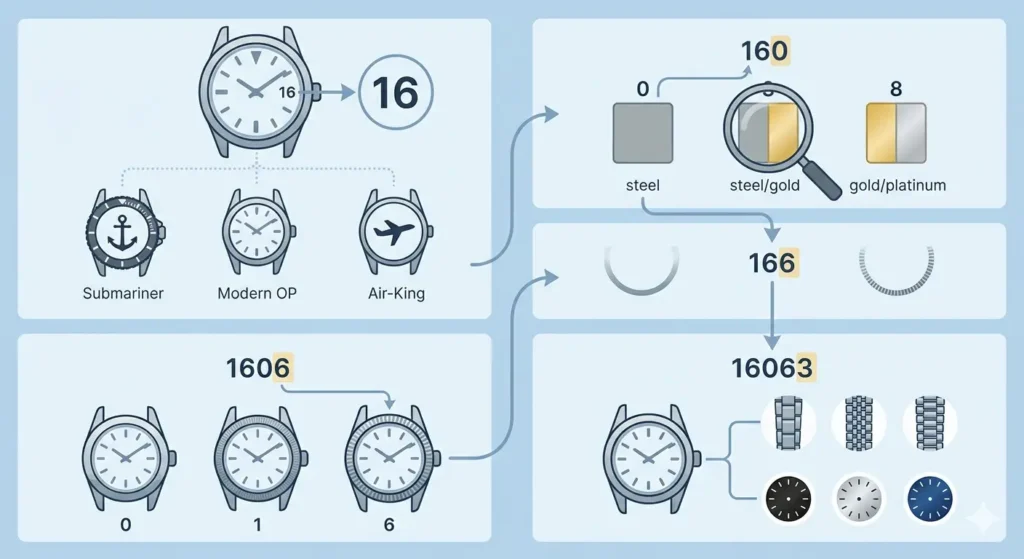
Five-digit references appeared in the 1980s-1990s and provide more detailed specifications.
- Step 1: Read the first two digits for the model family (16 = Submariner, 14 = modern Oyster Perpetual, 11 = Air-King)
- Step 2: Check the third digit for material (0 = steel, 3 = steel/gold, 8 = gold/platinum)
- Step 3: Examine the fourth digit for bezel type (0 = smooth, 1 = engine-turned, 6 = fluted)
- Step 4: Review the fifth digit for bracelet style and dial color variations
Example: Reference 16610 represents a Submariner (16) in stainless steel (6) with a rotating bezel (1) and standard black dial (0).
Method 3: Decoding 6-Digit References (Modern Models)
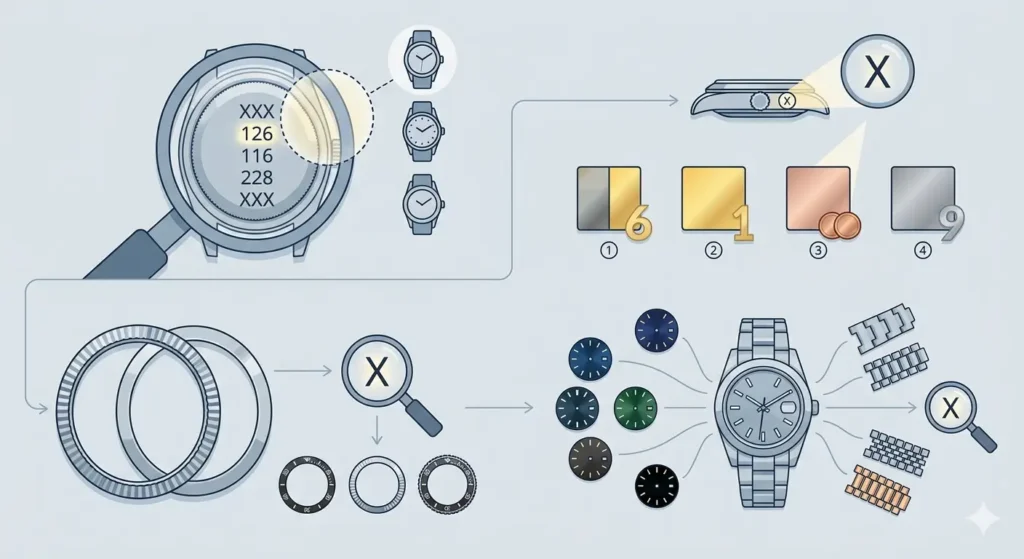
Six-digit references introduced around 2000 accommodate expanded model ranges and new materials.
- Step 1: Identify the model from the first three digits (126 = current Submariner generation, 116 = previous Submariner generation, 228 = GMT-Master II in precious metal)
- Step 2: Check the fourth digit for case material (6 = Rolesor steel/gold, 1 = yellow gold, 5 = Everose gold, 9 = platinum)
- Step 3: Read the fifth digit for bezel material and type
- Step 4: Examine the sixth digit for dial and bracelet combinations
Example: Reference 126610LN indicates a Submariner Date (126) with ceramic bezel (6) in stainless steel (1), black dial (0), and ‘LN’ suffix denoting Lunette Noir (black bezel).
Common Reference Number Patterns by Model
Certain number patterns consistently appear across Rolex’s most popular collections. Recognizing these patterns speeds up identification.
Submariner References
Submariner references typically begin with 5, 16, or 126. The classic no-date Submariner uses references like 5513, 14060, and 124060. Date versions include 1680, 16610, and 126610. The fourth and fifth digits reveal bezel colors and materials.
Datejust References
Datejust models commonly start with 16, 116, or 126. Men’s 36mm Datejust watches use references such as 16234 (steel/white gold) and 126234. Ladies’ 31mm versions include 178274 and 278274. The digits indicate case size, material combinations, and dial types.
Daytona References
Daytona chronographs feature references beginning with 6, 16, or 116. The legendary 6263 and 6265 represent vintage manual-wind models. Modern automatic versions include 116500 (steel with ceramic bezel) and 116520 (previous generation). Precious metal Daytonas use references like 116505 (Everose gold) and 116509 (white gold).
GMT-Master II References
GMT-Master II models use references starting with 16 or 126. The popular ‘Pepsi’ bezel appears in references 16710, 126710BLRO. ‘Batman’ blue/black bezels include 116710BLNR and 126710BLNR. Material and bezel combinations determine the specific digits.
Suffix Letters and Their Meanings
Modern Rolex references often include suffix letters that provide additional specifications. These letters appear after the main reference number and clarify bezel colors or dial materials.
Common suffixes include LN (Lunette Noir – black bezel), LV (Lunette Verte – green bezel), BLNR (bleu/noir – blue/black bezel), and BLRO (bleu/rouge – blue/red bezel). Other suffixes like SA indicate special dials, while RBR denotes rainbow gem settings on bezels.
For watches with multiple time zone complications, suffix codes help distinguish between similar models with different aesthetic choices.
Pro-Tip: Using Reference Numbers for Authentication
Counterfeiters often engrave incorrect or mismatched reference numbers. Cross-reference the number with Rolex’s official specifications to verify authenticity. The engraving quality should be sharp, precise, and match the font style Rolex uses for that production era. Any discrepancy between the reference number and visible features (like bezel color or case material) indicates a fake or modified watch. Additionally, check that the reference number appears in the correct location for the watch’s production year – modern engravings on vintage-era watches signal forgery.
Tips for Working with Reference Numbers
Photographing the reference number ensures accurate record-keeping. Use adequate lighting and magnification to capture all digits clearly. Store this photo securely alongside purchase documentation.
When researching watches, use the complete reference number including any suffix letters. Partial numbers may return multiple results with different specifications. Online databases like Rolex forums and collector resources maintain comprehensive reference number catalogs.
Create a reference number checklist when buying pre-owned watches. Verify the number matches all paperwork, appears correctly engraved, and corresponds to the watch’s visible features. This three-point verification prevents costly authentication mistakes.
Reference numbers help track production changes. Rolex sometimes updates models mid-production run with improved movements or revised bracelets while maintaining the same reference number. Research the specific production year alongside the reference for complete accuracy.
Common Problems and Troubleshooting
Fix 1: Reference Number is Illegible or Worn
Heavy wear or polishing can diminish engraving clarity. Use a jeweler’s loupe with LED illumination to examine worn engravings. Angle the light to create shadows that reveal faint digits. Professional watchmakers can sometimes enhance visibility using specialized lighting equipment.
If the case engraving remains unreadable, check original documentation. Warranty cards, certificates, and service records always list the complete reference number. Contact authorized dealers with the serial number – they can look up corresponding reference numbers in Rolex’s database.
Fix 2: Reference Number Doesn’t Match Watch Features
Mismatched reference numbers and physical features indicate modifications, parts replacement, or counterfeits. Compare the reference number against Rolex’s official specifications for that code. Check if components like the dial, bezel, or bracelet match the reference designation.
Legitimate service replacements might alter original specifications. Rolex sometimes substitutes updated parts during repairs. Request service history documentation to verify any authorized modifications. Independent watchmakers occasionally replace components with non-original parts, creating mismatches.
Fix 3: Cannot Find Reference Number Information Online
Extremely rare or limited edition references may lack comprehensive online documentation. Consult specialized Rolex reference books like ‘Rolex Submariner Story’ or ‘Complete Price Guide to Watches’ that catalog obscure references.
Contact authorized Rolex service centers directly. Provide the reference number and serial number – their internal databases contain information on all manufactured models. Vintage watch experts and auction houses also maintain extensive reference archives for research purposes.
Frequently Asked Questions
Where exactly is the reference number located on a Rolex watch?
On watches made before 2005, the reference number appears between the lugs at 12 o’clock, visible only after removing the bracelet. Modern Rolex watches (2005 onwards) have the reference number engraved on the inner rehaut at 12 o’clock, visible without removing the bracelet. The number also appears on warranty cards and certificates of authenticity.
How many digits are in a Rolex reference number?
Rolex reference numbers contain 4, 5, or 6 digits depending on production era. Vintage models from 1950s-1970s typically use 4-digit references. Models from 1980s-1990s feature 5-digit references. Modern watches manufactured from 2000 onwards generally have 6-digit reference numbers, sometimes followed by suffix letters.
Can two different Rolex models share the same reference number?
No, each reference number corresponds to one specific model configuration. The reference number uniquely identifies the exact combination of model type, case material, bezel style, and dial variation. Different models always receive distinct reference numbers, though they may share similar digit patterns within the same collection.
What does the reference number reveal about a Rolex watch?
Reference numbers indicate the model family (Submariner, Datejust, GMT), case material (steel, gold, platinum), bezel type (smooth, fluted, rotating), and dial variations. Modern 6-digit references provide the most detailed specifications, while vintage 4-digit references offer basic model and material information. Suffix letters add details about bezel colors and special features.
How do reference numbers help determine a Rolex watch’s value?
Reference numbers identify rare configurations, discontinued models, and limited editions that command premium prices. Certain references like the Daytona 6263 or Submariner 5513 achieve higher valuations due to collectibility. The reference number also helps determine production period, affecting vintage watch values based on era-specific features and materials.
Are reference numbers the same as serial numbers on Rolex watches?
No, reference numbers and serial numbers serve different purposes. Reference numbers identify the model type and specifications, remaining the same across all watches of that configuration. Serial numbers are unique identifiers assigned to individual watches, indicating production date and serving as the watch’s individual ‘fingerprint’ for authentication and service records.
Why did Rolex change from 5-digit to 6-digit reference numbers?
Rolex expanded to 6-digit references around 2000 to accommodate more model variations, new materials like Everose gold and ceramic, and increased product line complexity. The additional digit provided more coding combinations for distinguishing between similar models with different materials, bezels, and dial options as the catalog grew.
Can reference numbers help authenticate a Rolex watch?
Yes, reference numbers are essential authentication tools. The reference must match the watch’s visible features exactly – case material, bezel type, dial color, and bracelet style. Counterfeit watches often have incorrect reference numbers or engravings with poor quality. Cross-referencing the reference number with official Rolex specifications confirms authenticity when combined with examining engraving quality and placement.
What do suffix letters mean after a Rolex reference number?
Suffix letters provide additional specifications about bezel colors and dial materials. LN means black bezel, LV indicates green bezel, BLNR designates blue/black bezel, and BLRO specifies blue/red bezel. SA suffixes indicate special dials, while RBR denotes rainbow gem-set bezels. These suffixes help distinguish between similar models with different aesthetic variations.
How can someone look up detailed specifications using a reference number?
Enter the complete reference number (including suffix letters) into specialized Rolex databases, collector forums, or watch documentation websites. Authorized Rolex dealers can access official databases with comprehensive specifications. Reference books like ‘Rolex Encyclopedia’ catalog specifications by reference number. Online tools and timing resources maintained by watch communities also provide reference number lookup services.
Understanding Reference Number Evolution
Rolex’s reference number system evolved alongside manufacturing capabilities and market expansion. Early references from the 1950s used simple 4-digit codes because the product line remained relatively limited. As Rolex introduced more materials, complications, and case sizes, the coding system expanded to accommodate these variations.
The transition periods reveal interesting patterns. References from the late 1980s show both 4-digit and 5-digit systems coexisting as Rolex phased in the new format. Similarly, the move to 6-digit references around 2000 coincided with the introduction of the ‘Super Case’ with broader lugs and the Parachrom hairspring technology.
Collectors often focus on transitional reference numbers that mark significant technological upgrades. For example, reference 16610 (the last aluminum bezel Submariner) and 116610 (the first ceramic bezel version) represent a major evolution. These transitional pieces sometimes become more collectible than earlier or later references.
Reference Numbers and Market Value
Specific reference numbers carry dramatically different market values even within the same model family. A Daytona reference 116500LN (white dial, steel, ceramic bezel) commands prices far exceeding similar references due to demand and limited availability. Understanding these value distinctions helps both buyers and sellers make informed decisions.
Discontinued reference numbers typically appreciate faster than current production models. When Rolex stops manufacturing a particular reference, scarcity drives collector interest. References associated with significant events or celebrity ownership also achieve premium valuations regardless of their original retail positioning.
Regional variations exist within reference numbers. Some references were produced exclusively for specific markets or in very limited quantities for particular retailers. These regional references, when authenticated, often achieve higher prices than standard production versions with similar specifications.