

Authenticating an Omega Seamaster requires careful examination of specific details that separate genuine luxury timepieces from counterfeit replicas. This step-by-step guide reveals the key indicators that help determine whether an Omega Seamaster is authentic or fake, covering everything from serial numbers to movement quality.
Quick Summary Table
| Authentication Point | Authentic Seamaster | Fake Seamaster |
|---|---|---|
| Serial Number | Laser-engraved, precise, verifiable | Stamped, uneven, non-verifiable |
| Weight | Substantial, feels premium | Lighter, cheaper feel |
| Caseback | Detailed engravings, hippocampus logo | Blurry markings, poor quality |
| Movement | Swiss automatic, smooth sweep | Quartz ticking, rough movement |
| Dial Details | Perfect printing, aligned indices | Smudged text, misaligned markers |
Method 1: Check the Serial Number
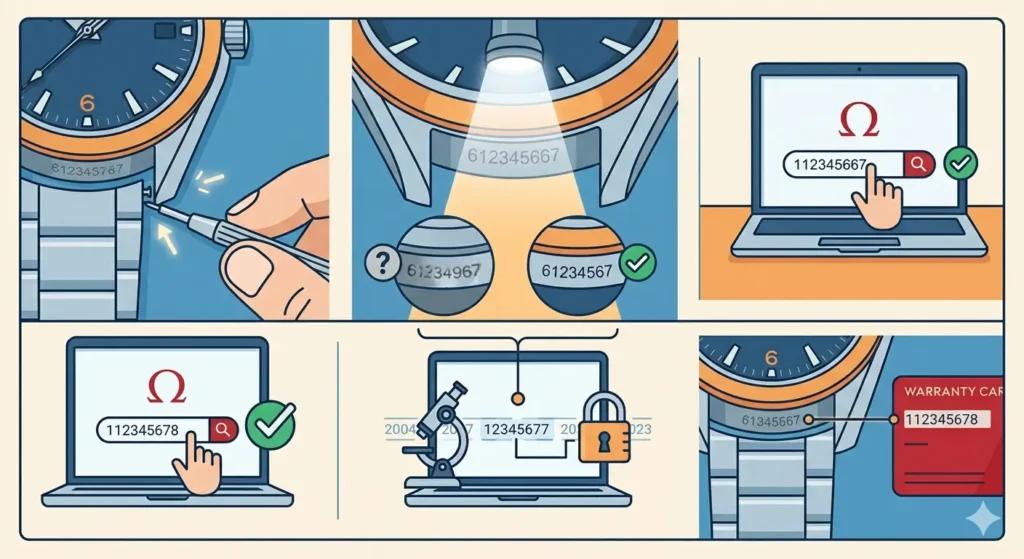
The serial number serves as the primary identifier for any authentic Omega Seamaster. Genuine watches feature laser-engraved serial numbers with precise, clean edges that reflect light at specific angles.
- Step 1: Locate the serial number between the lugs at 6 o’clock position (requires removing the bracelet)
- Step 2: Examine the engraving quality under good lighting – authentic numbers appear crisp with no rough edges
- Step 3: Verify the serial number format matches Omega’s numbering system for the production year
- Step 4: Visit Omega’s official website or authorized dealer to confirm the serial number exists in their database
- Step 5: Check that the serial number matches the documentation and warranty card
Pro-Tip: Fake Omega watches often use stamped serial numbers instead of laser engraving. Stamped numbers have raised edges and uneven depth, while authentic laser engravings create a recessed, perfectly uniform appearance that catches light differently than the surrounding metal.
Method 2: Examine the Weight and Build Quality
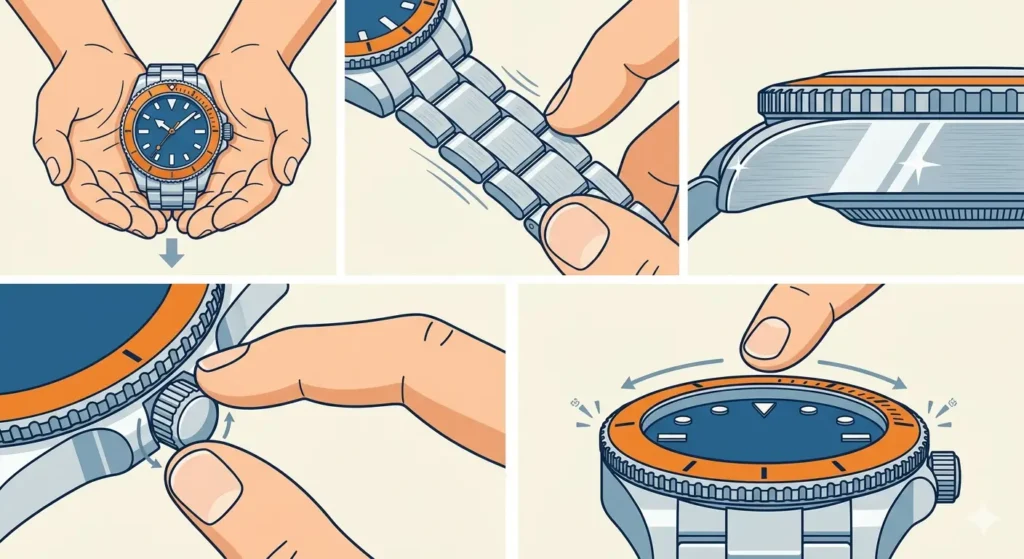
Authentic Omega Seamaster watches possess substantial weight due to premium materials like stainless steel, gold, or titanium combined with robust Swiss movements.
- Step 1: Hold the watch in hand and assess the overall weight – genuine Seamasters feel noticeably heavy
- Step 2: Check the bracelet links for smooth operation without rattling or loose connections
- Step 3: Inspect the case finishing for flawless polishing and brushing with no visible toolmarks
- Step 4: Test the crown action – it should screw down smoothly with precise threading
- Step 5: Verify the bezel rotation feels firm with distinct clicks at each position
Method 3: Inspect the Caseback Details
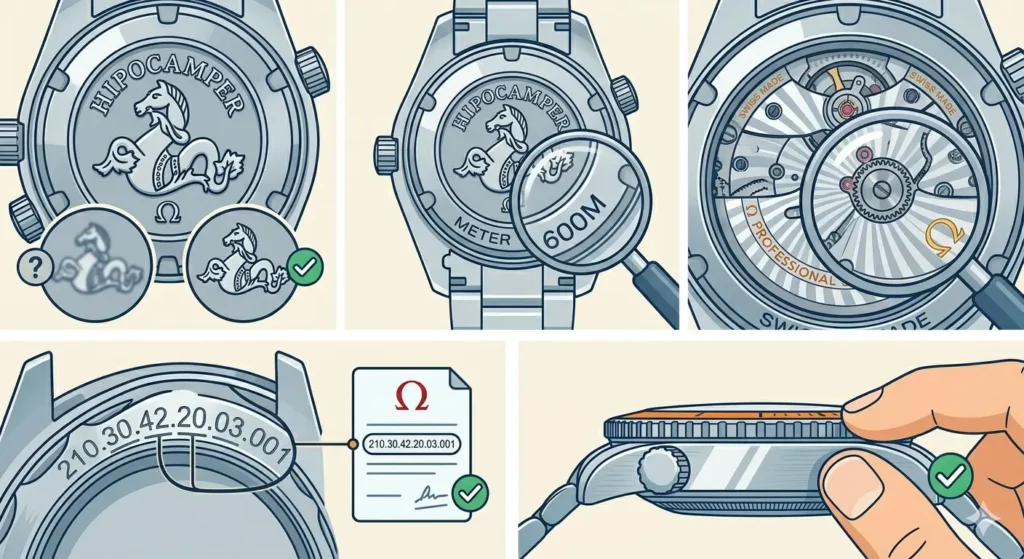
The caseback of an Omega Seamaster contains specific engravings and markings that counterfeiters struggle to replicate accurately.
- Step 1: Look for the iconic hippocampus (seahorse) logo – authentic versions show intricate detail
- Step 2: Check the depth rating engraving (300M, 600M, etc.) for sharp, clear lettering
- Step 3: Verify the reference number format matches official Omega documentation
- Step 4: Examine any exhibition casebacks for perfectly finished movements with Geneva stripes
- Step 5: Confirm the caseback sits flush against the case with no gaps
Method 4: Analyze the Dial and Hands
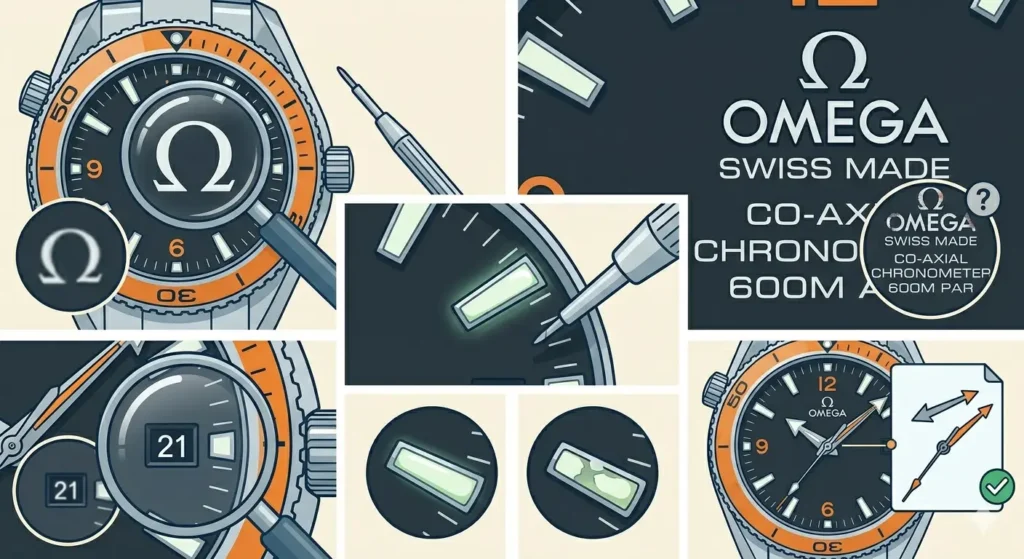
The dial represents one of the most telling areas where fakes reveal their true nature through poor execution of fine details.
- Step 1: Inspect the Omega logo for perfect symmetry and clean edges using magnification
- Step 2: Check the printing quality of text – authentic dials show razor-sharp lettering
- Step 3: Verify the lume application on hour markers appears even and properly filled
- Step 4: Examine the date window alignment and magnification (if applicable)
- Step 5: Confirm the hands match the correct style for the specific Seamaster model
Method 5: Evaluate the Movement
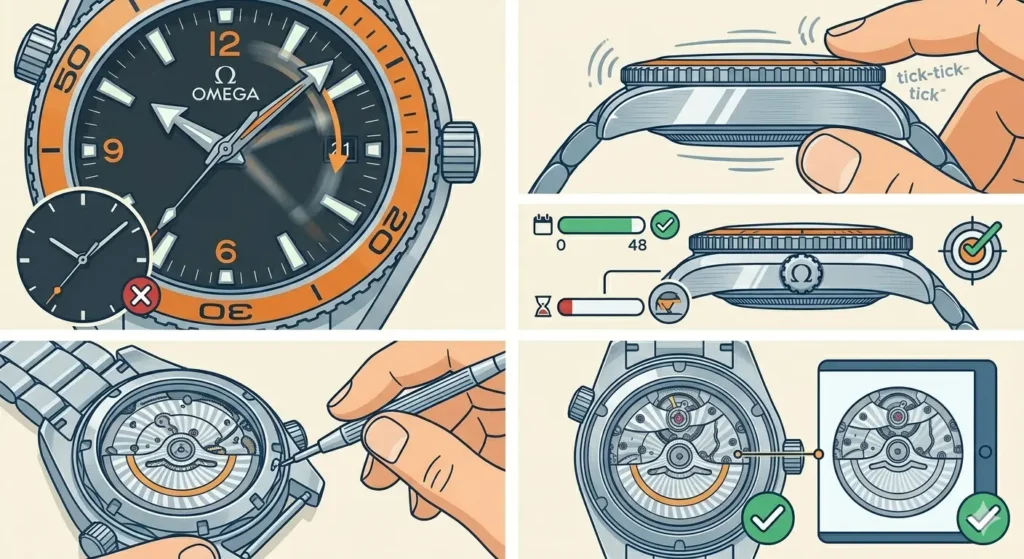
The heart of any Omega Seamaster lies in its Swiss-made automatic movement, which fakes cannot replicate with the same quality and precision.
- Step 1: Observe the seconds hand sweep – authentic automatic movements create smooth, flowing motion
- Step 2: Listen for the rotor sound when gently shaking the watch (should sound refined, not loud)
- Step 3: Check the power reserve performance – genuine movements maintain accuracy for 48+ hours
- Step 4: If possible, have a watchmaker open the case to inspect movement finishing and authenticity
- Step 5: Verify the movement caliber matches the model specifications from Omega
Pro-Tip: Counterfeit Omega watches frequently use cheap quartz movements that produce visible ticking instead of the smooth sweep characteristic of automatic movements. Even when fakes use automatic movements, the rotor noise sounds significantly louder and rougher than genuine Swiss calibers.
Method 6: Test the Helium Escape Valve
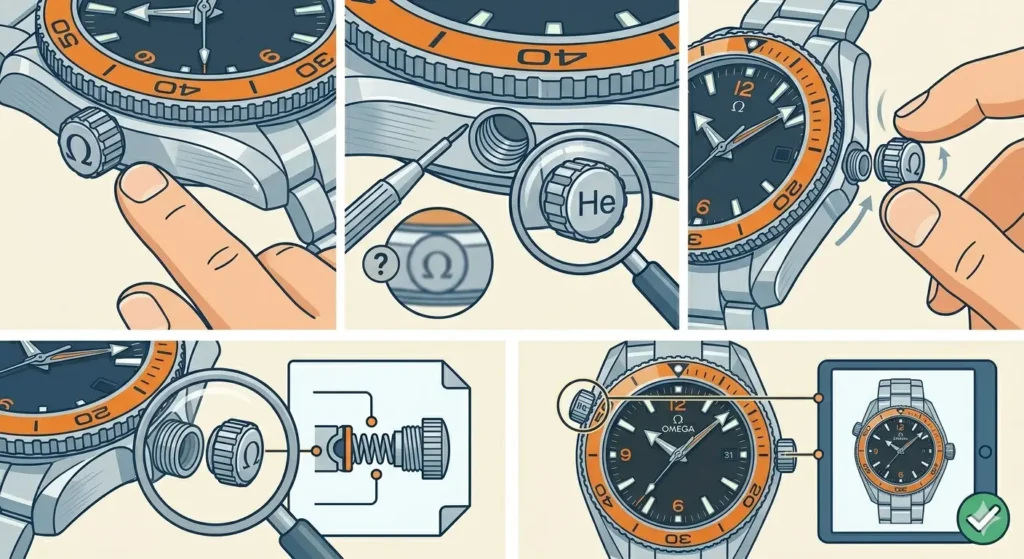
Professional Seamaster models feature a helium escape valve designed for saturation diving, which provides another authentication checkpoint.
- Step 1: Locate the valve on the case side (typically at 10 o’clock position)
- Step 2: Examine the valve construction for proper threading and authentic Omega markings
- Step 3: Check that the valve operates smoothly when unscrewed slightly
- Step 4: Verify the valve design matches the specific Seamaster model reference
Method 7: Review Documentation and Packaging
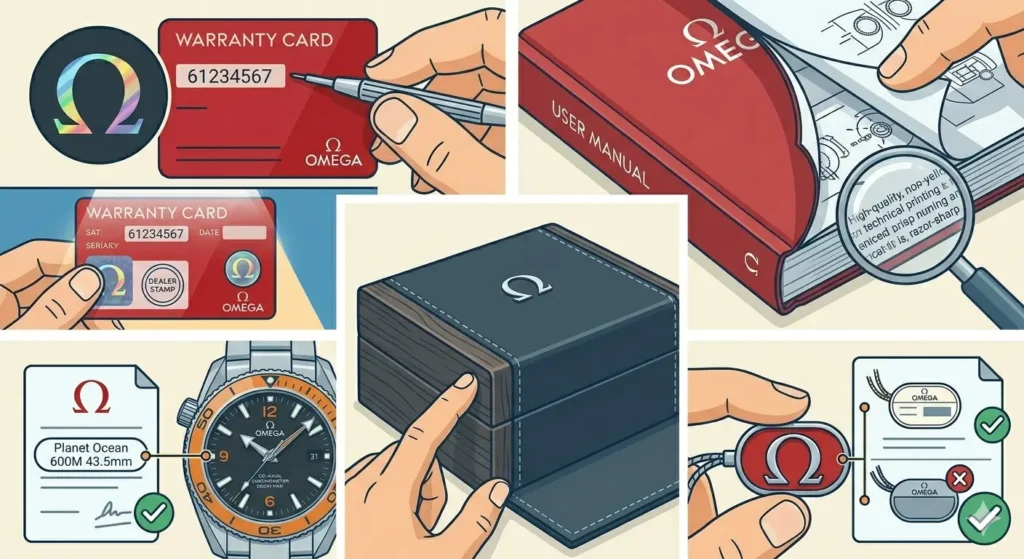
Authentic Omega Seamaster watches come with comprehensive documentation and premium packaging that fakes rarely duplicate convincingly.
- Step 1: Inspect the warranty card for proper holograms, serial number matching, and dealer stamps
- Step 2: Check the manual quality – genuine Omega manuals use high-quality paper and printing
- Step 3: Examine the presentation box for solid construction and perfect finishing
- Step 4: Verify any certificates of authenticity include correct model information
- Step 5: Confirm the hang tag matches current Omega design standards
Tips for Authenticating Omega Seamaster Watches
- Purchase only from authorized Omega dealers or reputable pre-owned watch specialists with authentication guarantees
- Use the world time comparison tool to coordinate with Omega boutiques in different time zones for verification calls
- Request detailed photographs showing serial numbers, movement, and caseback before purchasing online
- Compare the watch against official Omega catalog images for the specific reference number
- Invest in professional authentication services when dealing with high-value vintage Seamasters
- Check seller reputation through reviews and verified transaction history
- Be wary of prices significantly below market value – genuine Seamasters hold their value
- Use a clock tab to track auction ending times when bidding on authenticated pieces
- Examine the bracelet clasp for precise Omega engravings and smooth operation
- Compare the watch’s lume color to known authentic examples in collector forums
Common Problems When Authenticating Omega Seamasters
Fix 1: Dealing with Franken Watches
Some watches combine genuine Omega parts with aftermarket or fake components, creating ‘Franken watches’ that pass basic authentication checks. Solution: Have a certified Omega watchmaker perform a complete movement and parts verification, as these professionals can identify non-original components that appear genuine to untrained eyes.
Fix 2: Handling Refinished Dials
Vintage Seamasters sometimes feature refinished dials that look too perfect, potentially indicating restoration or replacement with non-original parts. Solution: Research the specific vintage model’s aging characteristics and patina patterns, then compare against documented examples from reputable collectors to identify whether the dial shows appropriate aging for its era.
Fix 3: Identifying Super Clones
High-quality counterfeit ‘super clone’ Seamasters replicate many authentic features with surprising accuracy. Solution: Focus on movement inspection, as even the best fakes use inferior movements, and verify the serial number directly with Omega customer service, as super clones often reuse legitimate serial numbers from different watches.
Fix 4: Missing or Incomplete Documentation
Legitimate pre-owned Seamasters may lack original papers, making authentication more challenging. Solution: Request an extract from the Omega archives, which provides official documentation of the watch’s production details based on the serial number, though this service requires a fee and processing time using an online stopwatch to track the wait period.
Frequently Asked Questions
What is the easiest way to spot a fake Omega Seamaster?
The easiest indicator involves checking the seconds hand movement – authentic Omega Seamasters with automatic movements display a smooth, sweeping motion, while most fakes use quartz movements that produce visible ticking. Additionally, checking the weight provides an immediate tell, as genuine Seamasters feel substantially heavier than counterfeit versions due to premium materials and Swiss movements.
Where is the serial number located on an Omega Seamaster?
The serial number appears engraved between the lugs at the 6 o’clock position on most Omega Seamaster models. Accessing this number requires removing the bracelet or strap using a spring bar tool. Authentic serial numbers feature laser engraving with precise, clean edges, while fake watches typically show stamped or poorly engraved numbers.
Can Omega verify if a Seamaster is authentic?
Yes, Omega can verify authenticity through their customer service department or authorized service centers. Contact Omega with the serial number, and they will confirm whether it matches their production records. For a more comprehensive verification, Omega offers an Extract from the Archives service that provides complete production details for vintage and modern watches.
How much does a real Omega Seamaster weigh?
Authentic Omega Seamaster watches typically weigh between 150-200 grams depending on the specific model and materials. Stainless steel models generally weigh around 180-190 grams, while titanium versions weigh approximately 150-160 grams. Fake Seamasters usually weigh 20-40% less due to cheaper materials and inferior construction quality.
Do all Omega Seamasters have a helium escape valve?
No, only professional diving models like the Seamaster Professional 300M and Planet Ocean feature helium escape valves. Standard Seamaster models, dress versions, and vintage references typically lack this feature. The presence or absence of a helium valve should match the specific model specifications when authenticating a watch.
What movement do authentic Omega Seamasters use?
Authentic modern Omega Seamasters use Swiss-made automatic movements, primarily calibers 8800, 8900, and their variants, which feature Co-Axial escapement technology. Vintage models used calibers 1120, 2500, and others. All genuine movements display exceptional finishing, smooth operation, and accurate timekeeping that counterfeit movements cannot replicate.
How can someone verify an Omega warranty card?
Genuine Omega warranty cards feature specific security elements including holograms, unique serial numbers matching the watch, authorized dealer stamps with dates, and high-quality card stock with precise printing. Contact the listed authorized dealer to confirm they sold the watch on the date indicated. Modern cards include QR codes that link to Omega’s verification system.
Are exhibition casebacks standard on Omega Seamasters?
Exhibition casebacks vary by model – some Seamaster references feature transparent sapphire casebacks displaying the movement, while others have solid stainless steel backs with engravings. Check official Omega specifications for the specific reference number to determine which caseback style is correct, as fakes sometimes add exhibition casebacks to models that never featured them.
What should the hippocampus logo look like on an authentic Seamaster?
The authentic hippocampus (seahorse) logo on an Omega Seamaster caseback displays intricate detail with clearly defined fins, tail curves, and body segments. The engraving should appear deep, crisp, and three-dimensional when viewed under magnification. Fake versions typically show shallow, blurry engravings with simplified details and poor definition.
Can fake Omega Seamasters have working chronograph functions?
Yes, some counterfeit Omega Seamaster chronographs feature working chronograph complications, though the quality and accuracy fall far below authentic standards. However, the finishing, button feel, and reset precision differ significantly from genuine models. Many fakes also misalign subdials or use incorrect hand styles that reveal their counterfeit nature upon close inspection.