
Learning how to tell if a Rolex is real or fake protects buyers from costly counterfeit purchases. Authentic Rolex watches represent significant investments, with prices ranging from thousands to hundreds of thousands of dollars. Understanding the telltale signs of genuine Rolex craftsmanship helps distinguish authentic timepieces from sophisticated replicas flooding the luxury watch market.
Quick Summary Table
| Verification Method | What to Check | Authentic Rolex | Fake Rolex |
|---|---|---|---|
| Weight Test | Physical heaviness | Noticeably heavy due to precious metals | Lightweight, hollow feeling |
| Second Hand Movement | Sweeping motion | Smooth gliding sweep | Ticking or stuttering motion |
| Cyclops Lens | Date magnification | 2.5x magnification, crystal clear | Poor magnification, distorted view |
| Serial Number | Engraving quality | Deep, precise engraving | Acid-etched, sandy appearance |
| Case Back | Engravings and finish | Smooth, minimal markings | Exhibition windows, decorative engravings |
Method 1: Check the Weight and Feel
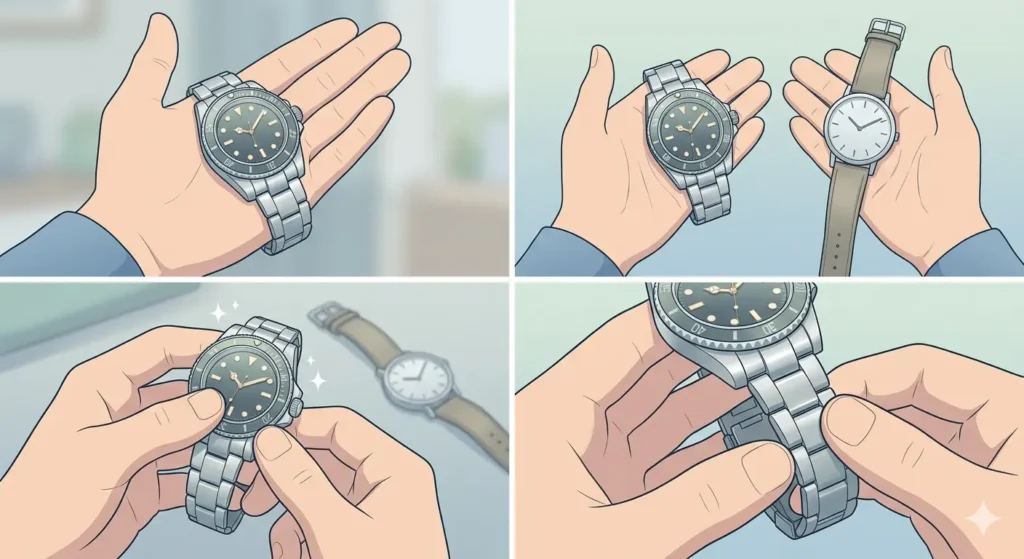
Authentic Rolex watches possess substantial weight due to their construction from premium materials including 904L stainless steel, 18k gold, or platinum. The heft of a genuine Rolex immediately distinguishes it from counterfeits.
Step 1: Hold the watch in your hand and assess its weight. A real Rolex feels noticeably heavy and solid.
Step 2: Compare the weight to similar-sized watches. Genuine Rolex timepieces weigh significantly more than standard watches of comparable dimensions.
Step 3: Check for any hollow or cheap feeling. Counterfeit watches often use lightweight alloys that create an insubstantial sensation.
Step 4: Examine the bracelet links. Authentic Rolex bracelets move fluidly without feeling flimsy or rattling excessively.
The weight difference becomes immediately apparent when handling both authentic and counterfeit pieces side by side. Most people find that genuine Rolex watches feel like solid blocks of metal rather than hollow shells.
Pro Tip
A genuine Rolex Submariner weighs approximately 155 grams, while a Datejust typically weighs around 135-140 grams. Counterfeits rarely achieve even 75% of these weights due to cheaper materials and hollow construction methods.
Method 2: Observe the Second Hand Movement
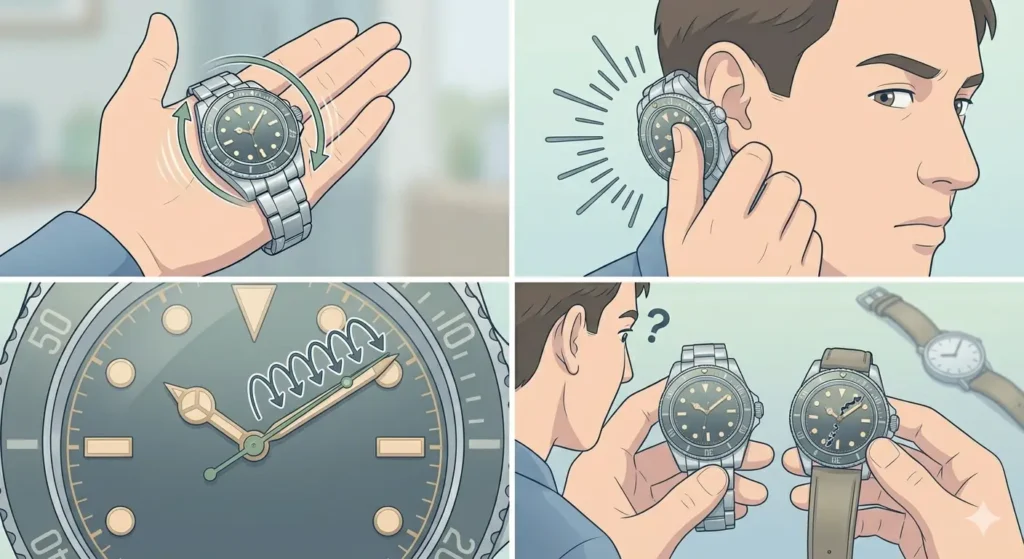
The movement of the second hand provides one of the most reliable indicators of Rolex authenticity. Genuine Rolex watches utilize high-beat automatic movements that create distinctive motion patterns.
Step 1: Watch the second hand as it moves around the dial. A real Rolex second hand sweeps smoothly in a continuous gliding motion.
Step 2: Listen closely to the watch. Authentic Rolex movements operate nearly silently, without audible ticking sounds.
Step 3: Count the micro-movements. Genuine Rolex movements beat at 28,800 vibrations per hour, creating eight tiny movements per second that appear as smooth sweeping.
Step 4: Look for any stuttering or jumping. Fake watches typically use quartz movements or low-quality automatic movements that tick noticeably or stutter between seconds.
The sweeping motion remains one of the easiest authentication methods for anyone to perform. Using an online stopwatch helps time the second hand precisely to verify the smooth eight-beat-per-second rhythm characteristic of authentic Rolex movements.
Method 3: Inspect the Cyclops Lens Magnification
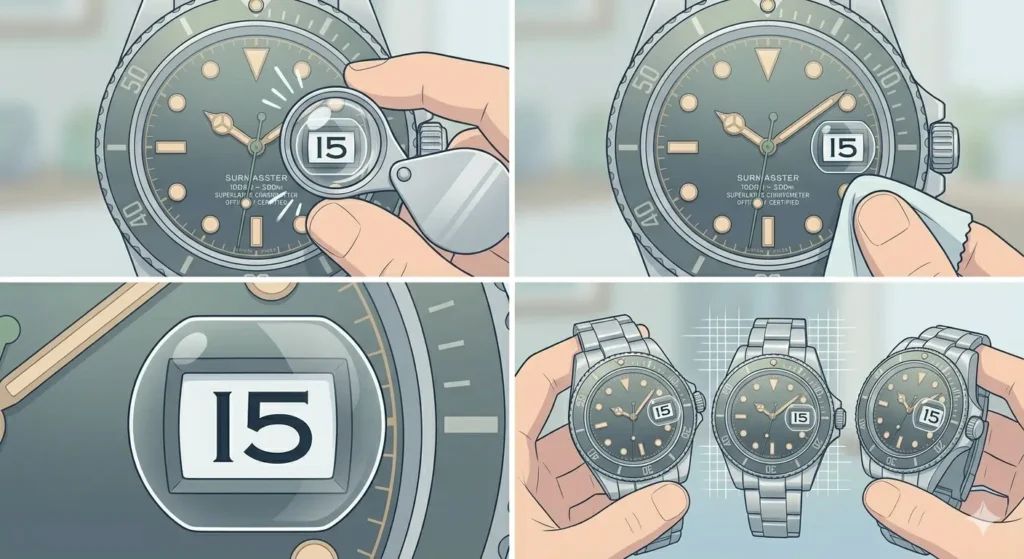
Rolex models featuring date displays include a cyclops lens—a magnifying bubble on the crystal that enlarges the date window. This component reveals significant differences between genuine and counterfeit pieces.
Step 1: Look at the date through the cyclops lens. Authentic Rolex cyclops lenses magnify the date 2.5 times, making numbers appear large and easily readable.
Step 2: Check the clarity and distortion. Genuine Rolex crystals provide crystal-clear magnification without distortion or blurriness around the edges.
Step 3: Verify the date fills the magnified area. Real Rolex watches display dates that occupy most of the magnified bubble space.
Step 4: Examine from different angles. Authentic cyclops lenses maintain consistent magnification quality from various viewing positions.
Counterfeit watches typically feature poor-quality cyclops lenses with magnification ratios of only 1.5x or less. The date appears smaller and harder to read compared to genuine pieces. Some sophisticated fakes omit the cyclops entirely on models that should include it.
Method 4: Examine the Serial and Model Numbers
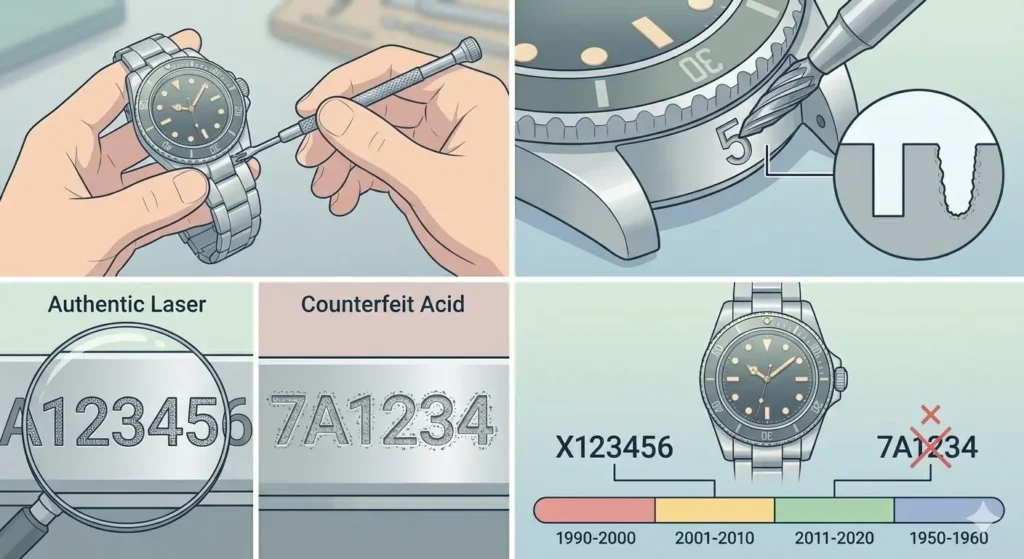
Every authentic Rolex contains unique serial and model numbers engraved between the lugs. The quality and placement of these engravings distinguish real from fake timepieces.
Step 1: Remove the bracelet to access the numbers. Serial numbers appear between the lugs at 6 o’clock, while model numbers sit between the lugs at 12 o’clock.
Step 2: Inspect the engraving depth and precision. Genuine Rolex engravings feature deep, clean cuts with sharp edges and consistent depth.
Step 3: Check the engraving method. Authentic Rolex watches from 2005 onward use laser engraving that creates microscopic patterns within the numbers.
Step 4: Verify the serial number format matches the production year. Rolex serial numbers follow specific formats corresponding to manufacturing periods.
Step 5: Look for signs of acid etching. Counterfeit watches often use acid etching that produces sandy, rough-looking numbers with uneven depth.
Pro Tip
Rolex stopped placing serial numbers between the lugs in 2008, instead engraving them on the inner rehaut (the ring between the dial and crystal) at the 6 o’clock position. Knowing your watch’s production era helps determine the correct serial number location.
Method 5: Analyze the Case Back
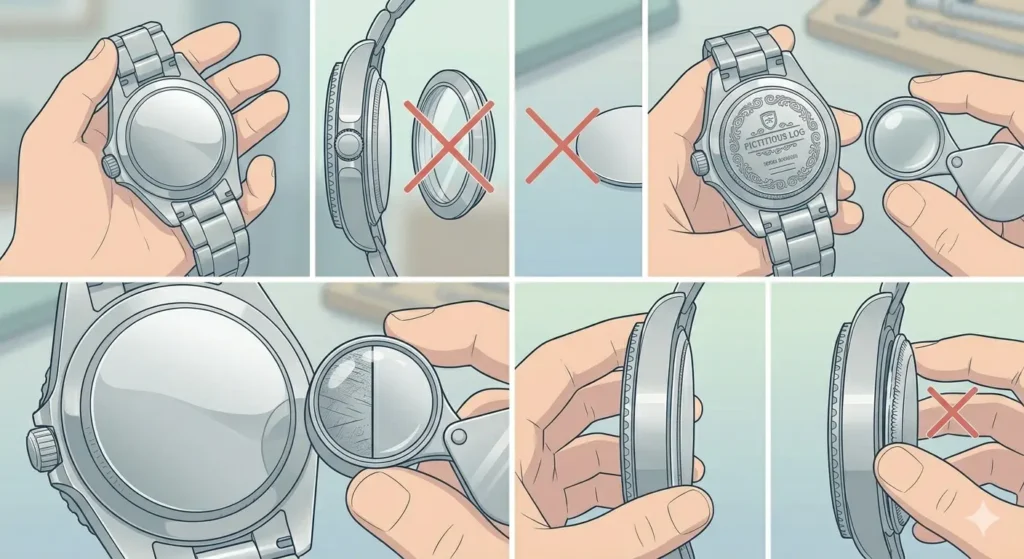
The case back of a Rolex watch provides crucial authentication clues. Rolex maintains strict design standards for case backs that counterfeiters struggle to replicate accurately.
Step 1: Examine the case back surface. Authentic Rolex sports models and most dress watches feature completely smooth, polished case backs without engravings or exhibition windows.
Step 2: Check for exhibition windows. Rolex never uses transparent case backs on production models, though some vintage models have solid metal case backs with minimal engravings.
Step 3: Look for decorative engravings or logos. Fake watches frequently add elaborate engravings, Rolex logos, or decorative text that genuine pieces never display.
Step 4: Inspect the finishing quality. Real Rolex case backs show flawless polishing without tool marks, scratches from manufacturing, or uneven surfaces.
Step 5: Verify the case back fits flush. Authentic case backs screw down tightly with perfectly matched threading and no gaps between the case and back.
The key is to remember that Rolex prioritizes function and durability over flashy aesthetics. Exhibition case backs and decorative engravings appeal to consumers but compromise water resistance and case integrity—qualities Rolex refuses to sacrifice.
Additional Tips for Verification
Beyond the five primary authentication steps, several additional verification methods help confirm Rolex authenticity. These supplementary checks provide extra confidence when evaluating potentially counterfeit timepieces.
Check the Crown Logo
The Rolex crown logo on the dial, crown, and clasp must show perfect proportions and sharp details. Authentic crowns feature five precisely formed points with consistent spacing. Counterfeit logos often display uneven points, poor definition, or incorrect proportions.
Verify the Dial Printing
Genuine Rolex dials exhibit flawless printing with crisp text, perfect alignment, and consistent spacing. The word ‘SWISS MADE’ appears at the bottom of every authentic dial with specific spacing standards. Fake dials frequently show smudged printing, uneven letter spacing, or misaligned text.
Test the Winding Mechanism
Authentic Rolex watches feature buttery-smooth winding action with consistent resistance. The crown should screw down firmly with precise threading. Counterfeit watches often have gritty, inconsistent winding with loose or cross-threaded crowns.
Examine the Bracelet Quality
Rolex bracelets demonstrate exceptional engineering with solid end links, precise tolerances, and smooth operation. Each link should move freely without excessive play. The clasp must close securely with a satisfying click and display the Rolex crown logo with proper proportions.
Consult Reference Materials
Comparing the watch against official Rolex catalog images and specifications helps identify discrepancies. Reference the exact model number to verify dial variations, bezel markings, and bracelet styles match factory specifications.
Using a world time comparison tool proves helpful when coordinating with authentication experts or dealers in different time zones, ensuring timely communication during the verification process.
Common Authentication Problems
Several challenges commonly arise during Rolex authentication attempts. Understanding these issues helps avoid mistakes and improves verification accuracy.
Super Clone Complications
High-end counterfeit ‘super clones’ replicate many authentic Rolex characteristics, including proper weight, smooth movements, and quality engravings. These sophisticated fakes require expert examination of internal components to detect. Most people find that super clones fool basic authentication tests, necessitating professional watchmaker evaluation.
Franken Watches
Some counterfeit watches combine genuine Rolex parts with fake components, creating hybrid ‘Franken watches’ that pass certain authentication tests while failing others. These pieces might have authentic bracelets attached to counterfeit cases, or genuine dials installed in fake movements.
Refurbished and Modified Pieces
Legitimate Rolex watches sometimes receive aftermarket modifications including replacement dials, bezels, or custom engravings. These alterations can create authentication confusion even though the base watch remains genuine. Modified Rolex watches lose significant value and may trigger authentication concerns.
Vintage Model Variations
Older Rolex models feature different characteristics than modern pieces. Vintage watches may have different serial number placements, case back engravings, or movement types that appear incorrect when compared to contemporary standards. Research specific model years before authentication attempts.
Poor Lighting Conditions
Inadequate lighting hampers effective authentication by obscuring fine details, engraving quality, and finishing flaws. Always examine watches under bright, direct lighting that reveals subtle imperfections and manufacturing characteristics.
Professional authentication services provide definitive verification when personal examination proves inconclusive. Authorized Rolex dealers and certified watchmakers possess specialized tools and expertise to confirm authenticity conclusively.
Frequently Asked Questions
How much does a real Rolex weigh compared to a fake?
Authentic Rolex watches typically weigh between 135-155 grams depending on the model, while counterfeits often weigh 30-50% less due to cheaper materials and hollow construction. A genuine Submariner weighs approximately 155 grams, whereas fake versions rarely exceed 100 grams.
Do all real Rolex watches have smooth sweeping second hands?
Yes, all authentic Rolex watches use automatic movements that beat at 28,800 vibrations per hour, creating smooth sweeping second hand motion with eight micro-movements per second. The only exception is the Rolex Oysterquartz from the 1970s-1980s, which used quartz movement with ticking motion.
Can fake Rolex watches have real serial numbers?
Counterfeit watches sometimes use serial numbers copied from genuine Rolex pieces, but the engraving quality differs significantly. Authentic serial numbers feature deep, precise engraving with consistent depth, while fake numbers show sandy, acid-etched appearance with uneven surfaces.
Where should the serial number be located on a Rolex?
Rolex serial number location depends on production year. Watches manufactured before 2005 have serial numbers engraved between the lugs at 6 o’clock. Models from 2005-2008 feature serial numbers in the same location with laser engraving. Watches produced after 2008 display serial numbers on the inner rehaut at the 6 o’clock position.
Do authentic Rolex watches tick or sweep?
Genuine Rolex watches sweep smoothly rather than tick. The automatic movements create continuous gliding motion that appears nearly seamless to the naked eye. Ticking motion indicates quartz movement, which Rolex only used in the discontinued Oysterquartz model.
How can you tell if a Rolex cyclops is real?
Authentic Rolex cyclops lenses magnify the date 2.5 times, making numbers large and easily readable. The magnification remains crystal clear without distortion. Fake cyclops lenses provide only 1.5x magnification or less, resulting in smaller, harder-to-read dates with potential blurriness.
Why do fake Rolex watches have exhibition case backs?
Counterfeiters add exhibition case backs to showcase movements and create perceived luxury value. However, Rolex never uses transparent case backs on production models because they compromise water resistance and case integrity. Any Rolex with an exhibition case back is definitely counterfeit.
Can a jeweler tell if a Rolex is fake?
Professional jewelers and certified watchmakers can authenticate Rolex watches by examining internal components, movement quality, and manufacturing characteristics invisible to untrained eyes. However, not all jewelers possess specialized Rolex knowledge, so seeking experts specifically experienced with Rolex authentication provides best results.
What is the most reliable way to authenticate a Rolex?
The most reliable authentication method involves professional examination by authorized Rolex dealers or certified watchmakers who can open the case and inspect internal components. These experts verify movement authenticity, component quality, and manufacturing details that external examination cannot reveal.
How much does professional Rolex authentication cost?
Professional Rolex authentication services typically cost between 50-200 dollars depending on the service provider and evaluation depth. Authorized Rolex service centers may provide free authentication when considering watches for service, though policies vary by location.