
Understanding ISO 6425 certification is essential for anyone seeking a genuine dive watch that meets international safety standards. This certification guarantees that a timepiece can withstand the rigors of underwater diving, offering reliability and performance when seconds matter most. Whether shopping for a professional diving tool or simply wanting to know what makes a certified dive watch different from a regular water-resistant watch, this comprehensive guide breaks down everything about the ISO 6425 standard.
Quick Summary Table
| Key Aspect | Requirement |
|---|---|
| Minimum Water Resistance | 100 meters (10 ATM) |
| Overpressure Testing | 125% of rated depth for 2 hours |
| Shock Resistance | Must survive 5,000g impact from 3 directions |
| Magnetic Resistance | Exposure to 4,800 A/m magnetic field |
| Legibility | Visible from 25 cm in total darkness |
| Pre-Selection Time | Unidirectional rotating bezel required |
| Thermal Shock Test | 40°C to 5°C to 40°C cycle |
| Salt Water Resistance | 24-hour immersion in 30g/L salt solution |
Understanding ISO 6425 Certification
ISO 6425 is the international standard specifically designed for dive watches, established by the International Organization for Standardization. This standard differs significantly from basic water resistance ratings found on typical watches. While many watches claim water resistance, only those meeting ISO 6425 requirements can legitimately be marketed as ‘dive watches.’
The certification process involves rigorous testing protocols that simulate real diving conditions and extreme scenarios that a watch might encounter underwater. Each test evaluates a specific aspect of the watch’s construction, from case integrity to luminosity performance.
What Makes ISO 6425 Different from Water Resistance
Standard water resistance ratings indicate static pressure tolerance, meaning the watch can handle that depth while stationary. ISO 6425 certification goes further by testing dynamic conditions – arm movements, temperature changes, and prolonged exposure that mimic actual diving activities.
A watch rated for 100 meters of water resistance might fail under real diving conditions, while an ISO 6425 certified watch at the same rating has proven its capability through comprehensive testing.
Complete ISO 6425 Testing Requirements
Every dive watch seeking certification must pass multiple demanding tests. Here’s the complete breakdown of what manufacturers must verify:
Water Resistance Testing
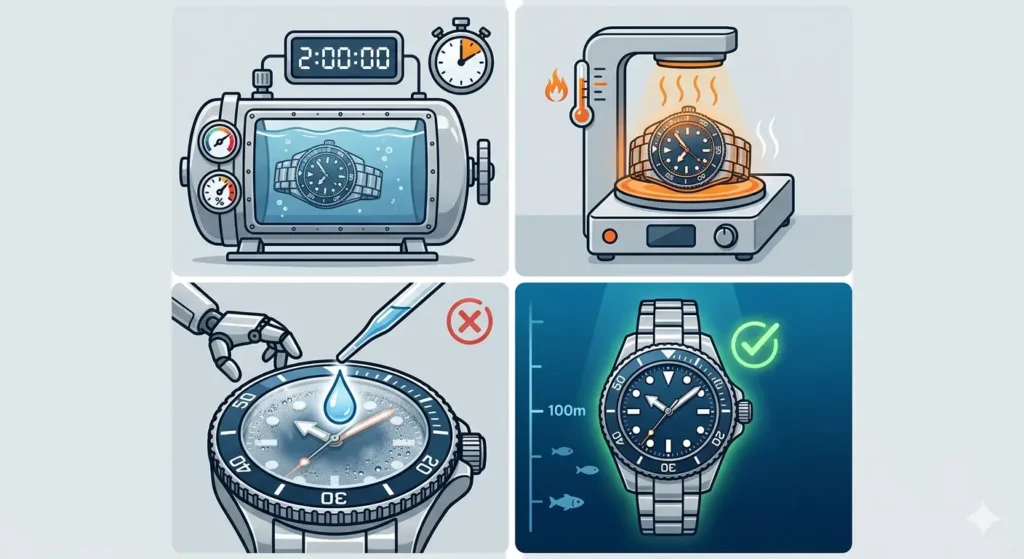
Step 1: The watch undergoes overpressure testing at 125% of its rated depth for a minimum of 2 hours
Step 2: Condensation testing follows, where the watch is heated to 40-45°C, then a cold water drop is applied to the crystal
Step 3: Any moisture appearing inside the crystal indicates seal failure and automatic certification rejection
Step 4: The watch must maintain a water resistance of at least 100 meters (10 bar/10 ATM) as the minimum standard
This testing ensures the watch can handle pressure changes encountered during descent and ascent, plus the additional stress from swimming movements.
Shock Resistance Requirements
Dive watches face impacts from equipment, boat surfaces, and underwater obstacles. The ISO 6425 standard requires watches to survive a 5,000g shock from three perpendicular directions without affecting functionality or water resistance.
This test uses a hard plastic hammer striking the watch while it sits on a rigid surface, simulating the types of impacts divers experience during normal equipment handling.
Magnetic Resistance Testing
Underwater equipment, boat engines, and diving gear can generate magnetic fields that affect watch accuracy. ISO 6425 mandates exposure to a magnetic field of 4,800 A/m (approximately 60 gauss) without the watch deviating more than allowed tolerances.
After magnetic exposure, the watch must maintain its accuracy within acceptable limits, proving the movement remains unaffected by magnetic interference.
Legibility Standards
Visibility in low-light or zero-light conditions is critical for diver safety. The standard requires:
- All time indicators must be clearly visible from 25 centimeters in total darkness
- Luminous material must remain visible for several hours after light exposure
- Contrast between dial and hands must be sufficient for instant readability
- Unidirectional rotating bezel must have clear minute markers
Most modern dive watches use Super-LumiNova or tritium-based luminescence to meet these requirements. The material choice affects how long the watch glows and how bright it appears underwater.
Rotating Bezel Functionality
The unidirectional rotating bezel is mandatory for ISO 6425 certification. This safety feature allows divers to track elapsed dive time without accidentally extending their planned duration.
Step 1: The bezel must rotate only counterclockwise, preventing accidental time extension
Step 2: Each click position must be distinct and secure, with clear audible or tactile feedback
Step 3: Minute markers must be visible and accurate, typically with high-contrast markings every 5 minutes
Step 4: The bezel must resist accidental movement while allowing intentional rotation with wet or gloved hands
This mechanism directly impacts diver safety, making it one of the most scrutinized aspects during certification.
Thermal Shock Testing
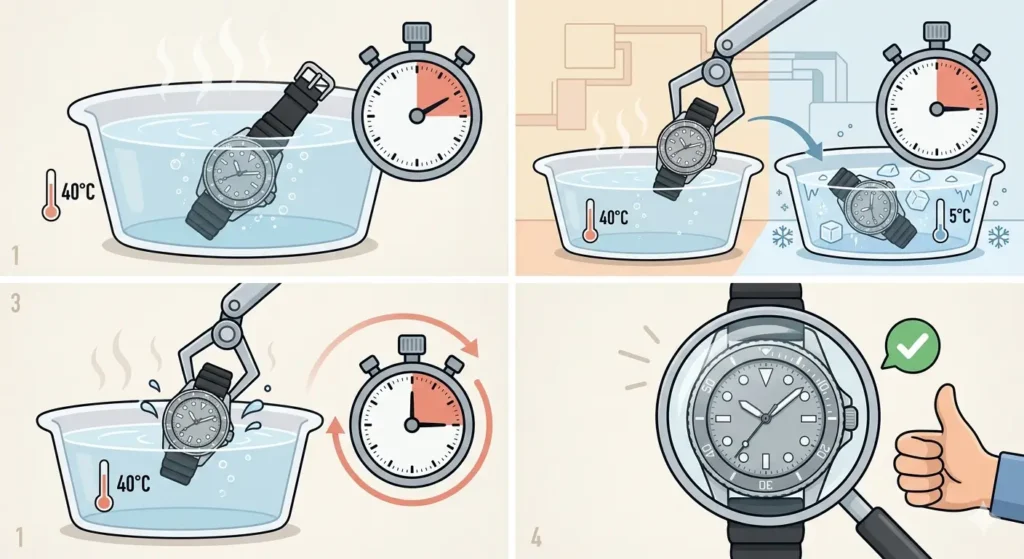
Temperature changes from warm surface water to cold depths can stress watch components. The thermal shock test cycles the watch through:
Step 1: Immersion in 40°C water for 10-15 minutes
Step 2: Immediate transfer to 5°C water for 10-15 minutes
Step 3: Return to 40°C water to complete the cycle
Step 4: Verification that seals, crystal, and case maintain integrity without condensation
This rapid temperature change simulates entering cold water after surface intervals in tropical climates or moving between thermoclines during a single dive.
Salt Water Corrosion Resistance
Marine environments expose watches to corrosive salt water continuously. ISO 6425 testing requires 24-hour immersion in a salt solution containing 30 grams of sodium chloride per liter of water.
After this exposure, the watch must show no signs of corrosion, degradation of seals, or reduced functionality. This ensures materials and coatings can withstand extended saltwater exposure without deterioration.
How Manufacturers Obtain ISO 6425 Certification

The certification process involves either in-house testing facilities or independent testing laboratories. Manufacturers must document each test result and maintain quality control systems ensuring every production unit meets the same standards.
Step 1: The manufacturer conducts all required tests on prototype and production samples
Step 2: Documentation of test results is compiled with technical specifications
Step 3: Independent verification may be requested by certification bodies or retailers
Step 4: Ongoing production monitoring ensures consistent compliance across all units
Some brands exceed ISO 6425 minimums, testing to higher pressures or adding proprietary tests. These exceed-standard practices often become marketing points for premium dive watch models.
Pro-Tip: Reading Certification Markings
Genuine ISO 6425 certified dive watches display specific markings on the dial or case back. Look for ‘DIVER’S’ followed by the depth rating, typically shown as ‘DIVER’S 200M’ or similar. The presence of this exact terminology indicates the watch meets ISO 6425 requirements, not just basic water resistance standards. Watches marked only with ‘water resistant’ or ‘WR’ without the ‘DIVER’S’ designation have not undergone full certification testing, regardless of their depth rating.
Practical Benefits of ISO 6425 Certification
Beyond professional diving applications, ISO 6425 certification provides tangible benefits for everyday wear. The robust construction required for certification means these watches handle daily shocks, temperature variations, and moisture exposure better than standard watches.
The legibility requirements make certified dive watches excellent choices for anyone needing quick time reference in low-light conditions. The unidirectional bezel serves as a reliable timer for any activity requiring countdown tracking, from cooking to exercise intervals.
Real-World Reliability
Certified dive watches regularly outlast non-certified counterparts because the testing process identifies and eliminates weak points in design and construction. The rigorous shock testing translates to watches that survive drops, bumps, and impacts during normal daily activities.
Water resistance testing at 125% of rated depth provides a safety margin ensuring the watch maintains integrity even when depth ratings are approached during actual dives or water sports.
Common Dive Watch Features Beyond ISO 6425
Many dive watches include features not required by ISO 6425 but valuable for diving or daily use:
- Helium escape valves for saturation diving beyond recreational limits
- Enhanced luminescence using multiple colors for different indicators
- Depth gauges integrated into the watch mechanism
- Extended power reserves for mechanical movements
- Reinforced crystal materials like sapphire with anti-reflective coatings
These additions complement the base certification requirements, offering enhanced functionality for specific diving scenarios or user preferences.
Maintaining ISO 6425 Certification Standards
Even certified dive watches require regular maintenance to maintain their certified performance levels. Seals and gaskets deteriorate over time, potentially compromising water resistance.
Step 1: Schedule pressure testing every 12-24 months, or after any significant impact
Step 2: Replace gaskets and seals during regular service intervals, typically every 3-5 years
Step 3: Rinse the watch with fresh water after saltwater exposure to prevent corrosion
Step 4: Avoid operating crown or pushers while the watch is wet or submerged
Step 5: Store the watch in moderate temperature and humidity conditions when not in use
Service by qualified watchmakers familiar with dive watch construction ensures proper maintenance of certification-level performance. Using timing tools like an online stopwatch can help track service intervals accurately.
Tips for Choosing an ISO 6425 Certified Dive Watch
Selecting the right certified dive watch depends on intended use, budget, and personal preferences. Consider these factors:
- Match depth rating to actual diving depths, adding safety margin for recreational diving
- Evaluate movement type – quartz offers accuracy and low maintenance, while mechanical provides traditional appeal
- Consider case size for wrist comfort and wetsuit compatibility
- Assess bracelet or strap options for diving versus daily wear flexibility
- Verify certification markings are present on dial or case back
- Research brand reputation for quality control and service support
- Compare luminescence performance if night diving is planned
Testing the bezel action, crown operation, and overall comfort before purchase ensures satisfaction with the watch’s physical characteristics beyond certification compliance.
Budget Considerations
ISO 6425 certified dive watches span wide price ranges, from affordable tool watches to luxury timepieces. The certification process costs money, but entry-level certified watches prove that premium pricing is not mandatory for meeting standards.
Higher prices often reflect premium materials, in-house movements, brand prestige, or enhanced finishing rather than superior certification compliance. A less expensive certified watch meets the same ISO 6425 requirements as luxury alternatives.
Common Problems and Troubleshooting
Even certified dive watches can develop issues requiring attention. Recognizing problems early prevents damage and maintains safety.
Condensation Under Crystal
Moisture inside the watch indicates compromised water resistance. This demands immediate professional service, as continued water exposure will damage the movement. Stop using the watch for water activities and schedule pressure testing.
Bezel Not Rotating Smoothly
Debris, salt deposits, or worn components can impede bezel rotation. Rinse thoroughly with fresh water first. If the problem persists, professional cleaning or component replacement may be necessary. A malfunctioning bezel compromises a key safety feature.
Reduced Luminescence
Luminous material degradation occurs over years of use and light exposure. While this doesn’t affect water resistance, it impacts the ISO 6425 legibility requirement. Dial refinishing or replacement restores certification-level visibility.
Accuracy Drift
Mechanical movements naturally vary in accuracy, but sudden changes may indicate magnetic exposure or shock damage. Demagnetization and regulation restore proper timekeeping. Comparing time against a reliable reference using tools like world time comparison tool helps track accuracy changes.
Crown Difficult to Operate
Stiff crown operation may result from dried lubricants, debris, or gasket swelling. Never force a resistant crown, as this can damage threading or compromise seals. Professional service addresses the underlying cause while maintaining water resistance.
Frequently Asked Questions
What depth rating is required for ISO 6425 certification?
The minimum water resistance for ISO 6425 certification is 100 meters (10 ATM). However, the watch must also pass overpressure testing at 125% of its rated depth for 2 hours, meaning a 100-meter rated dive watch is actually tested to 125 meters.
Can a watch lose its ISO 6425 certification over time?
The certification applies to the watch design and manufacturing process, not individual units. However, wear and lack of maintenance can cause a specific watch to no longer meet certification standards even though it was originally certified. Regular pressure testing and seal replacement maintain performance at certification levels.
Do all expensive watches with high water resistance have ISO 6425 certification?
No, many luxury watches with impressive water resistance ratings do not carry ISO 6425 certification because they lack required features like unidirectional bezels or have not undergone the complete testing protocol. Price and water resistance alone do not guarantee certification.
Is ISO 6425 certification necessary for recreational diving?
While recreational diving can be done with non-certified water-resistant watches, ISO 6425 certification provides verified safety margins and features specifically designed for diving conditions. The certification ensures the watch has proven reliability under controlled testing conditions that simulate real diving scenarios.
How often should an ISO 6425 certified watch be pressure tested?
Manufacturers and dive professionals recommend pressure testing every 12-24 months, or immediately after any significant impact. Regular testing identifies seal deterioration before it compromises water resistance during actual use.
Can quartz watches be ISO 6425 certified?
Yes, both quartz and mechanical movements can achieve ISO 6425 certification. The standard focuses on case construction, water resistance, and external features rather than movement type. Many certified dive watches use quartz movements for their accuracy and low maintenance requirements.
What does the unidirectional bezel requirement mean?
ISO 6425 requires a bezel that rotates only counterclockwise. This safety feature prevents accidental adjustment that would extend dive time. If the bezel is bumped during a dive, it can only reduce the elapsed time reading, providing a safety margin rather than a dangerous time extension.
Are digital watches eligible for ISO 6425 certification?
Yes, digital watches can meet ISO 6425 requirements if they pass all testing protocols and include necessary features like visible time indication, elapsed time tracking, and adequate legibility. The standard is technology-neutral regarding time display method.
Does ISO 6425 certification cover resistance to chemicals other than salt water?
The standard specifically tests salt water resistance but does not mandate testing against other chemicals like chlorine, sunscreen, or fuel. While certified construction generally resists common chemicals, specific compatibility should be verified with manufacturers for unusual exposure scenarios.
What happens if a certified dive watch fails pressure testing during service?
Failed pressure testing indicates compromised seals, gaskets, or case integrity. The watch should not be used for diving until repairs restore water resistance to certification levels. Qualified technicians replace worn components and re-test to verify proper sealing before returning the watch for water use.
Conclusion
ISO 6425 certification represents a comprehensive testing standard ensuring dive watches meet specific safety and performance requirements. Understanding these requirements helps distinguish genuine dive watches from water-resistant timepieces, guiding informed purchasing decisions.
The certification process validates every critical aspect of dive watch functionality, from pressure resistance to legibility. Whether planning professional diving activities or seeking a robust timepiece for daily wear, ISO 6425 certification provides verified assurance of quality and reliability.
Maintaining certified performance requires regular service and proper care, but the investment delivers a timepiece capable of handling demanding conditions both underwater and in everyday situations. For anyone serious about diving or wanting the most capable water-resistant watch available, ISO 6425 certification remains the definitive standard. Using timing tools like clock tab alongside a certified dive watch ensures accurate time tracking across all activities.