
Watch crystals are the transparent covers protecting a watch face, and choosing between acrylic, mineral, and sapphire types directly impacts durability, clarity, and cost. Understanding the differences between these three materials helps determine which crystal best suits specific needs and budgets.
Key Takeaways
- Acrylic crystals are lightweight, affordable, and easily polished but scratch more readily than other types
- Mineral crystals offer better scratch resistance than acrylic at a mid-range price point
- Sapphire crystals provide superior scratch resistance and clarity but come at a premium cost
- Each crystal type serves different watch styles, budgets, and usage requirements
- Proper identification and maintenance extend the lifespan of any watch crystal
What Are Watch Crystals?
A watch crystal is the clear protective cover that sits over the dial and hands of a timepiece. This component serves multiple purposes: protecting internal mechanisms from dust, moisture, and physical damage while allowing clear visibility of the time display.
The three primary types of watch crystals—acrylic, mineral, and sapphire—each use different materials and manufacturing processes. The choice of crystal material affects not only the watch’s appearance but also its durability, maintenance requirements, and overall value.
Acrylic Watch Crystals
Material Composition
Acrylic crystals consist of transparent plastic polymers, specifically polymethyl methacrylate (PMMA). This synthetic material has been used in watchmaking since the mid-20th century and remains popular in vintage-style and budget-friendly timepieces.
Advantages of Acrylic
The lightweight nature of acrylic makes it ideal for vintage watch designs where authenticity matters. Manufacturing costs stay low, which translates to more affordable watch prices. Most people find that minor scratches can be buffed out using plastic polish or toothpaste, making maintenance accessible without professional tools.
Acrylic crystals also resist shattering better than harder materials. When subjected to strong impacts, acrylic tends to crack rather than shatter into sharp fragments, reducing the risk of damage to the watch movement.
Disadvantages of Acrylic
Scratch susceptibility represents the primary drawback of acrylic crystals. Daily wear quickly accumulates surface scratches from contact with clothing, desk surfaces, and incidental bumps. The material also yellows over time when exposed to UV light, affecting clarity and aesthetics.
Water resistance poses another challenge. Acrylic crystals typically don’t seal as effectively as harder materials, making them less suitable for dive watches or timepieces requiring high water resistance ratings.
Mineral Watch Crystals
Material Composition
Mineral crystals are manufactured from tempered glass, similar to standard window glass but heat-treated to increase hardness and impact resistance. This mid-range option bridges the gap between acrylic and sapphire in both performance and cost.
Advantages of Mineral Glass
Scratch resistance improves significantly compared to acrylic. The hardened glass surface withstands daily wear better, maintaining clarity longer without visible scratches from normal use. Most fashion watches and entry-level timepieces use mineral crystals because they offer good value for money.
The material remains affordable to manufacture and replace, keeping watch prices accessible while providing adequate protection. Mineral crystals also maintain excellent optical clarity without the yellowing issues that affect acrylic over time.
Disadvantages of Mineral Glass
When mineral crystals do scratch, the damage cannot be easily polished out like acrylic. Deep scratches or chips typically require complete crystal replacement, which adds to long-term maintenance costs.
Impact resistance sits between acrylic and sapphire. While stronger than untreated glass, mineral crystals can still shatter under severe impacts, potentially damaging the watch dial and movement beneath.
Sapphire Watch Crystals
Material Composition
Sapphire crystals are made from synthetic sapphire (aluminum oxide), the same material used in high-end optical applications. The manufacturing process involves growing sapphire crystals in laboratories and then cutting, shaping, and polishing them to precise specifications.
Advantages of Sapphire
Sapphire rates 9 on the Mohs hardness scale, second only to diamond at 10. This exceptional hardness makes sapphire crystals virtually scratch-proof under normal wearing conditions. Only materials of equal or greater hardness—like diamond or corundum—can scratch sapphire.
The optical clarity of sapphire surpasses both acrylic and mineral glass. Light transmission remains consistent, and the material doesn’t yellow or cloud over time. Many luxury watchmakers apply anti-reflective (AR) coating to sapphire crystals, further enhancing readability by reducing glare.
Sapphire crystals maintain their appearance for decades without visible wear, making them ideal for heirloom timepieces and luxury watches intended for long-term ownership.
Disadvantages of Sapphire
The primary drawback is cost. Manufacturing sapphire crystals requires expensive equipment and specialized processes, significantly increasing watch prices. Replacement costs also run higher than acrylic or mineral alternatives.
While extremely hard, sapphire is more brittle than softer materials. A severe impact from the right angle can cause sapphire to shatter rather than just scratch or crack. This works best when combined with protective case designs that absorb shocks before they reach the crystal.
Direct Comparison Between Crystal Types
Scratch Resistance
Sapphire offers the highest scratch resistance, followed by mineral glass, with acrylic being the most susceptible. For daily wear watches exposed to desk diving, door frames, and general contact, sapphire maintains its pristine appearance longest.
Impact Resistance
Acrylic leads in impact resistance, as its flexibility allows it to absorb shocks without shattering. Mineral glass sits in the middle, while sapphire’s hardness makes it more prone to catastrophic failure from severe impacts, though this rarely occurs under normal wearing conditions.
Optical Clarity
Sapphire provides superior optical clarity and maintains it indefinitely. Mineral glass offers good clarity that remains stable over time. Acrylic starts clear but may develop micro-scratches and yellowing that reduce visibility as the watch ages.
Cost Considerations
Acrylic represents the most budget-friendly option, both for initial purchase and replacement. Mineral glass offers moderate pricing suitable for mid-range watches. Sapphire commands premium prices but provides long-term value through durability and maintained appearance.
Maintenance Requirements
Acrylic requires periodic polishing to remove scratches but anyone can perform this maintenance at home. Mineral glass needs professional replacement when damaged. Sapphire requires minimal maintenance beyond normal cleaning, though replacement costs are highest when damage does occur.
Identifying Your Watch Crystal Type
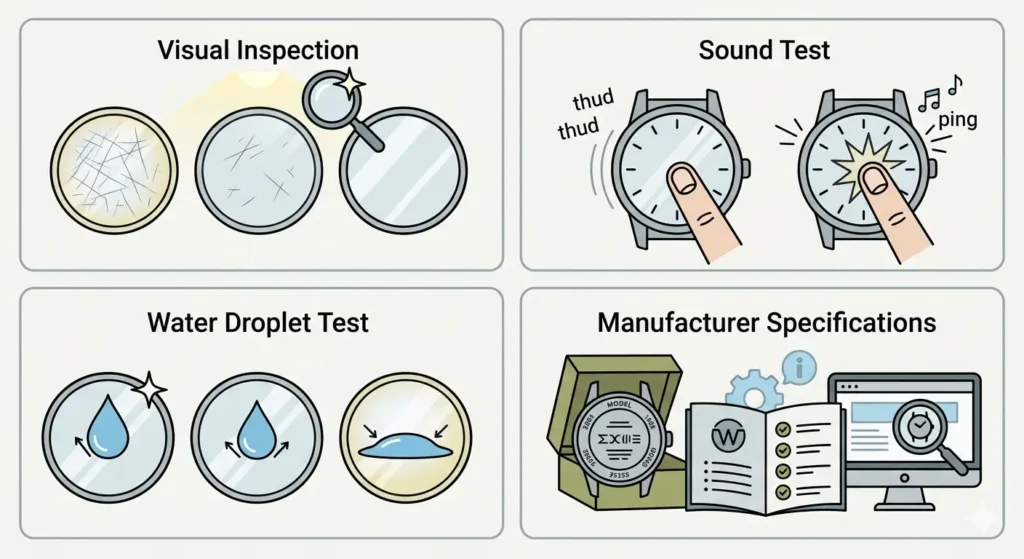
Method 1: Visual Inspection
Examine the crystal surface under good lighting. Acrylic typically shows more surface scratches and may appear slightly cloudy or yellowed on older watches. Sapphire maintains pristine clarity with minimal visible wear. Mineral glass falls between these extremes.
Method 2: Sound Test
Gently tap the crystal with a fingernail. Acrylic produces a dull, muted sound due to its plastic composition. Both mineral and sapphire create a sharper, more resonant sound, though distinguishing between these two requires experience.
Method 3: Water Droplet Test
Place a small water droplet on the crystal surface. On sapphire, especially with AR coating, the droplet tends to bead up and maintain its shape. On mineral glass and acrylic, the droplet spreads more readily. This test provides clues but isn’t definitive.
Method 4: Manufacturer Specifications
Check the watch documentation, manufacturer website, or case back engravings. Many watches specify ‘sapphire crystal’ or ‘mineral crystal’ in their specifications. When documentation isn’t available, contacting the manufacturer directly provides accurate information.
Choosing the Right Crystal for Specific Needs
For Daily Wear Watches
Sapphire crystals suit daily wear timepieces best, especially for professionals whose watches encounter desk surfaces, keyboards, and frequent contact with various objects. The investment pays off through maintained appearance over years of constant use.
For Dress Watches
Both sapphire and mineral glass work well for dress watches that see occasional wear. Sapphire ensures the watch maintains its elegant appearance for formal occasions, while mineral glass provides adequate protection at a lower price point for watches worn less frequently.
For Sports and Dive Watches
Sapphire crystals are preferred for serious dive watches and sports timepieces. The combination of scratch resistance and proper sealing capabilities ensures reliable performance in demanding environments. Most professional-grade dive watches use sapphire exclusively.
For Vintage-Style Watches
Acrylic crystals maintain authenticity in vintage or vintage-inspired timepieces. Many collectors specifically seek acrylic crystals for historical accuracy, and the warm, slightly domed appearance of acrylic complements classic watch designs.
For Budget Watches
Mineral glass offers the best balance of protection and affordability for budget-conscious buyers. The material provides adequate scratch resistance for occasional wear while keeping overall costs reasonable. Tracking time accurately matters more than premium materials for many users, and checking precise timing using tools like the world time comparison tool ensures any watch performs its primary function regardless of crystal type.
Tips for Watch Crystal Care
Cleaning Techniques
- Use microfiber cloths specifically designed for optical surfaces to avoid scratching
- Apply gentle pressure when cleaning—aggressive rubbing increases scratch risk even on sapphire
- Use mild soap and water for routine cleaning rather than harsh chemical cleaners
- Dry thoroughly after water exposure to prevent water spots and mineral deposits
- Consider anti-static cleaning solutions for acrylic to reduce dust attraction
Scratch Prevention
- Remove watches before activities involving abrasive materials or heavy impacts
- Store watches separately in soft pouches or dedicated watch boxes with individual compartments
- Avoid contact with metal surfaces, concrete, and other hard materials when possible
- Be mindful when using the online stopwatch feature on devices, as typing while wearing a watch increases desk contact
- Consider watch position on the wrist—wearing slightly higher reduces contact with surfaces
Professional Maintenance
Schedule regular service appointments for luxury watches with sapphire crystals. Professional watchmakers can inspect the crystal seal, check for micro-fractures invisible to the naked eye, and ensure water resistance remains intact.
For watches with mineral or acrylic crystals, professional assessment every few years identifies when replacement becomes necessary before damage affects the movement.
Pro Tip: Never attempt to replace watch crystals without proper tools and training. The crystal seal directly affects water resistance, and improper installation can allow moisture into the movement, causing expensive damage. Professional replacement ensures proper sealing and maintains manufacturer warranties.
Common Problems and Solutions
Fix 1: Removing Light Scratches from Acrylic
- Step 1: Clean the crystal thoroughly with mild soap and water, then dry completely
- Step 2: Apply a small amount of plastic polish or non-gel toothpaste to a soft cloth
- Step 3: Rub the scratched area using circular motions with light to moderate pressure
- Step 4: Continue buffing for 2-3 minutes, reapplying polish as needed
- Step 5: Wipe clean with a damp cloth and inspect results
- Step 6: Repeat the process if scratches remain visible
Fix 2: Dealing with Cloudy or Yellowed Acrylic
- Step 1: Clean the crystal surface with isopropyl alcohol to remove oils and residue
- Step 2: Apply UV-resistant plastic polish designed for headlight restoration
- Step 3: Buff using circular motions for several minutes
- Step 4: If yellowing persists, consider professional crystal replacement as the discoloration may have penetrated deep into the material
Fix 3: Addressing Moisture Under the Crystal
- Step 1: Stop wearing the watch immediately to prevent further moisture damage
- Step 2: Do not attempt to open the case, as this may introduce additional moisture or damage seals
- Step 3: Take the watch to a professional watchmaker within 24-48 hours
- Step 4: The watchmaker will properly dry the movement, replace seals, and test water resistance
Pro Tip: If condensation appears under the crystal after temperature changes, place the watch in a dry, warm environment for a few hours. If moisture doesn’t clear completely or returns repeatedly, the crystal seal has failed and requires professional attention to prevent movement corrosion.
Fix 4: Preventing Anti-Reflective Coating Damage
AR coatings on sapphire crystals can develop a ‘milky’ appearance or visible wear patterns. Avoid abrasive cleaners, ultrasonic cleaning unless specified by the manufacturer, and harsh chemicals. If coating damage occurs, professional reapplication or crystal replacement becomes necessary, as the coating cannot be repaired at home.
Frequently Asked Questions
Can sapphire watch crystals scratch?
While sapphire rates 9 on the Mohs hardness scale and resists most scratches, materials like diamond, silicon carbide, and certain ceramic compounds can scratch it. In daily wear, sapphire scratches are extremely rare, but contact with concrete, granite countertops, or diamond jewelry can cause damage. Normal activities rarely expose watches to harder materials, making sapphire effectively scratch-proof for typical use.
How can the difference between mineral and sapphire crystals be identified?
The most reliable method involves checking manufacturer specifications. Physical tests include the fingernail tap test (sapphire produces a sharper sound) and examining scratch patterns under magnification (sapphire shows virtually no wear while mineral displays fine scratches). Professional jewelers use thermal conductivity testers, as sapphire dissipates heat faster than mineral glass, providing definitive identification.
Is acrylic crystal replacement expensive?
Acrylic crystal replacement costs significantly less than mineral or sapphire alternatives. Generic acrylic crystals for common watch sizes range from $5-$20 for parts, with installation adding $20-$50 at watch repair shops. The total cost rarely exceeds $75, making it the most economical replacement option. Many watch enthusiasts replace acrylic crystals themselves using inexpensive tools.
Do all luxury watches use sapphire crystals?
Most modern luxury watches from established manufacturers use sapphire crystals as standard equipment. However, some vintage-inspired models and specific heritage collections intentionally use acrylic crystals to maintain historical accuracy. Brands like Omega, Rolex, and Patek Philippe use sapphire exclusively for contemporary models, while certain limited editions may specify acrylic for authenticity.
Can mineral glass be polished like acrylic?
Mineral glass cannot be effectively polished to remove scratches. The hardness that provides better scratch resistance than acrylic also prevents successful buffing with standard polishing compounds. Attempting to polish mineral glass typically yields no improvement and may create uneven surfaces. Deep scratches in mineral crystals require complete replacement rather than repair.
What causes watch crystals to crack without obvious impact?
Sudden temperature changes create thermal stress that can crack watch crystals, especially mineral glass and sapphire. Moving from extreme cold to heat, or exposing watches to hot water after cold conditions, causes rapid expansion that exceeds material tolerances. Manufacturing defects, invisible micro-fractures from previous impacts, and improper installation also contribute to spontaneous cracking without obvious recent trauma.
Are domed crystals more prone to damage?
Domed or ‘box’ crystals extend higher above the case, increasing exposure to impacts. However, the curved shape can deflect glancing blows better than flat crystals. The trade-off depends on wearing habits—domed crystals suffer more frequent minor contact but may survive certain angular impacts better. Flat crystals sit lower and encounter fewer obstacles but absorb impacts more directly when they occur.
How does anti-reflective coating affect crystal durability?
AR coating itself is relatively soft and can scratch or wear even on sapphire crystals. The coating applies in thin layers on the crystal surface and doesn’t affect the underlying crystal’s hardness. While AR coating improves readability dramatically, it requires careful maintenance. Single-sided coating (inside surface only) reduces wear concerns while maintaining most visibility benefits.
Can watch crystals be upgraded from mineral to sapphire?
Crystal upgrades are possible for many watches but require professional installation. The replacement crystal must match exact dimensions, including diameter, height, and edge profile. Generic sapphire crystals exist for common watch sizes, while custom cutting serves specific models. Costs range from $50-$200 plus installation, depending on watch size and crystal specifications. Not all watch cases accept different crystal types due to design constraints.
Why do some dive watches use mineral instead of sapphire?
Some manufacturers choose mineral glass for dive watches because it’s less brittle under extreme pressure changes and severe impacts. While sapphire offers superior scratch resistance, its brittleness can be a liability in harsh underwater environments where sudden impacts occur. Professional divers often prefer the impact resistance of mineral glass, accepting more frequent scratches as acceptable trade-offs. Modern dive watches increasingly use sapphire with reinforced case designs to address brittleness concerns.