

Understanding watch movements is essential for anyone looking to purchase a timepiece or appreciate horology. A watch movement, often called the caliber, is the mechanism that powers the watch and keeps time. The three main types – quartz, automatic, and manual – each offer distinct advantages, maintenance needs, and price points that appeal to different watch enthusiasts.
Quick Summary Table
| Movement Type | Power Source | Accuracy | Maintenance | Price Range |
|---|---|---|---|---|
| Quartz | Battery | ±15 seconds/month | Battery change every 2-3 years | $50 – $5,000+ |
| Automatic | Motion (self-winding) | -10 to +30 seconds/day | Service every 3-5 years | $200 – $50,000+ |
| Manual | Hand-winding | -10 to +30 seconds/day | Service every 3-5 years | $300 – $100,000+ |
Understanding Quartz Movements
Quartz movements revolutionized the watch industry in the 1970s by offering unparalleled accuracy at affordable prices. These movements use a battery to send electrical current through a quartz crystal, causing it to vibrate at precisely 32,768 times per second. This vibration drives the motor that moves the watch hands.
How Quartz Movements Work
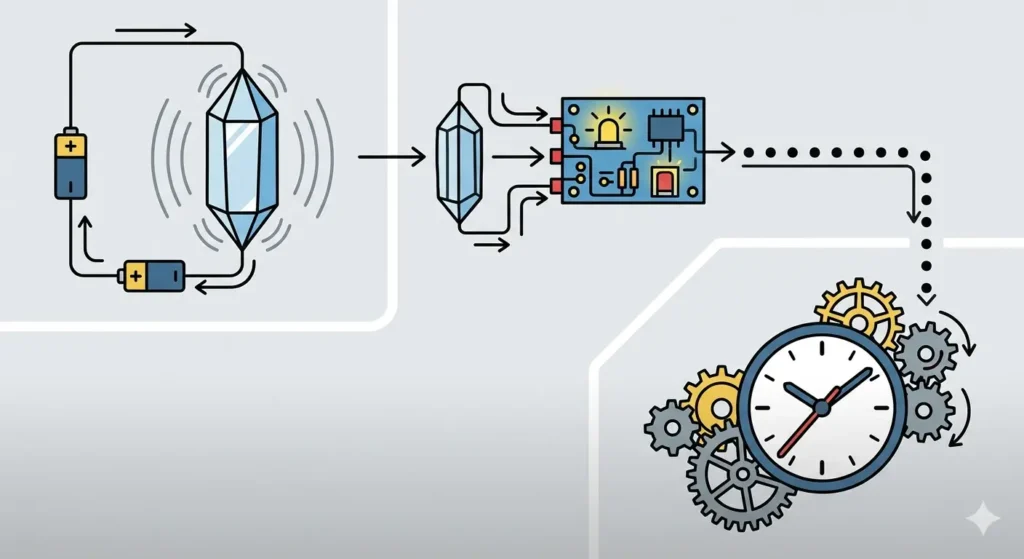
The quartz crystal acts as the timekeeper, oscillating at a consistent frequency when electricity passes through it. A circuit board counts these vibrations and converts them into regular one-second pulses, which move the watch hands forward. This electronic precision makes quartz watches the most accurate movement type available for everyday wear.
Advantages of Quartz Watches
- Exceptional accuracy with minimal drift
- Low maintenance requirements
- Affordable price points across all ranges
- Lightweight and durable construction
- No daily winding needed
- Instant start after battery replacement
Disadvantages of Quartz Watches
- Requires battery replacement every 2-3 years
- Less prestigious in luxury watch circles
- Limited collector appeal compared to mechanical movements
- No visible craftsmanship through case back
- Ticking second hand instead of smooth sweep
Pro-Tip: Higher-end quartz movements from brands like Grand Seiko or Breitling offer accuracy within ±10 seconds per year, far surpassing standard quartz movements. These premium quartz calibers combine electronic precision with refined finishing and design.
Understanding Automatic Movements
Automatic movements, also known as self-winding movements, represent the pinnacle of convenient mechanical watchmaking. These movements wind themselves using a weighted rotor that spins with the natural motion of the wearer’s wrist, eliminating the need for daily manual winding while maintaining the traditional appeal of mechanical horology.
How Automatic Movements Work
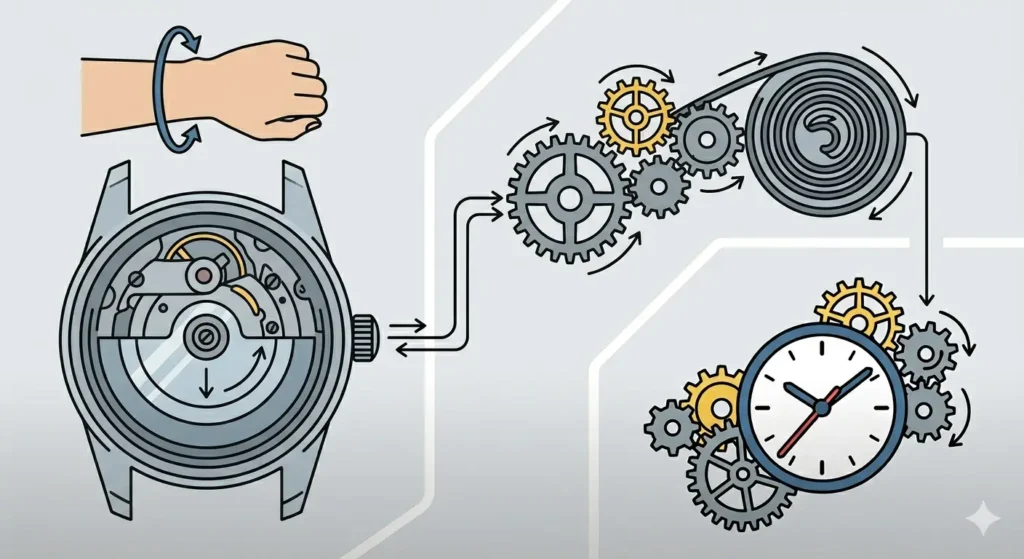
An automatic movement contains a semi-circular weighted rotor mounted on the movement’s back. As the wrist moves throughout the day, gravity pulls the rotor, causing it to spin. This rotation winds the mainspring through a series of gears, storing energy that powers the watch. Most automatic watches provide 38-72 hours of power reserve when fully wound.
Advantages of Automatic Watches
- No battery required – environmentally friendly
- Self-winding during daily wear
- Smooth sweeping second hand motion
- High collector and resale value
- Visible craftsmanship through exhibition case backs
- Traditional watchmaking heritage
- Long lifespan with proper maintenance
Disadvantages of Automatic Watches
- Less accurate than quartz movements
- Requires regular wear or watch winder
- Higher initial cost
- Periodic servicing needed every 3-5 years
- Stops running if not worn for several days
- Sensitive to magnetic fields and shocks
Understanding Manual Movements
Manual movements, also called hand-wound movements, represent the oldest form of portable timekeeping. These movements require daily winding by turning the crown, which tensions the mainspring and stores energy to power the watch. Manual movements appeal to purists who appreciate the ritualistic connection with their timepiece.
How Manual Movements Work
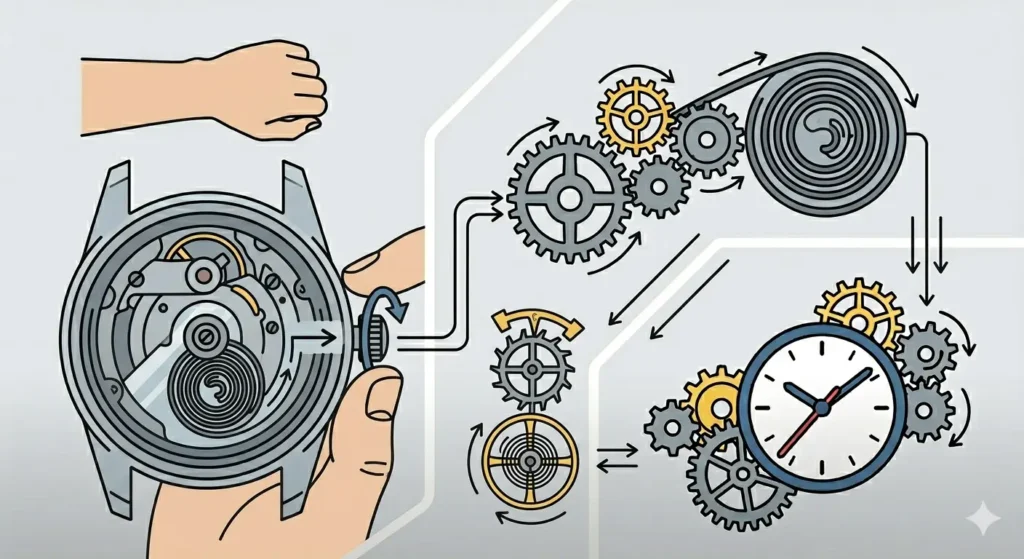
Turning the crown clockwise winds the mainspring, a tightly coiled spring that stores mechanical energy. As the mainspring slowly unwinds, it releases energy through a gear train, which is regulated by the escapement and balance wheel. This controlled release of energy moves the watch hands at precise intervals, keeping accurate time until the spring fully unwinds.
Advantages of Manual Watches
- Thinner case profile without rotor mechanism
- Direct connection through daily winding ritual
- Traditional watchmaking at its purest form
- Often more affordable than comparable automatics
- Highly valued by collectors
- Complete control over power reserve
- Simpler movement construction
Disadvantages of Manual Watches
- Requires daily winding to maintain accuracy
- Stops if winding is forgotten
- Risk of overwinding damage if excessive force applied
- Less convenient than automatic or quartz
- Similar accuracy limitations to automatic movements
- Requires regular servicing
Pro-Tip: When winding a manual watch, stop immediately when resistance is felt. Forcing the crown past this point can damage the mainspring. Most manual movements require 20-40 gentle turns daily, preferably at the same time each day for consistent performance.
Comparing Accuracy Across Movement Types
Accuracy varies significantly between movement types. Standard quartz movements deviate by approximately ±15 seconds per month, making them the most precise option for everyday timekeeping. High-accuracy quartz movements achieve ±10 seconds per year, surpassing even chronometer-certified mechanical movements.
Mechanical movements, both automatic and manual, typically run between -10 to +30 seconds per day. COSC-certified chronometers meet stricter standards of -4 to +6 seconds daily. Factors affecting mechanical accuracy include position, temperature, magnetism, and mainspring tension. Even premium mechanical watches cannot match quartz precision, though enthusiasts value their traditional craftsmanship over absolute accuracy.
Maintenance Requirements for Each Movement Type
Quartz Movement Maintenance
Quartz watches require minimal maintenance beyond battery replacement every 2-3 years. When the second hand begins jumping in 2-4 second intervals, the battery needs replacement. Complete servicing every 10 years includes cleaning, lubrication, and gasket replacement to maintain water resistance. This low-maintenance nature makes quartz ideal for daily wear watches.
Automatic Movement Maintenance
Automatic movements need professional servicing every 3-5 years to maintain optimal performance. Service includes disassembly, cleaning, lubrication, regulation, and timing adjustment. Between services, keep the watch wound through regular wear or a watch winder. Watches worn daily typically maintain sufficient power reserve, but pieces worn occasionally benefit from winders to prevent lubricant coagulation.
Manual Movement Maintenance
Manual movements follow similar servicing intervals to automatics, requiring professional attention every 3-5 years. Daily winding prevents mainspring set and keeps lubricants flowing properly. Wind the watch at the same time daily, using gentle, consistent pressure. Never force the crown past natural resistance, as this damages the mainspring and barrel.
Cost Considerations for Different Movements
Quartz movements span the widest price range, from $50 fashion watches to $5,000+ luxury pieces. The electronic components cost less to manufacture than mechanical movements, though premium quartz calibers with advanced features command higher prices. Battery replacement costs $10-30 for standard watches and $50-100 for luxury pieces requiring pressure testing.
Automatic movements start around $200 for entry-level pieces and extend beyond $50,000 for haute horlogerie complications. Manufacturing costs reflect the hand-assembly and adjustment required for mechanical movements. Service costs range from $200-500 for standard movements to $1,000+ for complicated calibers. These ongoing expenses represent significant ownership costs beyond initial purchase price.
Manual movements occupy similar price territory to automatics, ranging from $300 to over $100,000. Simple three-hand movements cost less than automatics due to fewer components, but complications like chronographs or perpetual calendars increase prices substantially. Service costs mirror automatic movements, typically $200-500 for basic calibers.
Choosing the Right Movement for Different Lifestyles
Active lifestyles benefit from quartz movements due to their durability, accuracy, and low maintenance. Sports watches, dive watches, and tool watches frequently use quartz for reliability in demanding conditions. The accuracy ensures timing functions remain precise without daily adjustment, while shock resistance handles physical activities better than delicate mechanical movements.
Office professionals and daily desk workers find automatic movements ideal, as regular wrist motion maintains winding throughout the workday. The smooth sweeping second hand and visible movement through exhibition case backs provide aesthetic appeal during meetings and presentations. Power reserves of 40-72 hours accommodate weekend storage without stopping.
Watch enthusiasts and collectors gravitate toward manual movements for the intimate connection with traditional watchmaking. The daily winding ritual creates mindful moments and appreciation for mechanical craftsmanship. Dress watches particularly suit manual movements, as the thinner profile slips comfortably under shirt cuffs. For tracking time across different zones, tools like world time comparison complement any movement type.
Movement Complications and Special Features
Complications are features beyond basic timekeeping that add functionality and value to watches. Quartz movements easily accommodate complications like chronographs, alarms, and perpetual calendars through electronic circuits. Digital displays enable features like world time, countdown timers, and multiple alarms without mechanical complexity.
Mechanical complications showcase watchmaking expertise through intricate gear work. Common complications include date displays, chronographs, moon phases, and GMT functions. Advanced complications like perpetual calendars, minute repeaters, and tourbillons represent pinnacle achievements in horology, requiring hundreds of hand-assembled components and months of adjustment.
The complexity of mechanical complications directly affects price and servicing costs. Simple date complications add minimal expense, while perpetual calendars or minute repeaters increase service costs to $2,000-5,000 or more. Quartz complications maintain affordable servicing despite added features, though premium electronic modules require specialized technicians.
Power Reserve and Usage Patterns
Quartz movements provide years of continuous operation from a single battery, offering unmatched convenience for occasional-wear watches. The battery depletes gradually regardless of usage, though display features and complications accelerate consumption. Most quartz watches run 2-3 years before requiring replacement, with some lasting 5-10 years using efficient movements and lithium batteries.
Automatic movements store 38-72 hours of power when fully wound, depending on caliber design and barrel size. Daily wear easily maintains full winding, but watches left unworn for 2-3 days stop completely. Watch winders solve this issue by rotating watches during storage, maintaining winding and eliminating the need to reset time and date after periods of rest.
Manual movements provide similar power reserves to automatics, typically 40-50 hours for standard calibers. Extended power reserves of 7-10 days exist in specialty movements but require larger barrels and thicker cases. Daily winding at consistent times maintains optimal power reserve and accuracy, as mechanical movements perform best with 50-75% mainspring tension.
Environmental Impact and Sustainability
Quartz movements require battery disposal every few years, creating electronic waste concerns. However, modern batteries contain fewer toxic materials than earlier generations, and many jewelers offer battery recycling programs. The electronic components also require mining rare earth elements, though the minimal material usage per watch reduces overall impact compared to other electronics.
Mechanical movements offer superior sustainability through decades of use without disposable components. Proper maintenance extends lifespan to generations, with many vintage mechanical watches still functioning after 50-100 years. The ability to repair and rebuild movements reduces waste, though servicing requires cleaning fluids and lubricants with environmental considerations.
The longevity of mechanical movements outweighs the battery waste from quartz in long-term sustainability. A mechanical watch serviced every 5 years for 50 years generates less waste than 25 batteries from quartz movements. However, the higher initial energy and resource costs of manufacturing mechanical movements partially offset this advantage.
Water Resistance and Movement Protection
Quartz movements handle moisture better than mechanical movements due to sealed electronic components and fewer entry points for water. Standard quartz watches achieve 50-100m water resistance easily, while dive watches reach 200-1000m ratings. The compact movement size allows thicker case construction and better gasket sealing without sacrificing wearability.
Automatic movements require careful sealing around the rotor and case back to maintain water resistance. Exhibition case backs reduce maximum water resistance ratings compared to solid backs, as crystal gaskets provide less reliable sealing than metal. Dive-rated automatic watches use solid backs and screw-down crowns to achieve 200-1000m ratings safely.
Manual movements face similar water resistance challenges to automatics, with the crown creating the primary vulnerability. Each winding operation potentially introduces moisture if the crown seal degrades. Screw-down crowns significantly improve water resistance by mechanically compressing gaskets against the case tube, making them essential for water sports and diving applications.
Common Problems and Troubleshooting
Quartz Movement Issues
When a quartz watch stops, the battery usually needs replacement. If the watch stops immediately after battery change, the circuit board may be damaged or the movement requires cleaning. Erratic timekeeping or stopped seconds hand with running hour and minute hands indicates low battery or circuit failure. Moisture inside the crystal suggests seal failure requiring immediate service to prevent movement corrosion.
Automatic Movement Issues
Automatic watches stopping overnight indicate insufficient winding from daily wear or depleted power reserve. Increase wearing time or use a watch winder to maintain winding. Watches gaining or losing significant time need regulation adjustment by a watchmaker. Unusual noises from the rotor suggest bearing wear requiring service. Watches stopping intermittently may have magnetized components, correctable through demagnetization without opening the case.
Manual Movement Issues
Difficulty winding or rough crown action indicates dirty movement internals or worn crown tube threads. Never force the crown, as this damages the winding stem or mainspring. Watches stopping before the expected power reserve depletes suggest mainspring issues or excessive friction in the gear train. Timekeeping that degrades as power reserve depletes indicates the need for regulation or mainspring replacement.
Tips for Movement Care and Longevity
- Store watches away from magnetic fields created by speakers, phones, and magnetic clasps
- Avoid extreme temperature changes that affect lubricant viscosity and metal expansion
- Remove watches before activities involving strong vibrations or impacts
- Service mechanical movements every 3-5 years regardless of apparent performance
- Replace quartz batteries promptly to prevent leakage damage
- Keep watches wound or use winders for automatic pieces in rotation
- Wind manual watches at consistent times with gentle, steady pressure
- Avoid quick-setting date functions between 9 PM and 3 AM when gears engage
- Test water resistance annually if the watch regularly contacts water
- Keep service records and boxes for warranty claims and resale value
For precise timing activities, consider using an online stopwatch to complement any watch movement type for specific measurement needs.
Movement Selection Guide
Choose Quartz If:
- Accuracy is the top priority for daily timekeeping
- Minimal maintenance appeals more than mechanical romance
- Budget constraints limit spending on watches and servicing
- The watch will see irregular or occasional wear
- Active lifestyle requires durable, shock-resistant timekeeping
- Multiple watches in rotation need reliable operation
Choose Automatic If:
- Daily wear provides sufficient movement for winding
- Appreciation exists for traditional mechanical watchmaking
- The smooth sweep second hand aesthetic appeals
- Investment in quality pieces with resale value matters
- Exhibition case backs showcase movement craftsmanship
- Environmental concerns favor non-battery watches
Choose Manual If:
- Daily winding ritual creates enjoyable mindful moments
- Thinner dress watch profile suits formal occasions
- Traditional watchmaking at its purest form appeals
- Collector value and horological heritage matter
- Direct connection with timepiece maintenance is desired
- Consistent daily routine supports regular winding
Frequently Asked Questions
How long do watch movements typically last?
Quartz movements last 20-30 years with regular battery changes, while mechanical movements (automatic and manual) can function for 50-100+ years with proper servicing every 3-5 years. Vintage mechanical watches from the early 1900s still operate reliably today, demonstrating the exceptional longevity of well-maintained movements.
Can automatic watches be manually wound?
Most automatic watches include manual winding capability through the crown, allowing quick power reserve restoration without wearing the watch. Some specialty automatics lack manual winding and rely solely on rotor motion. Check the manufacturer specifications to confirm manual winding functionality before purchase.
Why are mechanical watches less accurate than quartz?
Mechanical movements depend on physical components affected by gravity, position, temperature, and mainspring tension, causing accuracy variations of seconds per day. Quartz movements use electronic oscillation in a crystal that maintains consistent frequency regardless of position or temperature, achieving accuracy within seconds per month or year.
How often should watch movements be serviced?
Mechanical movements require professional servicing every 3-5 years to clean, lubricate, and regulate components. Quartz movements need battery replacement every 2-3 years, with full servicing every 10 years. Watches exposed to moisture, shocks, or magnetic fields may require more frequent service to maintain performance.
Do more expensive movements keep better time?
Among mechanical movements, higher prices generally correlate with better finishing, complications, and brand prestige rather than accuracy alone. Even affordable quartz movements outperform expensive mechanical pieces in pure timekeeping. Premium mechanical movements offer superior craftsmanship, heritage, and collector value beyond simple accuracy measurements.
Can magnetism damage watch movements?
Magnetic fields seriously affect mechanical movements by magnetizing the hairspring and other components, causing significant timekeeping errors of several minutes per day. Quartz movements resist magnetism better due to fewer ferrous components. Professional demagnetization corrects mechanical movement magnetization without opening the case, restoring normal accuracy immediately.
What happens if an automatic watch stops completely?
Automatic watches stop after 38-72 hours without motion, requiring manual winding or shaking to restart. After restarting, reset the time and date to current values. Prolonged storage without winding allows lubricants to settle and potentially coagulate, making periodic winding or watch winder use beneficial for long-term movement health.
Are hand-wound movements more fragile than automatic?
Manual movements contain fewer components than automatics, making them mechanically simpler but not necessarily more fragile. The absence of rotor mechanisms creates less long-term wear on bearings. However, daily winding creates repetitive stress on the winding stem and crown, which can wear faster than automatic winding mechanisms with proper maintenance.
Can quartz watches be as valuable as mechanical watches?
Certain quartz watches from prestigious brands like Grand Seiko, Breitling, or vintage Omega models hold significant collector value, though generally less than comparable mechanical pieces. Premium quartz movements with superior finishing, precious metal cases, and limited production runs appreciate in value, particularly historically significant models from the Quartz Crisis era.
How can movement type be identified without opening the case?
Observe the second hand motion – quartz movements tick once per second, while mechanical movements sweep smoothly. Check for rotor movement through exhibition case backs on automatic watches. Manual watches lack visible rotors and require daily winding. Product specifications and case back engravings also identify movement types without opening the watch.
Conclusion
Selecting between quartz, automatic, and manual movements depends on personal priorities regarding accuracy, maintenance, tradition, and lifestyle. Quartz movements deliver unmatched precision and convenience for practical daily wear. Automatic movements blend mechanical heritage with modern convenience through self-winding operation. Manual movements offer the purest connection to traditional watchmaking through daily winding rituals.
Each movement type serves specific purposes and appeals to different values. Understanding the technical differences, maintenance requirements, and lifestyle compatibility helps make informed decisions when purchasing timepieces. Whether prioritizing accuracy, craftsmanship, or convenience, the right movement enhances both the practical function and emotional connection with every watch. For keeping precise time during daily activities, complement any movement with tools like clock tab for additional timing needs.