
Reading a pulsometer scale on a watch allows anyone to measure heart rate quickly without digital devices. This traditional complication, found on chronograph watches, uses a simple calculation based on pulse beats and elapsed time. Understanding how to read a pulsometer scale provides a practical skill for fitness tracking, medical monitoring, and appreciating mechanical watch complications.
Key Takeaways
- A pulsometer scale measures heart rate by counting 30 pulse beats while timing with the chronograph
- The scale displays beats per minute (BPM) around the watch dial’s outer edge
- Most pulsometer scales are calibrated for 30 beats, though some use 15 or 20 beats
- Accurate readings require proper finger placement on the pulse point and steady counting
- The chronograph hand must point directly at the number when the final beat occurs
Understanding the Pulsometer Scale
A pulsometer scale appears as a series of numbers printed along the outer rim or chapter ring of a watch dial. These numbers typically range from 40 to 200, representing potential heart rates in beats per minute. The scale works in conjunction with the chronograph function, creating a specialized tool that doctors and athletes have used for decades.
The pulsometer differs from a standard stopwatch because it converts counted beats into a per-minute rate automatically. Instead of timing a full 60 seconds and counting all beats, the pulsometer allows measurement of just 30 beats, then displays the equivalent per-minute rate instantly.
How the Scale Calibration Works
Most pulsometer scales are calibrated for exactly 30 pulse beats. This calibration means the mathematical formula built into the scale’s design assumes 30 beats will be counted. The scale’s numbers are positioned at specific points around the dial based on this formula: 1800 divided by the number of seconds elapsed equals BPM.
Some vintage or specialized watches use different calibrations—15 beats or 20 beats—which will be marked clearly on the dial. Always check the watch face for any indication of the calibration number before taking measurements.
How to Read a Pulsometer Scale Step by Step
Taking an accurate pulse measurement requires coordination between finding the pulse, operating the chronograph, and reading the scale correctly. The process becomes natural with practice.
Locate the Pulse Point
Place two fingers (index and middle) on the radial artery at the wrist, just below the base of the thumb. Press gently until a steady pulse becomes detectable. The carotid artery on the neck also works, though wrist measurement keeps both hands free for watch operation.
Avoid using the thumb to check pulse, as it has its own pulse that can create confusion during counting.
Start the Chronograph
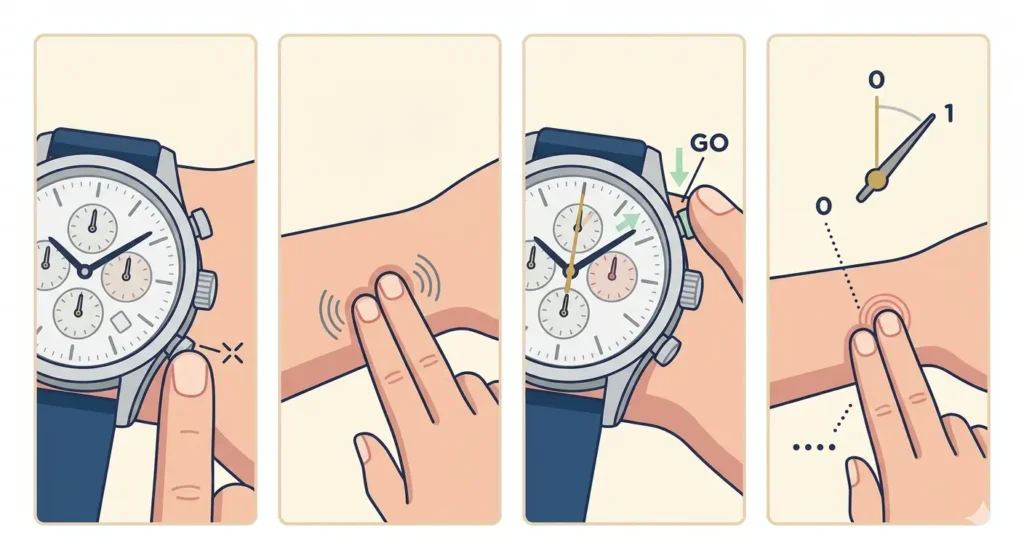
- Step 1: Reset the chronograph to zero by pressing the bottom pusher (typically at 4 o’clock position)
- Step 2: Feel for a clear, strong pulse beat
- Step 3: Press the top pusher (typically at 2 o’clock) to start the chronograph on the very next pulse beat
- Step 4: Begin counting from zero—that first beat when starting is ‘zero’
Count the Pulse Beats
Count each pulse beat out loud or mentally: zero, one, two, three, continuing up to 30 beats. Maintaining consistent counting rhythm ensures accuracy. Some people find that tapping a finger with each beat helps maintain focus during the count.
Pro-Tip: The first pulse beat when starting the chronograph counts as ‘zero,’ not ‘one.’ This common mistake throws off the entire measurement. The 30th beat is actually the 31st physical pulse felt—always start counting from zero.
Stop and Read the Scale
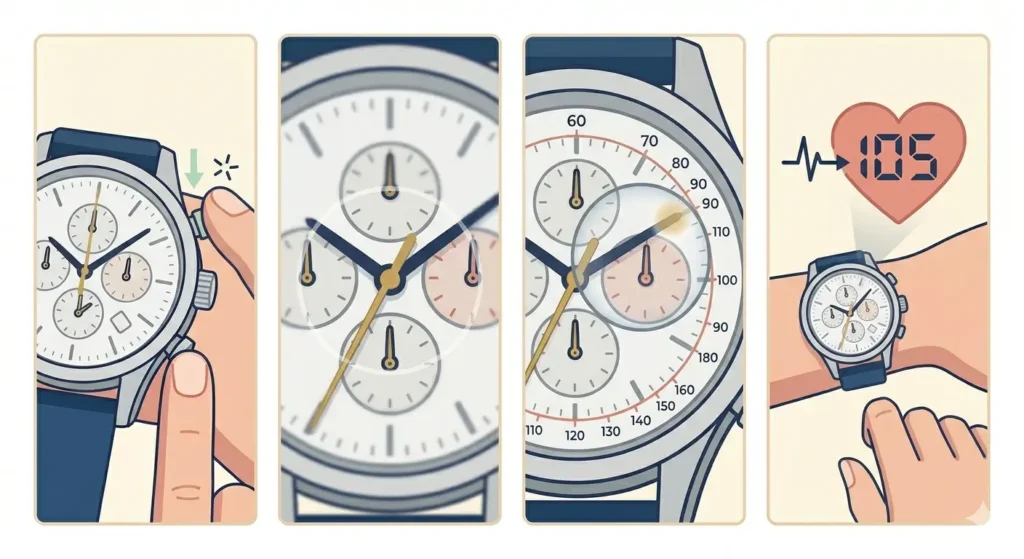
- Step 1: Press the top pusher again immediately when reaching the 30th beat
- Step 2: Look at where the chronograph seconds hand has stopped
- Step 3: Read the number on the pulsometer scale that aligns with the stopped chronograph hand
- Step 4: This number represents the current heart rate in beats per minute
The chronograph hand acts as a pointer to the pulsometer scale. If the hand stops between two numbers, estimate the BPM by judging the hand’s position—closer to 70 than 75 means approximately 72 BPM.
Reading Different Scale Configurations
Pulsometer scales appear in various designs and calibrations across different watch models. Recognizing these variations ensures accurate readings regardless of the specific watch being used.
Standard 30-Beat Scales
The most common configuration displays numbers from approximately 40 to 200 BPM. These scales assume 30 pulse beats will be counted. The numbers are typically printed in a contrasting color (often red or blue) to distinguish them from tachymeter or telemeter scales that may also be present.
Alternative Calibrations
Some watches use 15-beat or 20-beat calibrations, which allow faster measurements but may sacrifice some accuracy. These alternative scales will clearly state ’15 PULSATIONS’ or ’20 PULSATIONS’ somewhere on the dial. The counting process remains identical—simply count to the specified number instead of 30.
A 15-beat scale works well for very rapid heart rates where counting to 30 takes too long. Medical professionals sometimes prefer this configuration for emergency situations.
Tips for Accurate Pulsometer Readings
Several factors influence measurement accuracy beyond simply counting beats. Attention to these details improves reliability.
Optimal Measurement Conditions
Take readings when the person is still and relaxed. Movement, talking, or recent physical activity can make the pulse harder to detect consistently. Sitting quietly for 2-3 minutes before measurement provides the most stable baseline reading.
Ensure adequate lighting to see the chronograph hand clearly. Trying to read the scale in dim conditions often leads to misreading the final number by 5-10 BPM.
Maintaining Counting Accuracy
Focus entirely on the counting process rather than watching the chronograph hand move. Looking back and forth between the pulse point and the watch dial disrupts concentration and leads to lost count.
Speaking the numbers out loud (when appropriate) reinforces the count and reduces the chance of losing track midway through the measurement. Using a reliable time reference alongside the pulsometer can help verify accuracy when learning the technique.
Understanding Scale Resolution
Pulsometer scales have limited precision. The spacing between numbers means readings are accurate to approximately ±2-5 BPM. For medical-grade accuracy, digital devices remain superior, but pulsometers provide adequate precision for general fitness monitoring and historical interest.
Pro-Tip: Practice measuring your resting heart rate multiple times throughout the day to develop consistency. Most adults have resting rates between 60-100 BPM, with athletic individuals often falling between 40-60 BPM. Knowing your normal range helps identify when a reading seems incorrect.
Common Problems and Solutions
Even experienced users occasionally encounter difficulties when using a pulsometer scale. Most issues have straightforward solutions.
Losing Count During Measurement
Losing track of the count is the most frequent problem. If this happens, stop the chronograph immediately, reset it, and start over. Trying to estimate where the count was leads to inaccurate results.
Using a specific counting rhythm helps prevent this issue. Some people count in groups of five (0-5, 6-10, 11-15, etc.) which makes it easier to remember the current position.
Difficulty Finding Pulse
If the pulse feels weak or inconsistent, try a different finger position or switch to the carotid artery on the neck. Dehydration, cold temperatures, or low blood pressure can make wrist pulses harder to detect.
Pressing too hard on the artery can actually occlude it, making the pulse disappear. Use only gentle pressure—just enough to feel the pulsation clearly.
Chronograph Hand Between Numbers
When the hand stops between scale markings, estimate the BPM based on proportional distance. If the hand is roughly halfway between 70 and 75, the heart rate is approximately 72-73 BPM. This estimation is acceptable given the scale’s inherent precision limitations.
Inconsistent Readings
Taking multiple readings that vary by more than 10 BPM suggests technique issues. Common causes include starting the chronograph at the wrong moment, counting inconsistently, or the subject moving during measurement.
Take three consecutive measurements and average them for the most reliable result. Discard any reading that seems dramatically different from the others.
Practical Applications
Understanding when and why to use a pulsometer scale adds context to this traditional complication.
Fitness and Exercise Monitoring
Athletes use pulsometer scales to check heart rate during training without relying on electronic devices. Taking a pulse immediately after exercise provides insight into cardiovascular response and recovery patterns.
Comparing resting heart rate to post-exercise rate helps gauge workout intensity. The ability to take measurements anywhere makes pulsometer watches valuable for outdoor activities where electronic devices might fail or be impractical.
Medical and Historical Interest
Doctors historically used pulsometer watches for patient assessments before electronic monitors became standard. While modern medicine relies on digital equipment, understanding the pulsometer demonstrates the ingenuity of mechanical solutions to medical challenges.
Collectors and enthusiasts appreciate pulsometer scales as functional complications that connect modern horology to its practical roots in professional tool watches.
Frequently Asked Questions
What is the difference between a pulsometer and a tachymeter?
A pulsometer measures heart rate in beats per minute by counting pulse beats, while a tachymeter measures speed by timing distance traveled. Pulsometers are calibrated for counting body pulses (usually 30 beats), whereas tachymeters measure units per hour over a fixed distance (typically 1 kilometer or 1 mile). The two scales often appear together on chronograph watches but serve completely different purposes.
Can pulsometer watches measure irregular heartbeats?
Pulsometer scales work best with regular, consistent heartbeats. Irregular rhythms (arrhythmias) make accurate counting difficult and may produce unreliable BPM readings. For medical conditions involving irregular heartbeats, electronic monitors with ECG capabilities provide more appropriate monitoring. The pulsometer assumes evenly spaced beats throughout the measurement period.
Why do most pulsometers use 30 beats instead of 60?
Counting 30 beats balances accuracy with measurement speed. Counting to 60 takes too long (typically 45-60 seconds for normal heart rates), while counting fewer beats (like 15) reduces precision. The 30-beat standard provides results in 20-30 seconds while maintaining reasonable accuracy for most applications. This duration is long enough to average out minor beat-to-beat variations.
How accurate are pulsometer scales compared to digital heart rate monitors?
Pulsometer scales typically achieve accuracy within ±5 BPM when used correctly, while quality digital monitors can be accurate to ±1-2 BPM. The pulsometer’s accuracy depends heavily on user technique—counting errors, reaction time when stopping the chronograph, and reading the scale all introduce variables. For casual monitoring, pulsometer accuracy is sufficient, but medical decisions should rely on more precise digital equipment.
What heart rate range can a typical pulsometer measure?
Most pulsometer scales display ranges from approximately 40 BPM to 200 BPM. This range covers everything from well-trained athletes at rest (40-50 BPM) to maximum exercise heart rates for most age groups (180-200 BPM). Some specialized medical pulsometers extend the range higher for pediatric use, as children naturally have faster heart rates than adults.
Do automatic or quartz chronographs work with pulsometer scales?
Yes, any chronograph function works with a pulsometer scale regardless of the movement type. Mechanical manual-wind, automatic, and quartz chronographs all operate the same way for pulsometer purposes. The scale reading depends only on accurate chronograph timekeeping and proper counting technique, not the specific mechanism driving the watch. Quartz chronographs may offer slightly better timekeeping precision, but the difference is negligible for pulsometer use.
Can a pulsometer scale be used to measure animal heart rates?
Pulsometer scales can measure animal pulses, but the calibration may not be ideal since many animals have heart rates well above 200 BPM. Small dogs, cats, and birds often exceed the typical pulsometer range. Larger animals like horses (28-40 BPM at rest) fall within measurable range. The same counting technique applies, though finding the pulse point may require knowledge of animal anatomy.
What should someone do if the pulsometer reading seems unusually high or low?
First, retake the measurement to rule out counting errors. If repeated readings consistently show unusual values, consider factors like recent caffeine intake, stress, medications, or illness that affect heart rate. Resting rates below 40 BPM or above 100 BPM (for non-athletes) warrant medical consultation. Using a time comparison tool to track when unusual readings occur can help identify patterns worth discussing with healthcare providers.
Is it possible to use a pulsometer scale without the chronograph function?
No, the chronograph function is essential for pulsometer use. The scale only provides meaningful readings when the chronograph hand points to the appropriate position after timing 30 pulse beats. Without the chronograph, there is no way to correlate elapsed time with the scale numbers. Some people attempt to use the running seconds hand, but this method is impractical since it requires starting measurement at exact second markers and produces less accurate results.
How do pulsometer scales on vintage watches differ from modern ones?
Vintage pulsometer scales often used different calibrations (15 or 20 beats) and featured more elaborate printing styles with decorative fonts. Some vintage medical watches included multiple scales (pulsometer, respiratory rate, blood pressure reference) on the same dial. Modern pulsometers typically standardize on 30-beat scales with clearer, more legible printing. The fundamental function remains identical, though vintage scales may show wear that affects readability.