
Jump-starting a solar watch requires exposing it to bright light for extended periods to recharge the depleted battery. Solar watches like Citizen Eco-Drive and Casio Tough Solar models use photovoltaic cells to convert light into electrical energy, and when the power reserve runs too low, the watch stops functioning. This step-by-step guide shows exactly how to revive a dead solar watch and get it running again.
Quick Summary Table
| Step | Action | Duration |
|---|---|---|
| 1 | Place watch under bright light (sunlight or LED lamp) | 6-8 hours for initial charge |
| 2 | Check if watch starts moving | After initial charge |
| 3 | Continue charging for full power reserve | 24-48 hours total |
| 4 | Set time and date correctly | 5-10 minutes |
How to Jump-Start an Eco-Drive Watch
Citizen Eco-Drive watches feature a rechargeable battery that powers the movement. When completely drained, these watches enter a power-saving mode or stop entirely. The charging process differs slightly from Tough Solar models.
Method 1: Direct Sunlight Charging
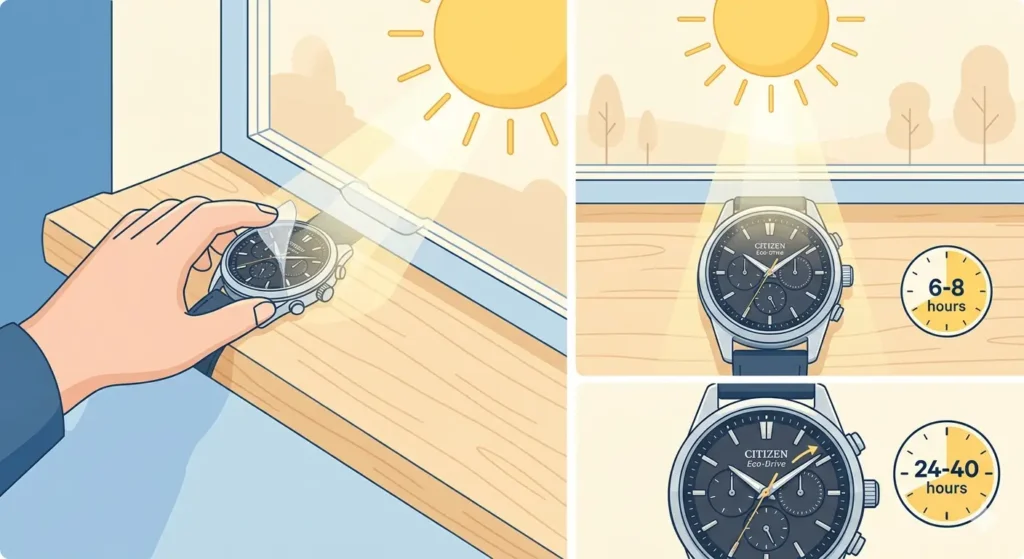
- Step 1: Remove the watch from the wrist and place it face-up on a windowsill or outdoor surface where direct sunlight hits the dial
- Step 2: Ensure nothing blocks the solar panel (the watch face) – remove any protective stickers or coverings if present
- Step 3: Leave the watch in direct sunlight for 6-8 hours continuously without interruption
- Step 4: Check if the second hand starts moving – most Eco-Drive watches will begin operating once sufficient charge accumulates
- Step 5: Continue charging for an additional 24-40 hours to reach full power reserve capacity
Pro-Tip: Avoid charging solar watches behind glass windows during peak summer heat. Excessive temperatures above 60°C (140°F) can damage the internal rechargeable cell. Morning or late afternoon sunlight works best, providing strong light without extreme heat buildup.
Method 2: Artificial Light Charging
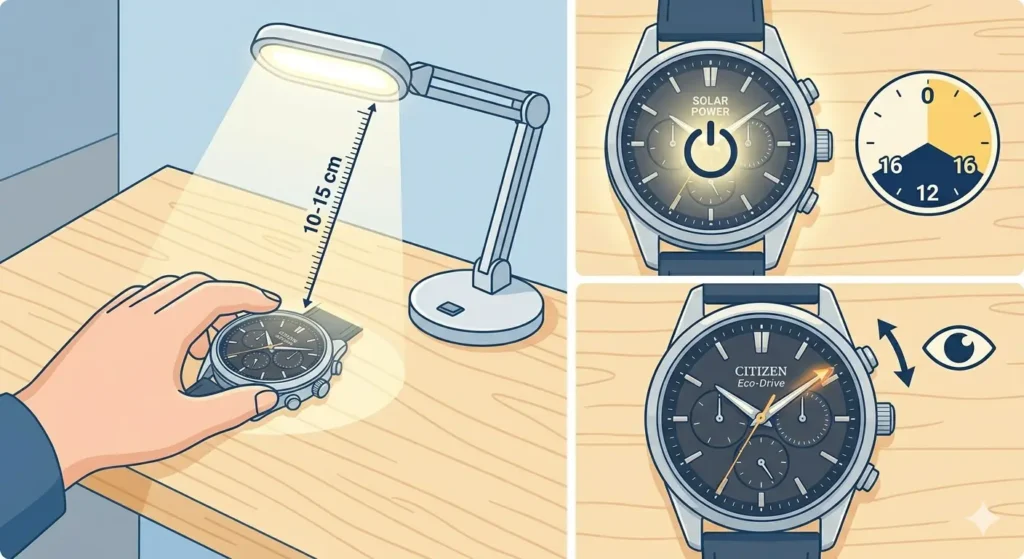
- Step 1: Position the watch directly under a bright LED desk lamp or fluorescent light (minimum 3,000 lux brightness)
- Step 2: Place the watch 10-15 cm (4-6 inches) away from the light source to maximize light absorption
- Step 3: Keep the light on continuously for 12-16 hours for initial charge activation
- Step 4: Monitor the watch every few hours – the second hand should eventually begin moving
- Step 5: Continue charging under artificial light for 48-72 hours total to fully replenish the power reserve
How to Jump-Start a Tough Solar Watch
Casio Tough Solar watches use similar technology but often include a battery level indicator and different charging requirements. These watches typically recover faster than Eco-Drive models when properly charged.
Method 1: Outdoor Sunlight Method
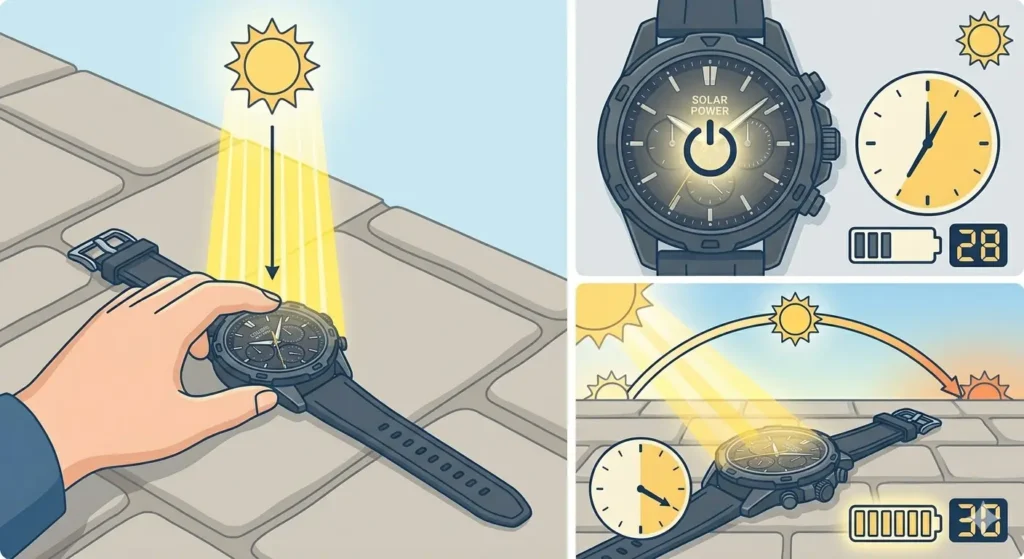
- Step 1: Place the Tough Solar watch face-up in direct outdoor sunlight (not through a window)
- Step 2: Position the watch at an angle where sunlight hits the solar panel perpendicularly for maximum efficiency
- Step 3: Charge for 5-7 hours in bright sunlight – cloudless days provide the fastest charging
- Step 4: Observe the battery indicator (if available) or check if the digital display activates
- Step 5: Extend charging to 20-30 hours total to achieve full battery capacity
Method 2: High-Intensity Lamp Charging
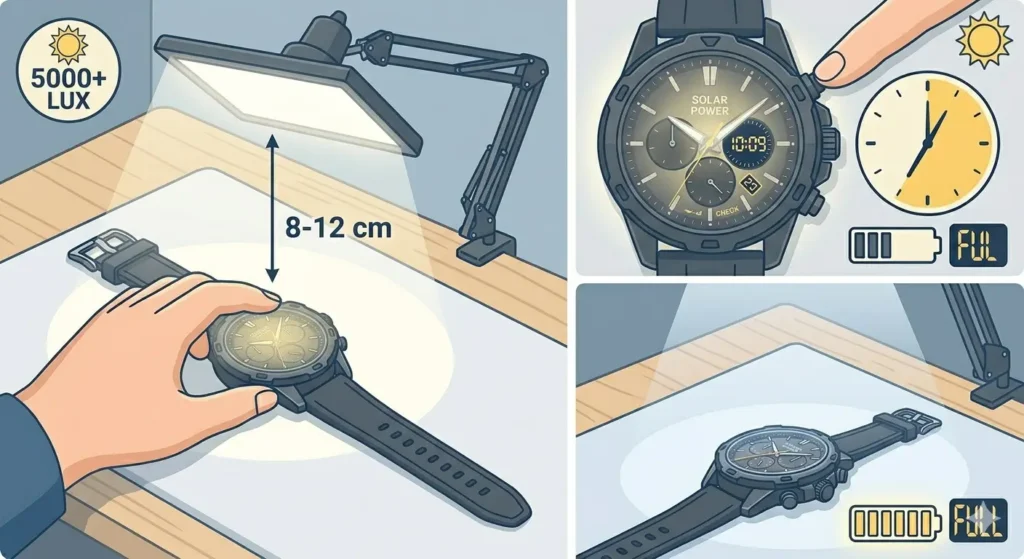
- Step 1: Use a high-output LED lamp (5,000+ lux) or a photography light for faster indoor charging
- Step 2: Position the watch 8-12 cm from the light source, ensuring the entire dial receives even illumination
- Step 3: Charge continuously for 10-14 hours as the initial charging period
- Step 4: Check if the watch functions return – digital displays should light up when buttons are pressed
- Step 5: Complete the full charge cycle by keeping the watch under light for 40-50 hours total
Pro-Tip: When using a stopwatch to track charging time, note that Tough Solar watches charge approximately 2-3 times faster in direct sunlight compared to indoor lighting. This timing difference helps plan the most efficient charging strategy.
Setting Time After Jump-Starting
Once the solar watch regains power, accurate time setting ensures reliable daily use. Both Eco-Drive and Tough Solar watches require manual adjustment after complete power depletion.
- Step 1: Pull the crown out to the time-setting position (usually the second click)
- Step 2: Use a reliable time source like online clock to reference the exact current time
- Step 3: Rotate the crown to move the hands to the correct time
- Step 4: If the watch has a date function, adjust the date by pulling the crown to the first position and rotating
- Step 5: Push the crown back to the normal position and ensure the second hand moves smoothly
Tips for Maintaining Solar Watch Charge
Regular exposure to light prevents future power depletion and extends the rechargeable battery lifespan. Simple habits keep solar watches running continuously without requiring jump-starts.
- Wear the watch regularly on the wrist where it receives ambient light throughout the day
- Store the watch face-up near a window or under room lighting when not wearing it
- Avoid keeping solar watches in dark drawers, boxes, or safes for extended periods
- Expose the watch to bright light for 2-3 hours monthly as preventive charging
- Check the power reserve indicator (if available) and charge before it reaches critical levels
- Clean the solar panel surface regularly with a soft cloth to remove dirt that blocks light absorption
- Replace the rechargeable cell every 10-20 years as manufacturer-recommended maintenance
Common Problems and Solutions
Fix 1: Watch Still Not Working After 48 Hours of Charging
When extended charging produces no results, the rechargeable battery may have reached end-of-life. Most solar watch batteries last 10-20 years before replacement becomes necessary. Contact an authorized service center for battery replacement – attempting DIY battery changes often damages water resistance seals and voids warranties.
Fix 2: Second Hand Moves in 2-Second Intervals
This behavior indicates insufficient charge in Eco-Drive watches. The 2-second interval jump serves as a low battery warning. Continue charging the watch for another 12-24 hours until the second hand returns to normal 1-second movements. This warning feature prevents complete power depletion when addressed promptly.
Fix 3: Watch Gains or Loses Time After Jump-Start
Extreme power depletion sometimes affects timekeeping accuracy temporarily. After jump-starting, monitor the watch for 3-5 days while keeping it well-charged. If accuracy problems persist beyond this period, the watch may require professional servicing to recalibrate the movement or check for mechanical issues.
Fix 4: Digital Display Remains Blank on Tough Solar Watch
Tough Solar models with digital displays need more initial charge than analog-only watches. Place the watch in direct sunlight for a full day (8-10 hours) before expecting the display to activate. Press any button after this charging period – the display should illuminate if sufficient power exists.
Frequently Asked Questions
How long does it take to fully charge a dead solar watch?
A completely dead solar watch typically requires 24-48 hours of continuous bright light exposure to reach full charge. Direct sunlight charges faster (20-30 hours) than indoor artificial light (40-72 hours). Initial functionality may return after 6-8 hours, but full power reserve capacity needs the extended charging period.
Can solar watches charge through window glass?
Solar watches do charge through window glass, but efficiency drops by 30-50% compared to direct outdoor sunlight. UV-blocking windows reduce charging effectiveness even further. For jump-starting a completely dead watch, outdoor placement without glass barriers produces the fastest results.
What is the best light source for charging solar watches indoors?
High-output LED lamps and fluorescent lights work best for indoor solar watch charging. Standard incandescent bulbs produce insufficient light intensity for efficient charging. Photography lights, bright desk lamps (3,000+ lux), and plant grow lights provide adequate brightness when placed 10-15 cm from the watch face.
How often should solar watches be charged?
Solar watches worn regularly during daytime hours receive sufficient ambient light and rarely need deliberate charging. Watches stored in darkness should receive 2-3 hours of bright light exposure monthly to maintain power reserves. Most solar watches hold a charge for 6-12 months when fully charged, even in complete darkness.
Will leaving a solar watch in sunlight damage it?
Moderate sunlight exposure does not damage solar watches under normal conditions. However, prolonged exposure to extreme heat (above 60°C/140°F) can degrade the rechargeable battery and damage seals. Avoid leaving watches on car dashboards or in direct summer sunlight for multiple consecutive days. Morning or evening sunlight provides safer charging conditions.
Can overcharging harm a solar watch battery?
Solar watches include built-in overcharge protection that prevents battery damage from excessive light exposure. Once fully charged, the watch automatically stops absorbing additional power. Leaving a solar watch in continuous bright light causes no harm – the protection circuitry handles excess energy safely.
Why does the second hand stop at 12 o’clock after charging?
When an Eco-Drive watch second hand stops at the 12 o’clock position despite charging, the watch has entered ‘insufficient charge’ mode. This indicates the power level remains too low for normal operation. Continue charging for another 8-12 hours until the second hand begins moving continuously.
How do different watch face colors affect charging speed?
Dark-colored watch faces (black, dark blue, dark gray) charge slightly slower than lighter-colored faces because they absorb more light as heat rather than converting it to electrical energy. The difference ranges from 10-15% in charging efficiency. White and silver dials charge fastest, but all colors eventually reach full capacity with adequate light exposure.
Can rechargeable batteries in solar watches be replaced?
Rechargeable batteries in solar watches can and should be replaced every 10-20 years as part of regular maintenance. Authorized service centers perform this replacement while maintaining water resistance and warranty coverage. Using non-genuine batteries or unauthorized service providers may compromise watch performance and durability.
What happens if a solar watch stays in darkness for years?
Solar watches stored in complete darkness for multiple years experience deep battery discharge that may prevent normal recharging. In some cases, the rechargeable cell enters a state where jump-starting through light exposure alone becomes impossible. Professional servicing or battery replacement becomes necessary to restore functionality after extreme long-term storage without light.