

A watch that stopped running can often be fixed at home without professional help. Whether dealing with a quartz watch that needs a battery replacement or a mechanical timepiece requiring winding, most stopped watches can be restored to working order through simple troubleshooting steps. This guide provides proven solutions to get any watch ticking again.
Key Takeaways
- Battery replacement fixes 80% of quartz watch issues – typically needed every 2-3 years
- Mechanical watches need daily winding or regular wear to maintain power
- Water damage and magnetization are fixable but may require professional tools
- Cleaning the movement can restore function to watches stopped by dirt or oil buildup
- Digital watches often just need a reset or new battery to resume operation
Replace the Battery in a Quartz Watch
Dead batteries cause most quartz watch failures. The average watch battery lasts 2-3 years before needing replacement. This fix works for 80% of stopped quartz watches and takes about 10 minutes.
Method 1: Basic Battery Replacement
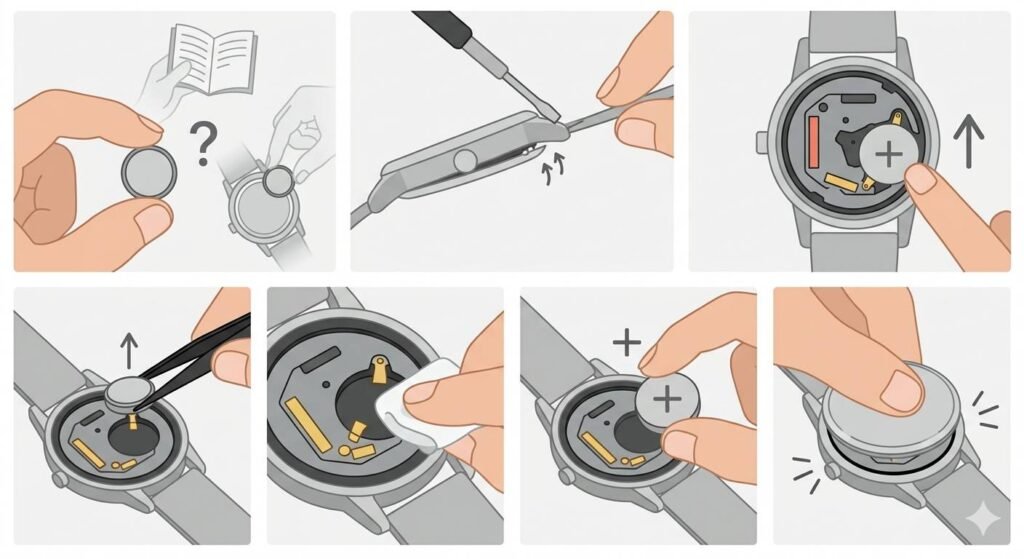
- Step 1: Purchase the correct battery type – check the watch manual or remove the old battery first to identify the model number (common types include SR626SW, CR2032, or SR920SW)
- Step 2: Use a case knife or small flathead screwdriver to carefully pry open the case back – apply gentle pressure at the notch or groove
- Step 3: Note the battery orientation before removal – the positive side usually faces up
- Step 4: Remove the old battery using plastic tweezers or a non-metal tool to avoid short circuits
- Step 5: Clean the battery contacts with a dry cloth to remove any corrosion or debris
- Step 6: Insert the new battery matching the exact orientation of the old one
- Step 7: Press the case back firmly until it clicks into place – ensure the gasket sits properly for water resistance
Pro-Tip: Always use plastic tweezers when handling watch batteries. Metal tools can discharge the battery instantly or damage delicate components. Keep a set of plastic watchmaker tweezers in any watch repair kit.
Wind and Set a Mechanical Watch
Mechanical watches stop when the mainspring loses tension. These timepieces need regular winding to maintain power – automatic watches wind through wrist movement while manual watches require hand winding every 24-48 hours.
Method 2: Manual Winding
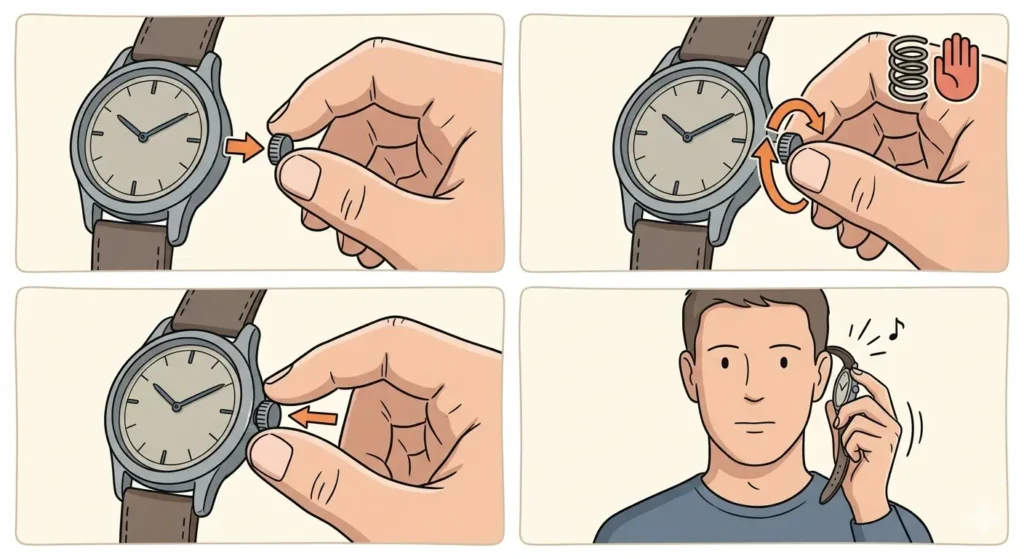
- Step 1: Pull the crown out to the first position (usually one click away from the case)
- Step 2: Turn the crown clockwise 30-40 times – stop when resistance increases significantly
- Step 3: Push the crown back to its original position against the case
- Step 4: Shake the watch gently near the ear to confirm the movement is running
Method 3: Automatic Watch Activation
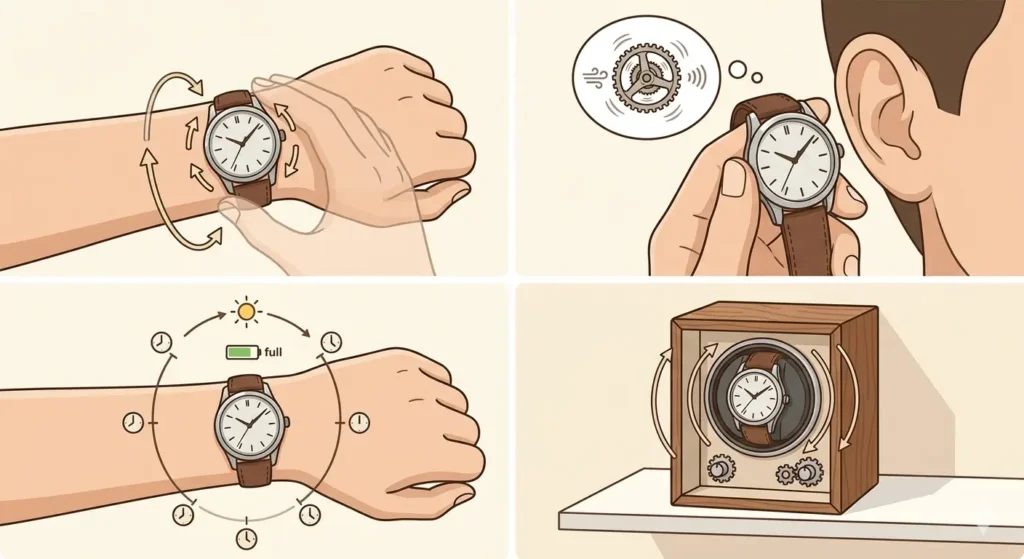
- Step 1: Hold the watch face-up and rotate the wrist in circular motions for 30-60 seconds
- Step 2: Listen for the rotor spinning inside – this indicates the winding mechanism is engaging
- Step 3: Wear the watch continuously for 8-10 hours to fully charge the mainspring
- Step 4: Consider using a watch winder if the watch sits unused for extended periods
Remove Magnetization from the Movement
Magnetic fields from phones, speakers, or magnetic clasps can disrupt watch movements. Magnetized watches run fast, slow, or stop completely. This issue affects both quartz and mechanical watches but remains completely reversible.
- Step 1: Download a compass app or use a physical compass to test for magnetization
- Step 2: Place the watch near the compass – if the needle deflects or spins, the watch is magnetized
- Step 3: Purchase a watch demagnetizer (available for $15-30 online)
- Step 4: Turn on the demagnetizer and slowly pass the watch over it in a circular motion
- Step 5: Move the watch away gradually while the demagnetizer is still running
- Step 6: Test again with the compass to confirm demagnetization
Clean and Service the Movement
Dirt, dust, and dried lubricant stop watch movements over time. Watches worn daily collect debris that eventually jams the gears. A thorough cleaning restores function to watches stopped by contamination.
- Step 1: Open the case back using the appropriate tool for the case type
- Step 2: Use compressed air to blow away loose dust and particles from the movement
- Step 3: Apply one small drop of watch oil to the barrel arbor and escapement pivot points
- Step 4: Avoid touching the balance wheel or hairspring – these components are extremely delicate
- Step 5: Reassemble the watch and test for 24 hours to ensure consistent operation
Pro-Tip: Never use household oils or WD-40 on watch movements. These products contain solvents that destroy delicate components. Only use specialized watch oils like Moebius 9010 or similar horological lubricants designed for timepiece movements.
Fix Digital Watch Issues
Digital watches stop due to battery failure, circuit board issues, or software glitches. Most digital watch problems resolve with a reset or battery replacement.
- Step 1: Remove the battery and wait 60 seconds to reset the internal circuits
- Step 2: Clean the battery contacts with isopropyl alcohol and a cotton swab
- Step 3: Install a fresh battery – digital watches typically use CR2016 or CR2025 batteries
- Step 4: Press the AC (all clear) button if available to reset the watch
- Step 5: Consult the manual for the specific reset sequence – usually involves holding multiple buttons simultaneously
Address Water Damage
Water inside a watch corrodes components and stops the movement. Quick action prevents permanent damage. Even water-resistant watches can leak if gaskets age or the crown stays open.
- Step 1: Open the case back and crown immediately to allow air circulation
- Step 2: Remove the battery if dealing with a quartz watch
- Step 3: Place the watch in a container of uncooked rice or silica gel packets for 48-72 hours
- Step 4: Examine the movement for rust or corrosion after drying
- Step 5: Replace corroded parts or seek professional service if damage is extensive
- Step 6: Replace all gaskets and test water resistance before normal use
Tips for Keeping Watches Running
- Store watches away from magnetic devices like phones, speakers, and laptop chargers to prevent magnetization
- Wind mechanical watches at the same time daily to maintain consistent power and accuracy
- Service mechanical watches every 3-5 years to replace dried lubricants and prevent wear
- Replace quartz watch batteries promptly when the second hand starts jumping in 2-second intervals
- Avoid exposing watches to extreme temperatures – heat expands components while cold thickens lubricants
- Keep watches dry and remove them before swimming unless rated for water resistance
- Use a timing tool to monitor accuracy and detect problems early
- Rotate automatic watches regularly or use a winder to prevent lubricant settling
Common Problems and Solutions
Understanding typical watch failures helps identify the right fix faster. Most stopped watches fall into recognizable patterns with straightforward solutions.
Watch Runs Then Stops Intermittently
This pattern indicates a weak battery in quartz watches or insufficient winding in mechanical watches. Replace the battery or establish a consistent winding routine. Intermittent stopping can also signal magnetization – test with a compass and demagnetize if needed.
Watch Stopped After Being Dropped
Impact damage often breaks the balance staff or dislodges the hairspring. Open the case and inspect the balance wheel – it should swing freely without wobbling. Professional repair is typically required for impact damage as replacement parts need precise fitting.
Watch Stopped After Crown Adjustment
The stem may have disconnected from the movement during crown pulling. Remove the case back and check if the stem detached. Reattach the stem by aligning it with the keyless works and pushing it back into position until it clicks.
Watch Stopped After Years of Storage
Lubricants dry and congeal during long storage periods. The movement needs cleaning and fresh lubrication. Soak the movement in watch cleaning solution for 15 minutes, rinse with isopropyl alcohol, dry completely, then apply fresh oil to pivot points.
Watch Second Hand Moves But Time Does Not Keep
The cannon pinion has loosened on the center wheel. This mechanical failure requires professional tightening of the pinion or replacement of the center wheel assembly. Attempting home repair often causes additional damage to the wheel train.
Frequently Asked Questions
How long does a watch battery typically last before the watch stops running?
Most watch batteries last 2-3 years under normal use. High-quality batteries can last up to 5 years while cheap batteries may fail within 12 months. Chronograph functions and backlights drain batteries faster. When the second hand starts jumping in 2-second intervals, the battery has approximately 2 weeks of life remaining.
Can a completely stopped mechanical watch be damaged by winding it?
No, winding a stopped mechanical watch does not cause damage when done correctly. Turn the crown gently and stop when resistance increases. Never force the crown past the point of resistance as this can break the mainspring. Most manual watches need 30-40 turns to reach full wind from a stopped state.
Why does a watch stop running at night but work during the day?
This pattern indicates an automatic watch with insufficient power reserve. The watch winds through wrist movement during the day but stops overnight when stationary. Wind the watch manually before bed or wear it more actively during the day to build adequate reserve. Consider using a watch winder for overnight storage.
How can someone tell if a stopped watch is magnetized?
Place a compass next to the watch. If the compass needle deflects or spins erratically, the watch is magnetized. Digital compass apps on smartphones work equally well. Magnetized watches often run fast (gaining several minutes per day) before stopping completely. Demagnetization takes less than 30 seconds with the proper tool.
What causes a watch to stop working immediately after battery replacement?
Common causes include reversed battery polarity, a short circuit from metal tools, or a depleted replacement battery. Remove the battery and check orientation – the positive side usually faces up. Clean the contacts with isopropyl alcohol and try a different new battery. If the watch still does not run, the circuit board may be damaged.
Is it safe to open a watch case back to fix a stopped watch at home?
Yes, opening snap-back and screw-back cases is safe with proper tools. Use a case knife for snap-backs and a case wrench for screw-backs. Avoid using sharp objects that can slip and scratch the case. Work over a soft cloth to catch small parts. However, avoid opening cases on expensive watches or those with complex complications – professional service is safer for valuable timepieces.
How long should someone wait before concluding a watch repair did not work?
Test a watch for at least 24 hours after any repair. Mechanical watches may need several hours to stabilize after servicing. Check accuracy against a reliable time source after the test period. If the watch gains or loses more than 30 seconds per day, additional adjustment is needed.
Can water damage be reversed if a watch stopped running after exposure?
Yes, if addressed within 24-48 hours. Open the case immediately and dry all components thoroughly. Replace corroded parts and clean rust with specialized solutions. Watches submerged in saltwater require professional cleaning as salt corrosion spreads rapidly. Fresh water damage is often reversible with prompt action and proper drying techniques.
Why would a watch stop running even with a new battery installed?
Circuit board failure, corroded contacts, or a damaged coil prevents the watch from running despite a good battery. Check battery contacts for green corrosion and clean with vinegar or contact cleaner. If contacts are clean and the battery tests good, the circuit board likely needs replacement – a repair best handled by professionals.
What is the most common reason automatic watches stop running overnight?
Insufficient power reserve causes most overnight stops. Automatic watches need 8-10 hours of active wear to build full reserve. Desk workers and people with sedentary lifestyles often do not generate enough movement. Manually wind the watch 15-20 turns each morning to supplement automatic winding and prevent overnight stops.