
How long is a decade? This fundamental question about time measurement has a straightforward answer: a decade is exactly 10 years. However, understanding decades goes beyond this simple definition, involving calendar systems, historical contexts, and cultural applications that make time tracking both practical and meaningful.
The Basic Definition of a Decade
A decade represents a period of ten consecutive years. The term originates from the Ancient Greek word “dekas,” meaning “a group of ten,” and can also be called a decennium from the Latin “decennium,” literally translating to “ten-year period.” Whether you’re referencing personal milestones, historical events, or planning future goals, decades provide a convenient way to organize time into manageable segments.
In practical terms, any continuous ten-year period qualifies as a decade. This could mean the ten years of someone’s twenties (age 20-29), a company’s first decade of operation, or the period from 2020 to 2029. The flexibility of this definition makes decades useful for various applications, from demographic studies to financial planning.
Two Methods of Counting Decades
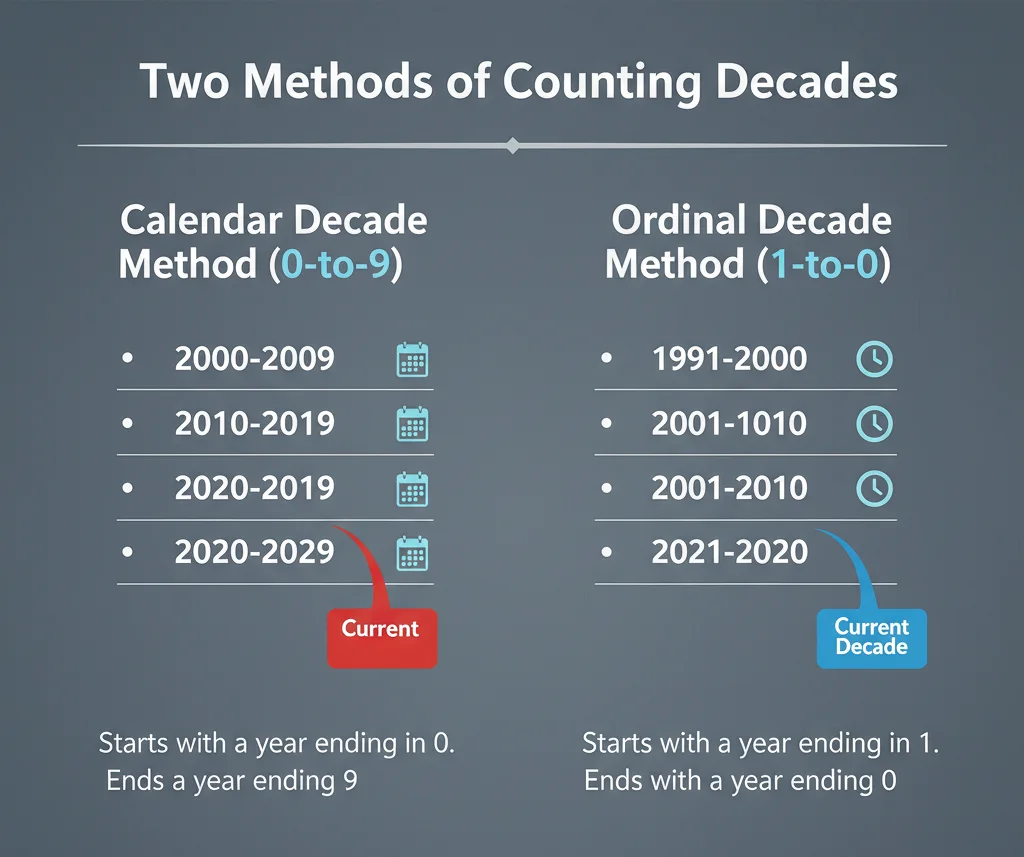
Understanding how decades work requires recognizing two distinct counting methods that create different starting and ending points for decade periods.
Calendar Decade Method (0-to-9)
The most commonly used approach groups years from those ending in 0 to those ending in 9. Using this method, the 2020s decade includes all years from 2020 through 2029. This system aligns with how we naturally think about decades in popular culture, such as “the Roaring Twenties” (1920-1929) or “the Swinging Sixties” (1960-1969).
A 2019 YouGov poll found that 64% of American adults believe decades begin with years ending in 0, making this the most widely accepted definition among the general public.
Ordinal Decade Method (1-to-0)
The alternative approach follows the same logic used for centuries and millennia, beginning with years ending in 1 and concluding with years ending in 0. Under this system, the first decade of the 2000s runs from 2001 to 2010, the second from 2011 to 2020, and so forth.
This method maintains consistency with how we officially count longer time periods. Just as the 21st century began in 2001 (not 2000) because there was no year zero in the AD calendar system, ordinal decades follow this same principle.
Historical Context and Cultural Applications
Decades serve as powerful organizational tools for understanding historical periods and cultural movements. The practice of naming decades became particularly popular in the 20th century, with each ten-year period often receiving distinctive nicknames that captured its essential character.
| Time Period | Popular Name | Key Characteristics |
|---|---|---|
| 1920-1929 | Roaring Twenties | Economic prosperity, jazz culture |
| 1930-1939 | Great Depression Era | Economic hardship, social change |
| 1960-1969 | Swinging Sixties | Cultural revolution, social movements |
| 1980-1989 | The Eighties | Technology boom, distinctive fashion |
These cultural labels help historians, researchers, and educators organize complex social, economic, and political developments into comprehensible periods. For instance, when someone mentions “the dot-com boom,” most people understand this refers to the late 1990s decade, demonstrating how decades function as shared reference points.
Decades in Personal Life and Planning
Beyond historical analysis, decades play crucial roles in personal development and life planning. People often organize their lives around decade-based goals and milestones, creating natural checkpoints for reflection and goal-setting.
Life decades typically follow personal timelines rather than calendar years. Someone’s “first decade” begins at birth and ends at their 10th birthday, while their “second decade” spans ages 10-19. This personal decade system helps individuals track major life phases and set long-term objectives.
Financial planning frequently utilizes decade-based strategies. Investment advisors commonly recommend portfolio adjustments every decade, retirement planners work in decade-long phases, and loan terms often span multiple decades. Understanding these timeframes becomes essential when using Timer Tools for long-term project management.
Decades Across Different Calendar Systems
While the Gregorian calendar dominates global timekeeping, other calendar systems handle decade-like periods differently. The ancient Egyptian calendar divided months into three ten-day periods called decades, while the French Revolutionary calendar similarly used ten-day weeks.
These historical variations remind us that decade organization reflects cultural choices about time measurement. Today’s standard decade system emerged from practical needs to organize years into meaningful groups, but alternative approaches have existed throughout history.
Modern Applications and Technology
Contemporary technology has revolutionized how we track and utilize decade-based time periods. Digital calendars, project management software, and time tracking applications now make it easier than ever to plan across decade-long timescales.
Businesses regularly conduct decade-based strategic planning, analyzing ten-year market trends and setting long-term corporate objectives. Climate scientists study decade-long weather patterns, while demographic researchers examine population changes across decade intervals.
For accurate time tracking and scheduling across these extended periods, professionals and individuals can utilize Current Local Times Around the world to coordinate international decade-based projects and maintain consistency across global operations.
Common Decade Calculation Examples
Understanding decade calculations becomes straightforward once you grasp the basic principles. Here are practical examples for different scenarios:
If you were born in 1995, your first decade ran from 1995-2005, second decade from 2005-2015, and third decade from 2015-2025. For calendar decades, the 1990s included 1990-1999, while the 2000s spanned 2000-2009.
Business applications might involve calculating product lifecycles, lease agreements, or strategic planning periods. A ten-year business plan initiated in 2025 would conclude in 2035, representing exactly one decade of operational objectives.
Practical Tips for Decade-Based Planning
Successful decade-based planning requires understanding both time measurement principles and practical application strategies. Start by clearly defining whether you’re using calendar decades or personal/project-specific ten-year periods.
When setting decade-long goals, break them into smaller milestone periods such as years, quarters, or months. This approach makes massive objectives manageable while maintaining focus on the ultimate ten-year vision.
Consider using professional time management resources and Guide materials to develop comprehensive decade-based planning strategies that align with your personal or professional objectives.
Conclusion
A decade consistently represents ten years, but its applications extend far beyond simple time measurement. Whether you’re studying historical periods, planning personal goals, or managing business objectives, understanding decade principles enables more effective organization and strategic thinking.
The choice between calendar decades (0-to-9) and ordinal decades (1-to-0) depends on your specific context and requirements. Both approaches are mathematically correct and serve different purposes in various applications.
As we continue advancing through the 2020s, decade-based thinking remains relevant for personal development, business planning, and historical analysis. Mastering these time concepts empowers better decision-making across all areas of life and work.